
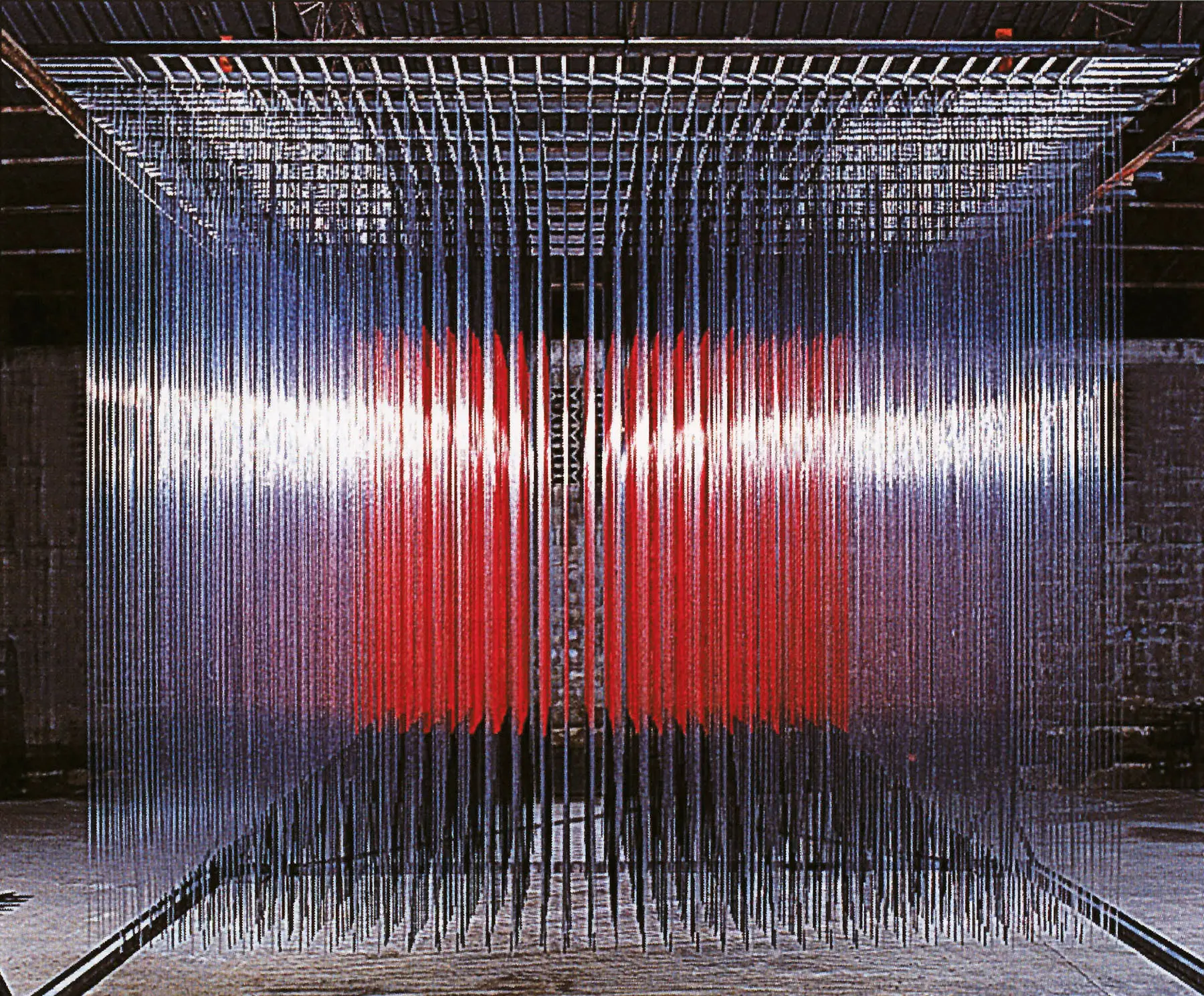
In France today it is unusual to find an exhibition that captures both the interest of the public and the unanimous approval of the critics. There is an intense debate at the moment about the state of contemporary art, exacerbating suspicion and distrust and encouraging peremptory judgments and apocalyptic warnings. The starting point of all this is to be found in the decreasing number of visitors to museums, the serious recession affecting the art market, and the feeling that the work of French artists is attracting less and less attention abroad. Such a situation is a matter of concern in a country that has been investing considerable budgetary resources in the promotion of its contemporary art. The journal Esprit, the director of the Picasso Museum Jean Clair, the academic Marc Fumaroli, and the philosopher Jean Baudrillard have all given fresh impetus to a thesis which has surfaced periodically in France since at least the end of the nineteenth century: recent production, devoid of any aesthetic criteria, has abandoned a sense of rigor and the formulation of objectives, resulting in the negation of art and the justified rejection of that production by the public.1
Thus the success of this retrospective show of work by Jesús Rafael Soto is a reason for hope, awakening as it did a sense of astonishment in the visitors, a desire to know more, and the sheer pleasure of looking. Soto's triumph is of particular merit as Latin American artists are normally expected to make a profession of their identity. Since the time Montaigne first referred to the indigenous populations of the Americas to criticize European dogmatism, and Hegel theorized that the American continent was nature but not spirit, there has been a persistent prejudice in Europe about Latin American artistic creation. It is expected to be full of exoticism, geography, hallucinatory beliefs, violent contrasts, and passionate forms of politics.
In such a context, the constant quest for something completely unrelated to any kind of localist rhetoric deserves all our praise. Born in 1923 in one of the Amazonian provinces of Venezuela, Soto earned his living by painting movie posters in Ciudad Bolivar before winning a scholarship in 1942 to study at the School of Fine Arts in Caracas. The artist recalls his first contact with the institution in which he began his training: "When I entered the School of Fine Arts, there was something which fascinated me: a still life by Braque which was on an easel near the entrance door. I felt at that moment the same interest I had had in hearing about surrealist poetry in Ciudad Bolivar. Immediately I turned my attention in this direction, with everything focusing on the same question: Why is this a work of art ... I began to feel unsatisfied and started to investigate and become as well informed as possible."2 Later, Soto was to become fascinated with Impressionist art ("I could not understand it in Venezuela because of the violence of the light"), Cezanne, and Cubism ("an exercise in construction and the ordering of surfaces”) until he decided in 1950 to leave the country for Paris in order to participate in "the birth of the new trends in art." The Atelier d'Art Abstrait, the Madi group, the Réalités Nouvelles Salon, and the Denise René Gallery marked the first stages of this process, which resulted in a severe judgment by the artist: "On my arrival in Paris, all the art, including that of the geometrical artists, was made with forms which recalled those which I had used to do portraits and landscapes. For me, this was not an abstraction but the simplification of figuration."3
A timely visit to the Netherlands to see the work of Mondrian would guide Soto in his quest. His objective was to renounce all the elements and resources of figurative art and to discover a language that would develop abstract art. He experimented with the multiplication of a simple element—the square—which was to allow him to discover gradually the use of repetition, series, and rhythm. It seems a coincidence that it was precisely Mondrian who provided the source of this new inspiration since the Dutch artist was the favorite target of certain opponents of contemporary art (cf. Mario Vargas Llosa, Ojos bonitos, cuadros feos, Lima, 1996).
For a period of ten years beginning in 1951, Soto would earn his living playing the guitar, until his work became known and gained international recognition. Serial and cacophonic music would influence his search for a new plastic language. Soto has insisted on his debt to the French composer Pierre Boulez and Rene Leibowitz's book on the school of Arnold Schoenberg. He has also said that his works are an attempt to produce the same impact on the spectator as music on the listener. In this same period in the 1950s, Nathalie Sarraute revolutionized the novel by trying to create an abstract narration, without characters, places, or plot—a novel inspired by her familiarity with contemporary painting.
The Jeu de Paume Gallery, situated in the Tuilleries Gardens, was used until the mid-1980s for presenting the works of the Impressionists, such as Monet and Degas. Since that time, the Impressionist works have been moved to the Musée D'Orsay and the Jeu de Paume has been transformed into a National Gallery used for presenting major exhibitions by contemporary artists.
The Soto exhibition received rave reviews from critics. "Soto really makes the ball move," read the cover of Beaux-Arts, referring to its review of the show titled Vibration and Vertigo." Le Journal des Arts reviewed the exhibition under the suggestive title of "The Music of Soto," while other publications emphasized the work's ludic dimension, its sense of sobriety, the variety of materials used, its sense of color, the evolution towards installation art, the originality of the Penetrables, the desire to achieve spectator participation, or its universal dimension.
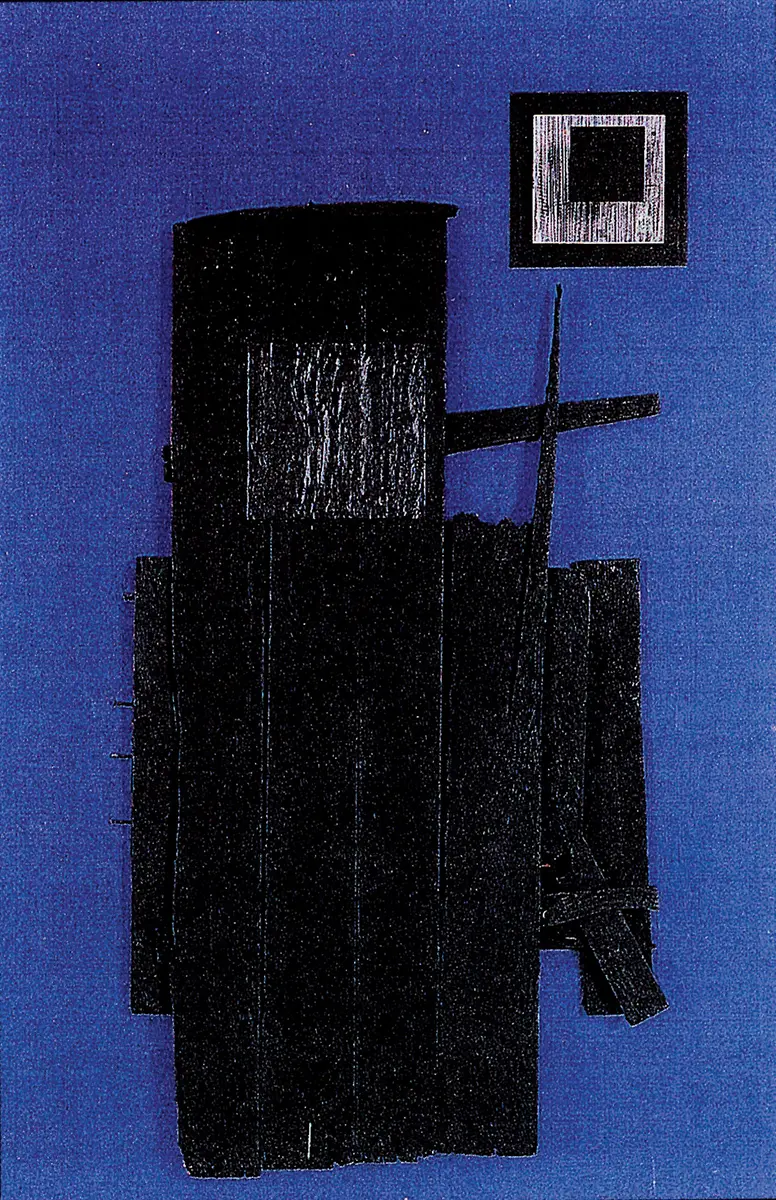
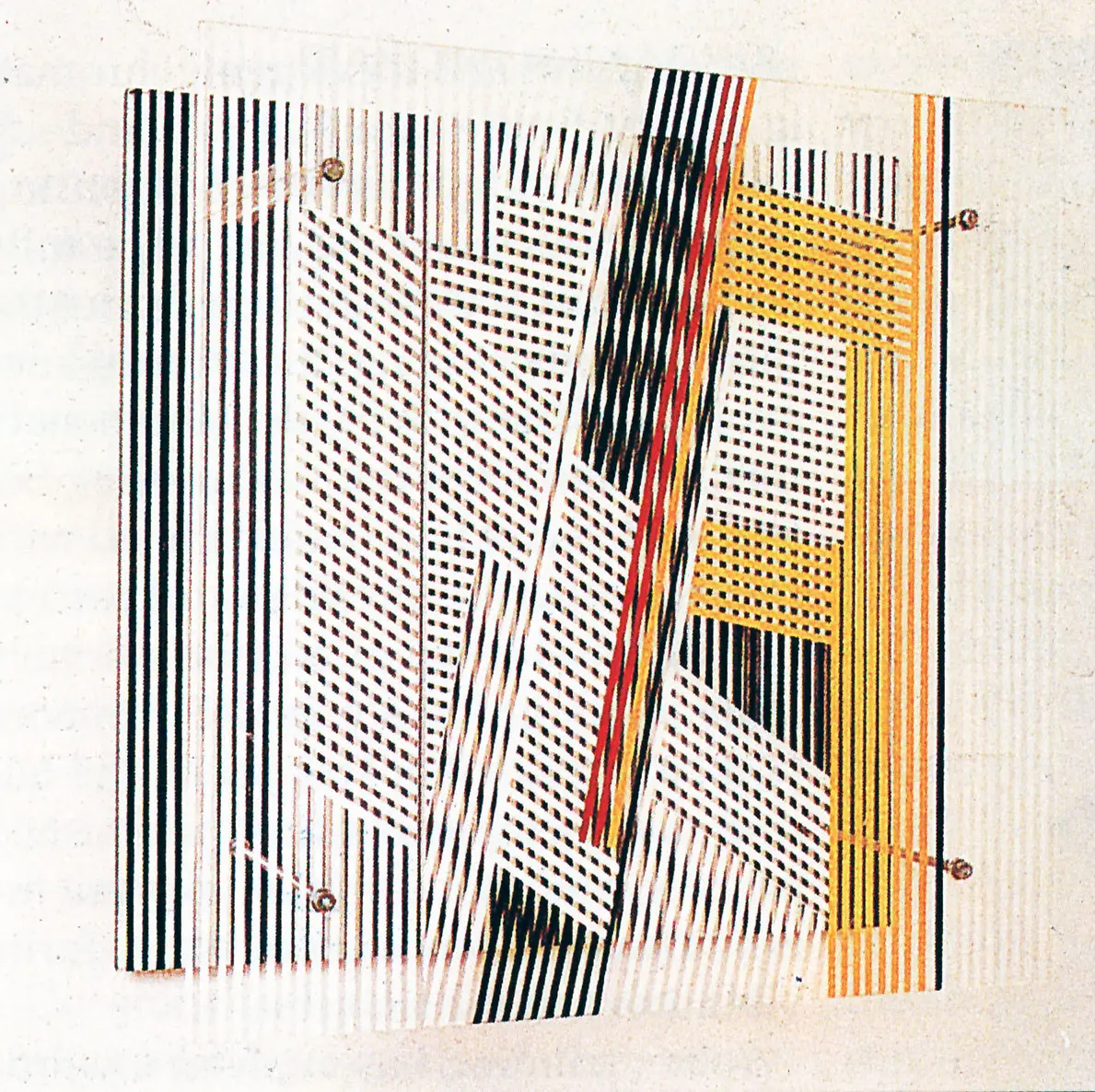
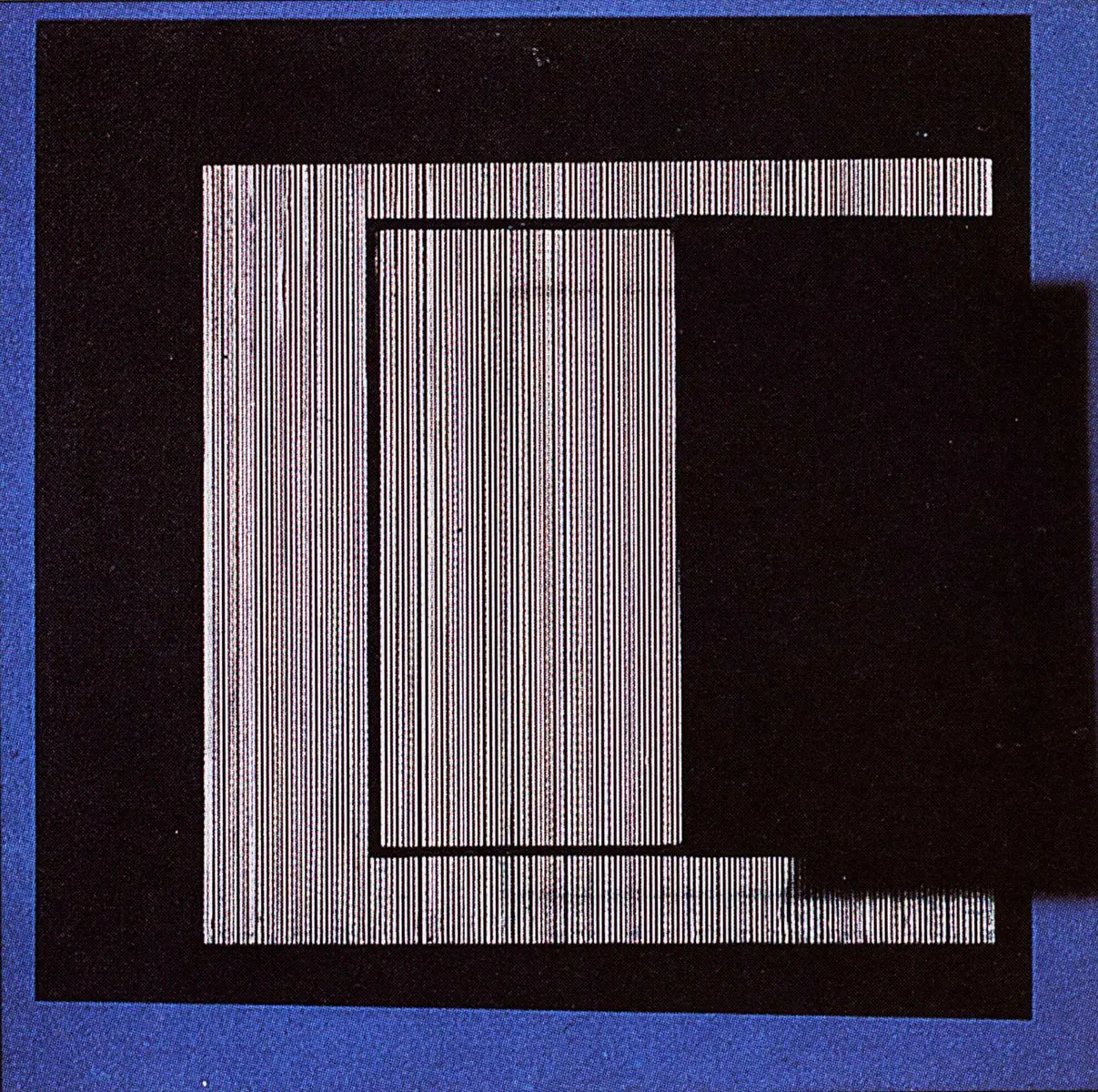
The 103 works by Soto in the Jeu de Paume exhibition dated from 1951 to 1996, years during which the artist has spent long periods in Paris. They represented 45 years of a production that has constantly involved other kinds of quests: Duchamp and Calder, Malevich and the Bauliaus, Vasarely, and Tinguely, Agam and Yves Klein, the New Realists, and the Zero Group. But it is Soto's connection to kinetic art which provides a simple way of approaching his work. From the 1960s, when he criticized the attempts to see him as a disciple of Vasarely or an epigone of op art, Soto has tried to define what he was trying to do: "Vasarely is an optical painter who limits himself to two dimensions. On the other hand, I consider myself as a kinetic painter... what interests me is the transformation of matter. To take an element, a line, a piece of wood or iron and transform it into pure light... transform it into vibrations. To make something solid seem ethereal, this is my current concern. It is not only a question of movement but also of the transformation of the elements."4 The importance of kinetic art and Soto's work in the reformulation of aesthetic sensibility contrasts with its relative decline from the 1980s, as the English critic Guy Brett has pointed out.5
The works from the 1950s are mainly done in paint on wood or paper: Interferential Parallels, Optical Repetition, Rotation, Progression, Studies for a Series, White Dots on Black Dots, Metamorphosis of a Cube. Towards the middle of that decade, Soto produced works using metal and plexiglass with titles that referred to the concept of vibration (Kinetic Structure, 1955, The Dynamics of Color, 1957, and Displacement of Various Elements, 1957). First Vibration (1957) introduced the use of wire, which was more adapted to the subsequent use of "isorel" (compressed cardboard). Rubber Points (1961) used canvas, plaster, and glue. The 1960s featured works in wood, metal, and wire, such as Blue and Black Log, 1960. Some murals in excess of five meters were also included in the show, as well as tiny pieces like The Needle, in painted wood, measuring only ten centimeters. Large Cadmium with a Hole (1971) established the use of color as a denomination for the paintings, to which nylon threads were added. An acrylic painting on wood and metal, measuring 4 meters by 2 meters (Aleatory II), Concord Sphere in aluminum and nylon, and a Penetrable Cube (which visitors could enter) where the most recent works included in the show—all were done in 1996).
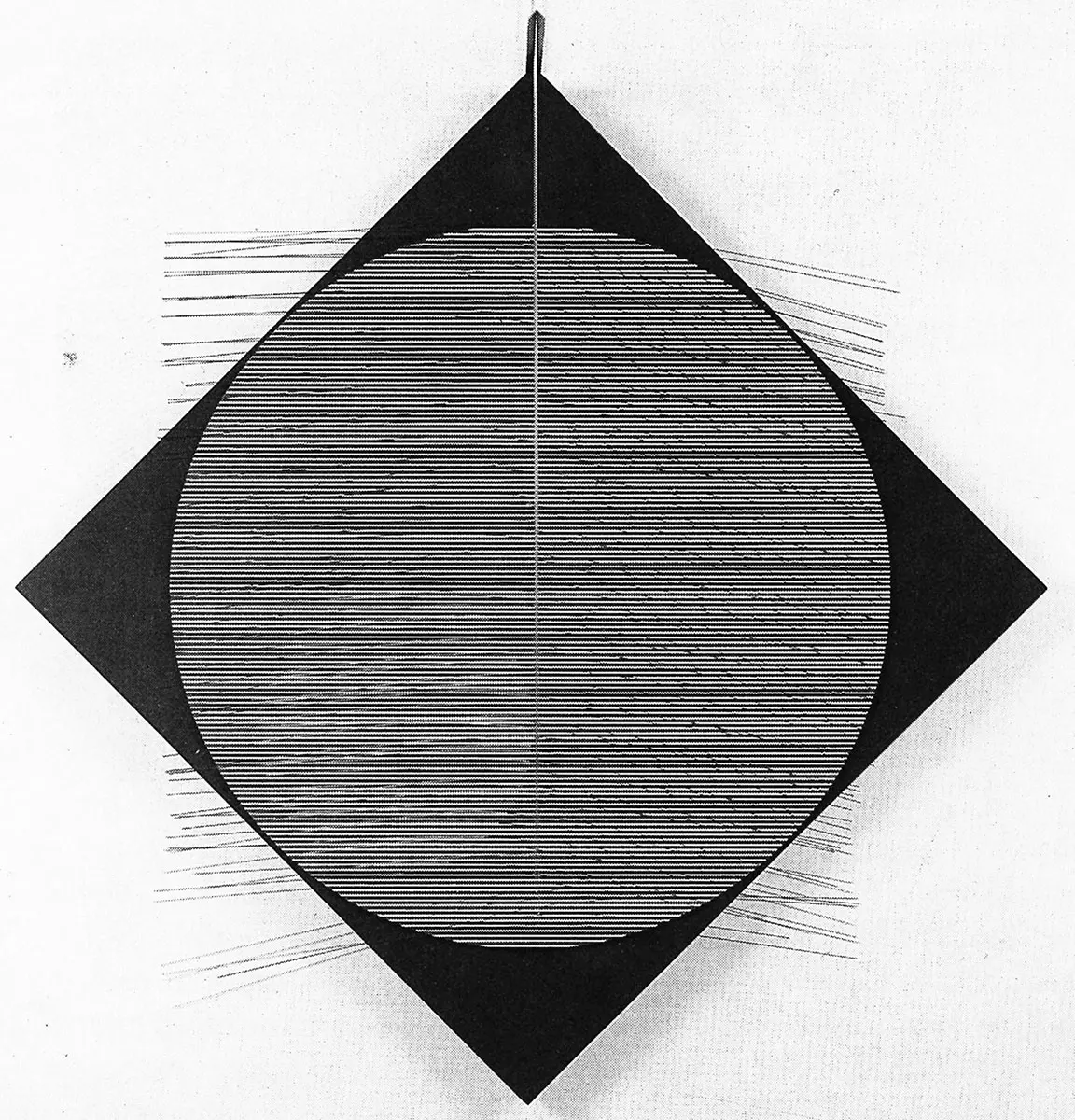
The visitor who paid attention to these different pieces would have left the show with a clear understanding of the artist's development from the time of his initial intuitions. The sensation of coherence and unswerving perseverance is paramount here, despite the incorporation of new elements and the extreme chromatic variety. Soto's idea that "art and science work together in confronting universal questions" seems to be fully justified. Just as the representation of the human body during the Renaissance evolved in line with the development of medical and anatomical science,6 Soto's work seems to go hand in hand with discoveries in the physiology of perception, and the observation of the infinitely large and the infinitely small by contemporary physics. For this reason, he has said that metaphysics is an unfinished physics and that art must express the new ideas of science about space, form, vibration, and the universe.
Soto's painting has evolved towards the creation of monumental works which now form part of the urban landscape in many capitals of the world. Hence his insistence on the desire to integrate his art into architecture. On the teamwork, he has said, "I believe it is a coherent position in art which, unfortunately, was interrupted with the romantic movement, when artists turned inwards towards intimacy. We thus lost the marvelous idea of the Greeks, of medieval art and the Renaissance about art as something monumental and participatory."7 This retrospective exhibition, which opened in Paris on January 7th, will subsequently travel to Germany, Spain, Norway, Brazil, Colombia, and Argentina, before ending its journey in Venezuela. It was curated by Daniel Abadie, director of the Jeu de Paume National Gallery, and is accompanied by a catalog with texts by Marc Collet and Arnauld Pierre, as well as a “graphic" poem dedicated to Soto by Michel Butor, evocatively titled The Breathing of the Square.
NOTES
1. Cl. the article on the extreme right attacking contemporary art in Art Press. No. 223, April 1997, Paris.
2. Soto, pintura flgurativa 1944-1950, exhibition catalogue, Galena de Arte Inciba, Palacio de las Industrias. Caracas, 1971.
3. "Teoria de Jesus Soto", El Minero, Caracas, Vol.7, No. II (Sept.-Oct. 1967) p.5.
4. Interview with Carlos Diaz Sosa, “La Gran Pintura es Cosa de Progeso Hist6rico," El Nacional, Caracas, August 1,1966.
5. In an article on kineticism and tradition in painting and sculpture in Artstudio, Paris, No. 22 (Autumn 1991) pp.84- 92.
6. L'invention du corps, Nadege Laneyrie-Dagen, Flammarion, Paris, 1997.
7. “Jesús Sotoy la integración del espectador a la obra", Clara Porro, Geomundo, Vol.4, p. 214 (Feb.l980) Panama.
FERNANDO CARVALLO
Peruvian philosopher and author. Lives in Paris