
Francine Birbragher: I would
like for you to tell us about the Jeu de Paume exhibition. Who was the curator?
How was the show organized? What works were included?
Jesus Soto: The retrospective exhibition was organized by Daniel Abadie, the director of the Jeu de Paume. He is an art historian who has followed Latin American art for many years and who has written a lot about my work. When he was appointed director, the first thing he said was, "Soto, we have to do a big retrospective, and it has to be in December." I asked him why December and he explained that many interesting people came to Paris at that time. We couldn't do it in December, and the show opened on January 7th. At all events, a record number of people came. Daniel Abadie made the selection of all the works. I made only three new works which he had asked me to do. He took care of the presentation, and the choice of the people who wrote the texts, and I am very grateful to him because the success of the show exceeded all expectations. I thought it would be interesting, but I never expected to see so many people. The show will go on to Germany, the Museum of the Americas in Washington, the Museum of Modern Art in São Paulo, the Museum of Montevideo, and the Museum of Modern Art in Buenos Aires. It will undoubtedly end in Caracas, in the Sofía Ímber Museum of Contemporary Art.
FB: Of the works selected for the show, which ones would you emphasize?
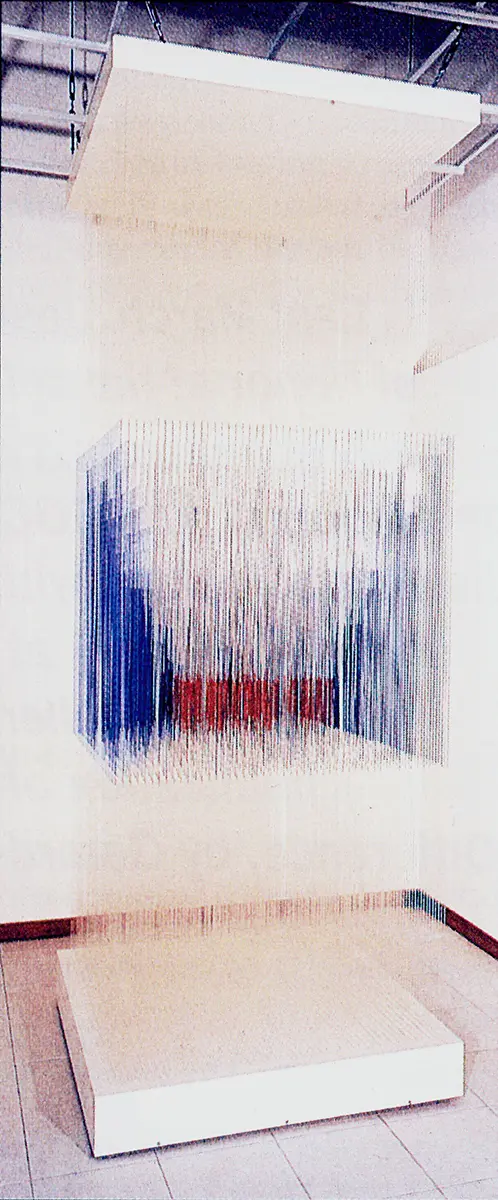
JS: As I said, I did not make the selection. It was Daniel who curated the show, and he insisted on including specific works that were not known in France. At one time, I worked a lot with my friends in the new French realism, and I tried to reflect this expression in kinetic art. Almost all of this work was presented in Venezuela in the 1960s. The poster and the invitation to the show illustrate these works, which are woven on pieces of old wood in which I create kinetic structures. The show was based on my entire creative process, beginning in the 1950s, when I arrived in Paris, until now. Around 100 works give a good idea of all my work and the way, it has developed, as seen in my current pieces, which are more or less virtual and interest me enormously. I believe that one of the great achievements of modern art was the discovery that volume is not necessarily a closed form, but can be an open form. In other words, that space can be brought close to volume, bits of space which I have had to invent, to create a kind of "space trap" to enable the public to understand that space has its own density. I presented two works of this kind at the São Paulo Biennial, and they were very well received. They were works that took a long time to do. Hours and hours of work involving, in addition to the creative part, a good deal of technical work over three or four months with several people, to create a work measuring 1 x 1 meter or 2 x 2 meters.
FB: At the international level, what events have you participated in recently?
JS: Last year, I was specially invited to the São Paulo Biennial. I sent them a model of the penetrable, and they constructed it. Since the theme of the Biennial was "the immaterial and dematerialization," the organizers thought that I was an artist who had worked a lot on this subject and that the Venezuelan pavilion should include my works. These two virtual works, the most recent, will soon be presented in an exhibition in Oklahoma, in the United States, to which Marisol and a group of young Venezuelan artists have also been invited.
FB: Your current projects include the Hong Kong airport.
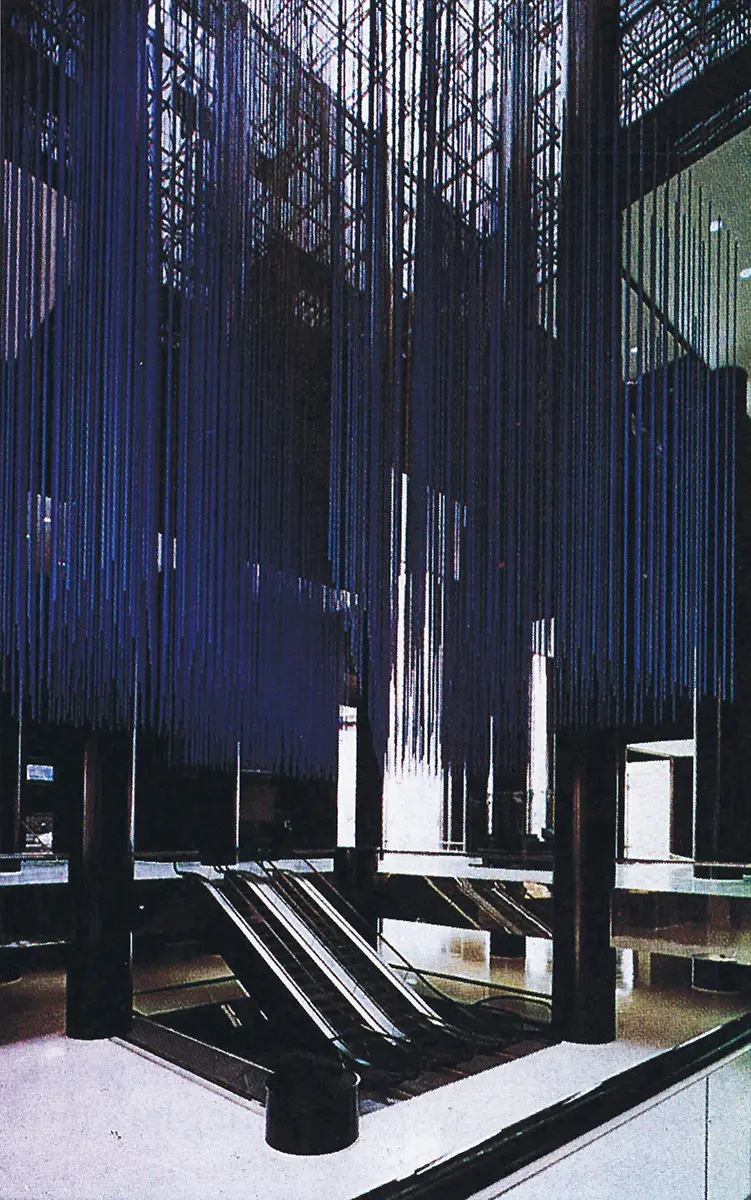
JS: Yes, we are working on this. They are very interested in my proposal, but the problem continues to be the cost. The work is one of enormous space. I have the impression that they will do it in parts. There are five models, five modules, and they have already requested the central one.
FB: Was the project the result of the competition?
JS: That was the original intention, but I told them that I was too old to participate in competitions, and they respected my opinion. At the moment, we are merely working to make it possible to begin. I am in no rush. I will do the project, and they will organize it. The central element is a work that measures some 25 meters; it will be 12 or 15 meters high.
FB: Is it a floor, a ceiling piece, or a penetrable?
JS: It is suspended work. People enter the airport at the lower level but park their cars on the second floor. The work will be visible from below and from above since it will be located in a double space void. There are five modules that all together will occupy approximately 200 meters.
FB: Next year, the Jesus Soto Museum of Modern Art, in Ciudad Bolivar, celebrates its twenty-fifth anniversary. What projects will mark the event?
JS: One which is being examined and which will undoubtedly materialize is a catalog. The same people who did Soto: La Difference are very interested in the idea, and I would do some of the design work. We are working on this. We started two months ago and are looking around for the best people, particularly people who have always felt an affection for the Museum. There are many, of course, including Gilles Placy, Jacques Leenhardt… Many people have followed my work and the Museum's work, and are very happy to participate. This is something that I have to resolve within the next two or three months because the book has to be put together, and we have only a year left.
FB: At the exhibition level, will you show the Museum's permanent collection or the work of young artists?
JS: I don't know yet. The celebrations for our twentieth anniversary involved considerable effort, and now here we are again with a new challenge. We have to start over again, although there are many people ready to help. I have a great team that takes care of the Museum. The administrative council, which is led by the most distinguished figures in the contemporary art world in Venezuela, carries out magnificent work. They really do it because of their love of art. With them, I will have to see how we will mark this new anniversary.
FB: Much has been written about the penetrables, works in public places, architectonic works, and the participation of the public throughout this process of 47 years of artistic practice. How do you see this proposal in the work of young artists?
JS: I do not think that they are very interested in the integration of art with architecture. We live in a very strange period and, as is normal, I cannot continue, because I belong to another generation with other concerns. Young artists are more interested in ephemeral things, and this too is very interesting. I hope, however, that with the examples provided by my generation--the generation of the fifties--architects will once again respect the artist's contribution. What happened was that the artist, from the eighteenth and nineteenth centuries onwards, forgot about the art of the street. The emphasis was on the studio, which had a beautiful name, the ivory tower. There the artist sat down with his small format and created marvelous things. The integration of art and architecture, which was quite reasonable in the Renaissance, in the middle ages, or the baroque period, had been lost, and we, at a given moment, found a way of convincing architects that our work enriched space and was not fighting against it. This theory has been developed quite well. Today, I have a lot of works of this kind. Friends of my generation, the artists of the movement, are all being invited to participate in daily-life spaces. That's nice, isn't it? People are always a bit afraid of museums, "I don't go to museums because I don't know enough about these things." There is a kind of hesitation. The museums have become very elitist, and it has been challenging to win the public over. If you do your work in the street, the public does not have to know anything about art. They live it and experience it, enjoy it or ignore it (although they do not generally ignore it, but are almost always interested), and each day there is more interest in installing works of this kind. For example, in Caracas, I have had the opportunity to be an artist who invented a new way of participating in architecture. I have also worked a lot in France, and now I am doing projects in Japan, Korea, and Hong Kong. People know that they can rely on artists like us to work in this public space without disturbing or disrupting the architecture. The Bauhaus had proposed this theory, but unfortunately, the war destroyed their contribution. My generation recuperated it, and I think that we have done well.
FB: In recent years, the art world has suffered setbacks in Europe and France, in particular. In commercial terms, many artists are leaving, and many galleries are closing down...
JS: There are periods of anguish (existentialism is a very French mode of expression). Anguish may arise at a given moment. Frankly, although I do not sell much in France, I am very happy to work there. I sell outside the country, but the French protect me, they like me, they make life easier for me so that I can do my work better. I believe that this is essential.
FB: And Venezuela?
JS: The same. In Venezuela, I am as popular as the best boxer. I am a rare case—a painter who has become as popular as a fighter. In the street, they see me as a popular figure. This is very nice and unusual. And this is also part of art in the street, the art which I have done.
FB: What projects have you undertaken recently in Venezuela?
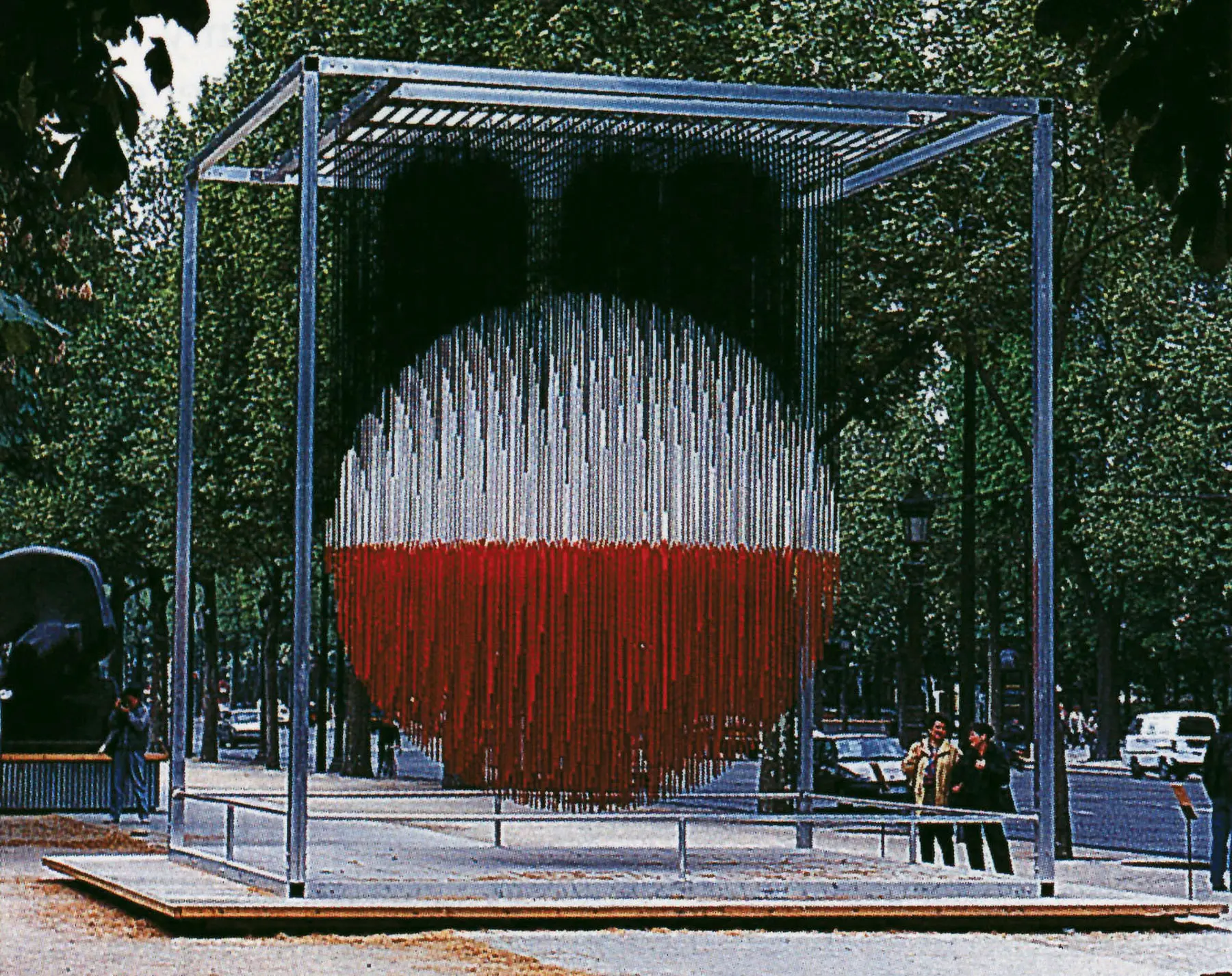
JS: I have just done a very large work for one of the main avenues in Caracas. It is a sculpture like the Seoul piece, but all in yellow (the Seoul work is in two colors). It is 13 meters high, and the sphere measures 9 meters. It was installed in December. I also have two major projects in Germany and Korea.
FB: In which part of Germany?
JS: In Berlin, there is an imminent project, but I don't want to say where, because as the Indians would say, I prefer to wait until I bag the catch. I am still working with the architect. There are also two large projects in Korea and another one in Venezuela.
FB: And in the rest of Latin America?
JS: The Brazilians are very interested in my work and are helping me a lot. There are projects planned for Brazil and Colombia. Colombians always welcome me warmly, and they now want to construct a "water" penetrable which I had proposed some fifteen years ago in Medellin.
FB: How would you define the "water" penetrable?
JS: It is a kind of water fountain, which springs from the ground, that people can enter. The project includes a small bungalow in which the public can change into their swimsuits. The idea is for people to experience the penetrable. We are trying to allow the formal elements, tubes, prisms, and so on, to function with an electronic system, enabling the penetrable to change form as people take a kind of shower in reverse.
FB: You have not yet given up in your search for non-traditional materials and techniques
JS: Indeed, no. Quite the contrary.
FB: Have you thought about using computerization?
JS: Yes, I am working on this. I am not going to study computerization. My son is a computer student, and I have architect friends who look at my drawings and ideas and work on them with the computer.
FB: So, we will soon have Soto on the Internet?
JS: But of course! Immediately! It is only a question of asking because I have been working on this for a long time. The Centre Pompidou work, for example, I did with a Colombian friend, an engineer, at a time when the machine still had to proceed line by line.
FRANCINE BIRBRAGHER
Art critic and historian, editorial advisor for ArtNexus. Member of the Board of the Museum of Contemporary Art (MOCA). Lives and works in Miami.