
This exhibition of a Cuban artist, now living in Miami, provides a quick but in-depth view of this artist's delving into tribal and contemporary spiritual traditions of Native America and Africa. Upon entering the huge open space, the viewer is met with a large installation depicting a ship crossing the ocean. This work talks about something shared by many Cubans, and others who carry the burden of being distanced from their homeland. The ship, made of concrete blocks and filled with earth represents the artist's need to leave, and his desire to take his land with him. A pair of weighted diver’s shoes and steel rails are included to symbolize the burden caused by such a journey. An altar of old buildings, rum, and tobacco, is added as an offering and a remembrance of the land left behind.
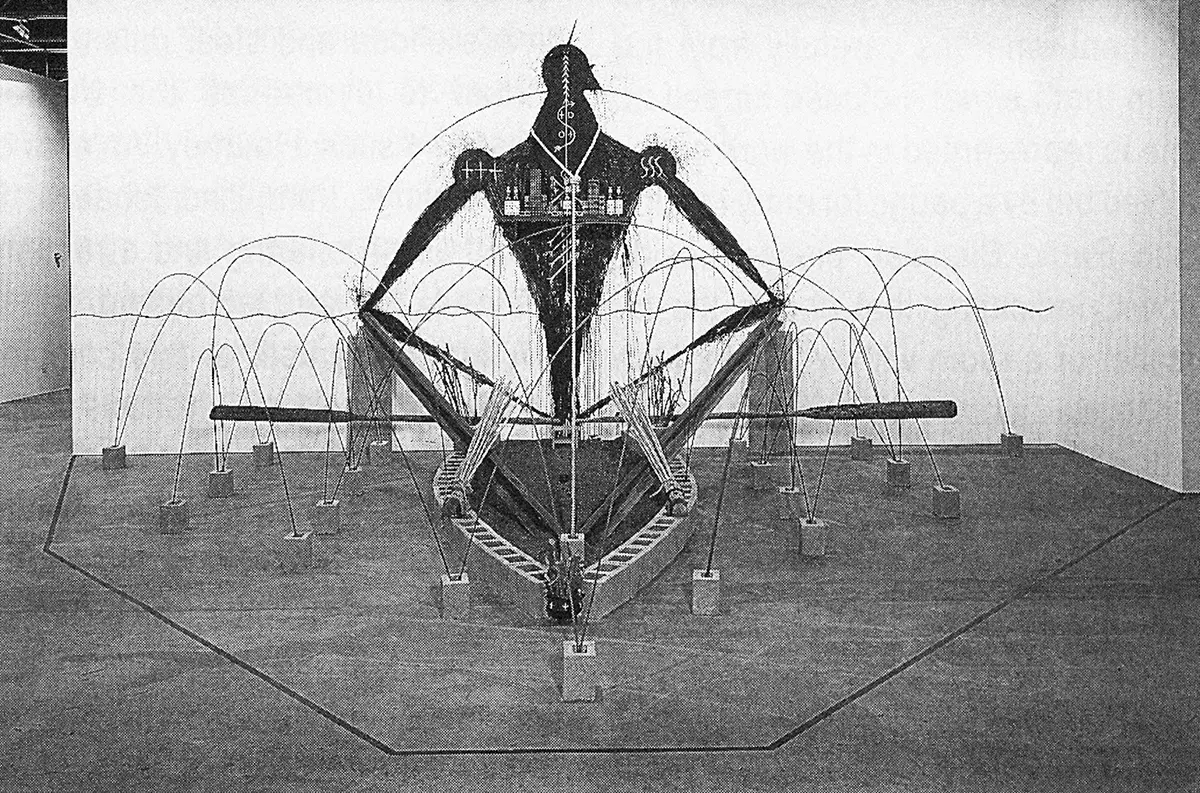
A further perusal of this complex and extensive exhibition shows us the artist's sincere search for tribal symbols and meanings provides this inside information-the artist is no dilettante when it comes to his participation in ritual and ceremony. He has sought out and been part of many Native American rituals, as well as active in Afro-Cuban traditions. He himself is an initiated priest in the Palo Monte tradition. His works, visually stimulating and fulfilling, are also filled with content, and it is content that is immediately accessible and invites the viewer to inquire. Unlike many of his peers in the installation genre, José Bedia demonstrates that he is an accomplished draftsman.
In a work untitled Al límite de lo posible (To the possible limit), Bedia depicts old Havana in an ochre/sepia color that elicits an unusual feeling; as if it were the memory of a dream. The work shows old buildings supported by metal rails in order to prevent collapses. In this work, he also uses language to add several dimensions: words such as design, a chant, and hip talk. The words are also a code used by street people to create a closed system of communication: Fula, jaba, jama, jeba, chiva, tropa, yuma, yimbe, they demonstrate the influence of African language on Cuban slang.
Another installation Buey suelto, shows a plastic bull with crutches (a reference to Babalú-Ayé and Afro-Cuban santo) pulling at humanity and all of its accouterments with chains that are attached to a black figure painted on the wall. Here, as in several other works, Bedia successfully plays with the idea of 2D and 3D. The flat images painted on the walls in black drips have parts that extend out and enter into our dimension, moving from symbol to reality.
This artist brings forth a sincerity of search and experience, and an ability to express visually that is worthy of special note. The exhibit is one that needs to be experienced, not only for its artistic merit and the power in the works but for an insider's view of an artist who spent his developmental years in Havana.
STUART ASHMAN