
Between the months of March and May, the Biblioteca Luis Ángel Arango devoted its Museum of Religious Art to an exhibition of works by Luciano Jaramillo (b. 1938), a painter who came to attention in the 1960s. This was perhaps the first show which highlighted his true merits and placed him in his due position within the history of Colombian art. This is the third exhibition focusing on the artistic development of his vision since his death in 1984.
The show clearly revealed the excellent pictorial qualities of the artist and his thematic obsessions over twenty-six years of professional activity. Both for those of us who had the good fortune to know him and enjoy his skill as a teacher, as well as for new generations, this occasion offered the opportunity to better know and understand his work, his passion for art, and his constant study of the personalities who left legacies to mankind. His figurative themes resulted in the invention of a new kind of face, transformed into artistic magic for the delight and admiration of the public.
The development of his career was clarified by the work of the curator, the selection of the pieces, and their installation. These are important elements that help highlight the pictorial qualities of Jaramillo, as well as the struggles and ghosts with which he was involved since his early childhood. The face is projected in different situations—faces with penetrating glances that play a predominant role in his production, as reflected in the title of the exhibition, Another Look, and in particular, the last seven years, with his series titled Imaginary Portraits. This is the gallery of his characters, his obsessions, and his myths.
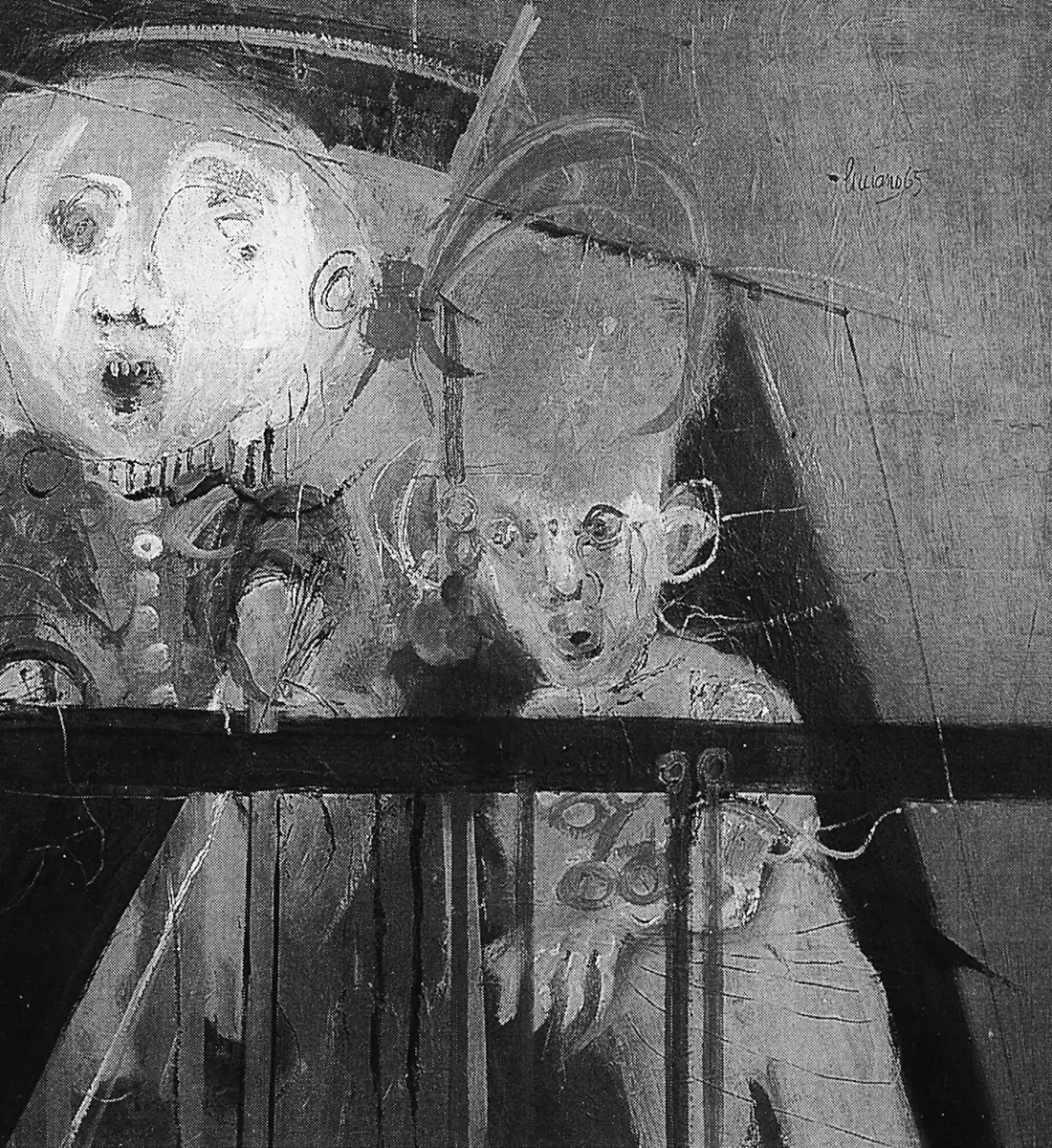
The Imaginary Portraits series was presented in three separate rooms. At the entrance, there was a group of portraits: Picasso 1965, Bolivar, Manuela, and Bolivar Dead, contrasting with the images of other portraits accompanied by latent demons, full of vivacious glances and the inner violence reflecting their lives. It is on this site that we find the dignified gazes of such figures like Van Gogh (1977), Gauguin (1984), Franz Hals (1984), Goya (1983 and 1978)—a testimony of admiration and idealized expression. The image is designed to seek out the physiognomy of the figures, with the horizon line creating a compositional interplay within which to set the demons that beset or accompany each figure.
The following room presented another theme—the figures of the Cocktail series, preceded by the 1983 diptych, the most important in the series. The figures in the main scene are accompanied by dolls representing the stages of innocence and affection. In the same room, there was the contrasting imaginary figure of Sarah Bernhardt (1982), the background of which is worked in dark colors within an indeterminate atmosphere. In the imaginary portraits of artists, the atmosphere is defined and localized, while in the portraits of writers, there is an atmosphere of mystery in the background. This concept was extended in the next room, with portraits of Lautréamont (1984), Baudelaire, Stendahl, Rimbaud (1983), accompanied by skulls, Verlaine (1984), and the Portrait of a Poet-Self-Portrait (1982), featuring a bull’s skull in the foreground. The figure looks out carefully at the spectator. The group of imaginary portraits ends with the Portrait of Juan and Bias (the artist’s sons) and Self-Portrait (1977), where the artist places himself between the hypothetical work and the spectator, as in Las Meninas of Velázquez (where the picture being painted is hidden from view.)
Although the main part of the exhibition consisted of the Imaginary Portraits, the circular room of the Museum included a rigorous selection of works from all periods, reflecting Jaramillo’s constant searches. Although most of the works were portraits, there were also tributes to various artists: Innocent X playing with two lemons (1964), Homage to Rousseau (1963), A strange animal almost like a sphinx (1962), Beauty Queen (1976), Summer (1977), Wedding in Tivoli (1978), and The Thief and the Sideboard (1974). The first floor was devoted to drawings, another medium that Jaramillo fully mastered, and this section was marked by the artist’s sense of autonomy and festive character.
Free and agile brush strokes recreate the forms which the artist takes apart and reassembles in search of perfection. He was a resolute and temperamental artist, who maintained his distance from any kind of fashion, preferring to engage in a dialogue with himself. His works are set against backgrounds that are rich in color. With a full mastery of drawing, it is his linework that allows him to connect up areas and make them integral parts of the composition. Although this exhibition did not include most of his production, it did offer an excellent selection and reflected his main concerns. The show achieved the basic objectives governing any curatorial endeavor: to further the understanding of an artist’s work and to highlight the creator’s artistic qualities.
MARIA TERESA GUERRERO