
The weavings of Olga de Amaral extend the achievements of indigenous American textiles in remarkably satisfying ways. Her use of metallic colors clearly links de Amaral’s works with the ancient tradition of textiles as sumptuary goods. Like her pre-Columbian predecessors who incorporated cosmic symbols into their works, de Amaral’s creations also evoke the spiritual qualities of the natural world.
The major distinction between the approaches taken by prehistoric weavers and de Amaral lies in their highly different levels of abstraction. Rather than use a symbol to represent a natural force, de Amaral recreates the vivid sensory impressions gathered by direct observation of the landscape that surrounds her. By intertwining fibers coated in silver leaf, Ríos 7 captures the impression created by the sun shimmering along the surface, and over the specks of pyrite scattered across the bottom of a clear stream. A related work, Ríos 2 executed in blues and reds, reproduces the visual distortions created by a swim through a swiftly moving stream. Even the slightest breath sets the layered fibers of Luna 3 into motion, producing the vague distortions that animate the surface of the moon in its journey across the night skies.
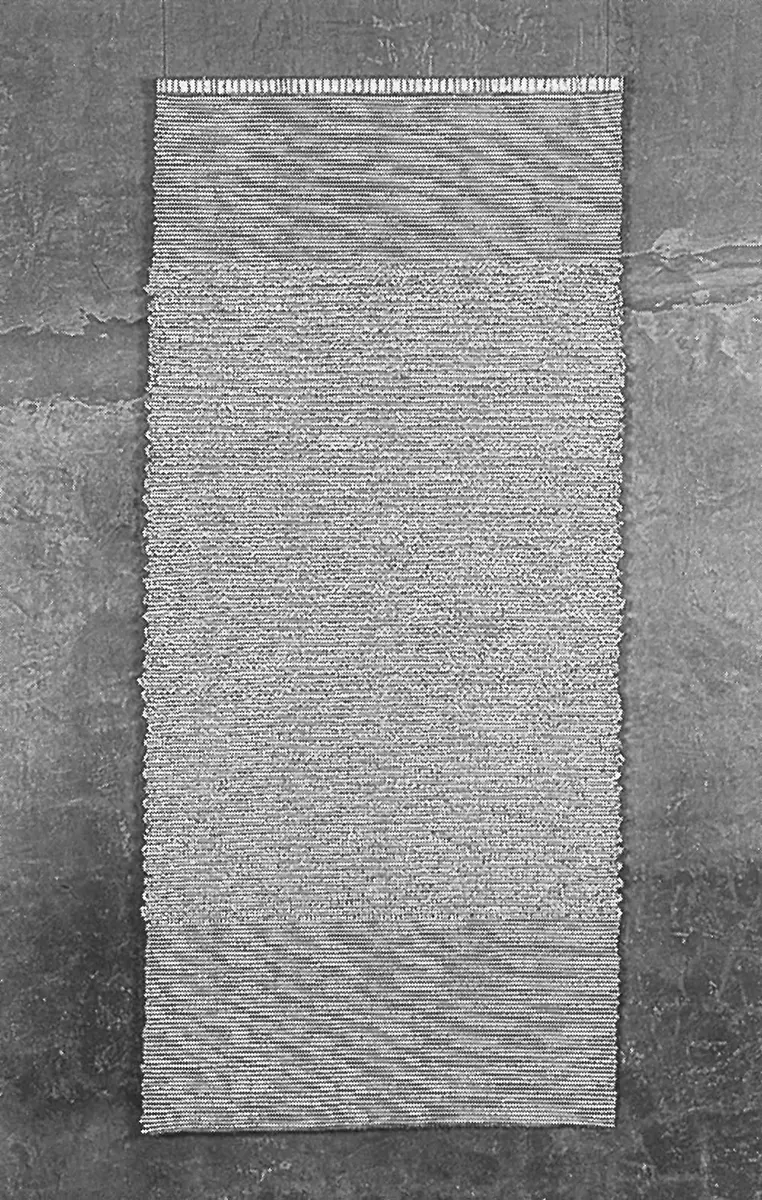
Other works are more allusive in their relationships to the landscape. De Amaral's sophisticated interweavings in works like Lost Image 1, displayed to tremendous advantage in an otherwise empty room, suggest the constantly shifting shadows created by a grove of trees on a windy day. Her sparing use of gray applied over the rich reds, golds, and blues of the weaving not only displays a highly refined understanding of color theory but creates an additional visual dynamic to those contained within patterns of the weaving itself.
In the show's most technically challenging and daring works, De Amaral has pushed her art in a different direction. In two installations of sculptural “stelae" concurrently on display in Washington, she has reinterpreted rock forms. It is immensely satisfying to see an established artist step outside the approach to her material that earned her international fame to explore new directions. Still, this new approach poses a set of interrelated problems that de Amaral has not yet fully resolved. Her solutions to the immense technical challenges posed in turning what are essentially two- dimensional weavings into three-dimensional works hide behind dense layers of gesso and gold leaf. The necessary rigidity this imposes impedes the potential offered by the more open construction of her earlier pieces. Consequently, the stelae become something other than textile pieces, gaining a certain formal austerity, yet losing much of their magic in the transformation.
Of the two groups, the appropriately golden Seven Stelae on display against the marble walls outside the Federal Reserve Board’s Conference Room is the most satisfying. Its two-dimensional presentation places the work’s visual juxtapositions more directly within the artists control. In contrast, de Amaral suspended the elements of Nine Stelae from the ceiling of the Art Museum of the Americas allowing viewers to wander among them. The actual movements of the viewers, and the occasional movements of an entire sculptural element, prove less compelling than the dynamics of color woven into the show’s other pieces.
An artist of immense creativity, Amaral will undoubtedly transcend these limitations as she continues her explorations. Given the ability and daring with which she has already approached her project, one expects the results will be nothing short of revolutionary.
K. MITCHELL SNOW