
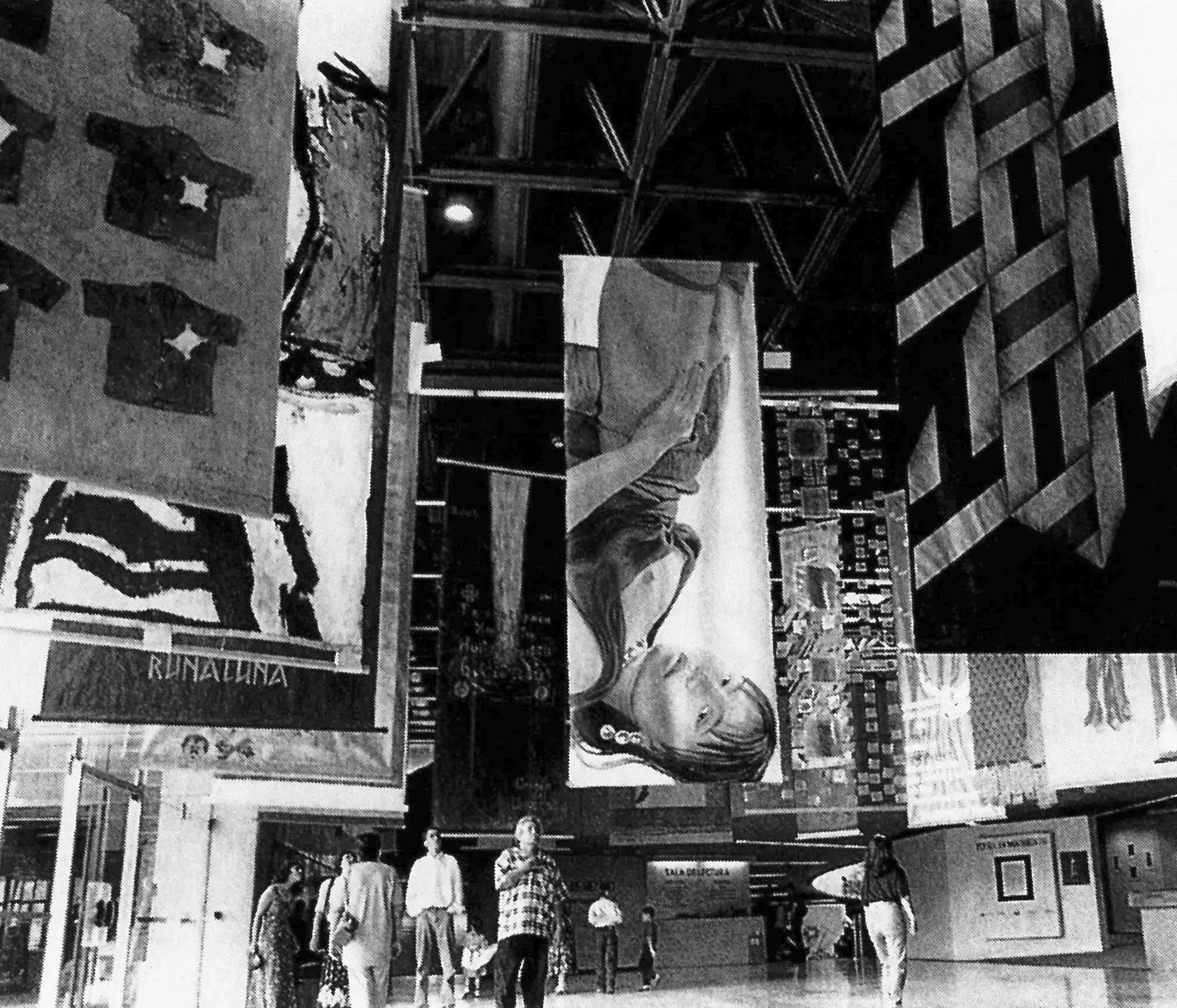
For the second time, the Tijuana Cultural Center has presented the results of an international competition it has organized and convened. For a country that lacked, despite the fame of its art in the past, any other international competition in the sphere of the visual arts (other than the far from prestigious Ibero-American Biennial organized by a wine-making company), the International Banner Salon has acquired an undeniable relevance. Conceived by its curator and coordinator Marta Palau, the event is a heterodox one since the flags, or banners, each measuring 1.5 meters x 80 cm., do not make up a specific genre. However, the rules governing the event guarantees that participants present a specially conceived work for the event. Further, the materials and supports used for the works (preferably strong wrapping paper) help reduce the costs of transport and insurance. The fact that the competition is held in Tijuana, the most northwesterly city in Mexico, on the border with the United States, gives added cultural weight to the city (which is also the Mexican venue for the inSite binational exhibition of installation work).
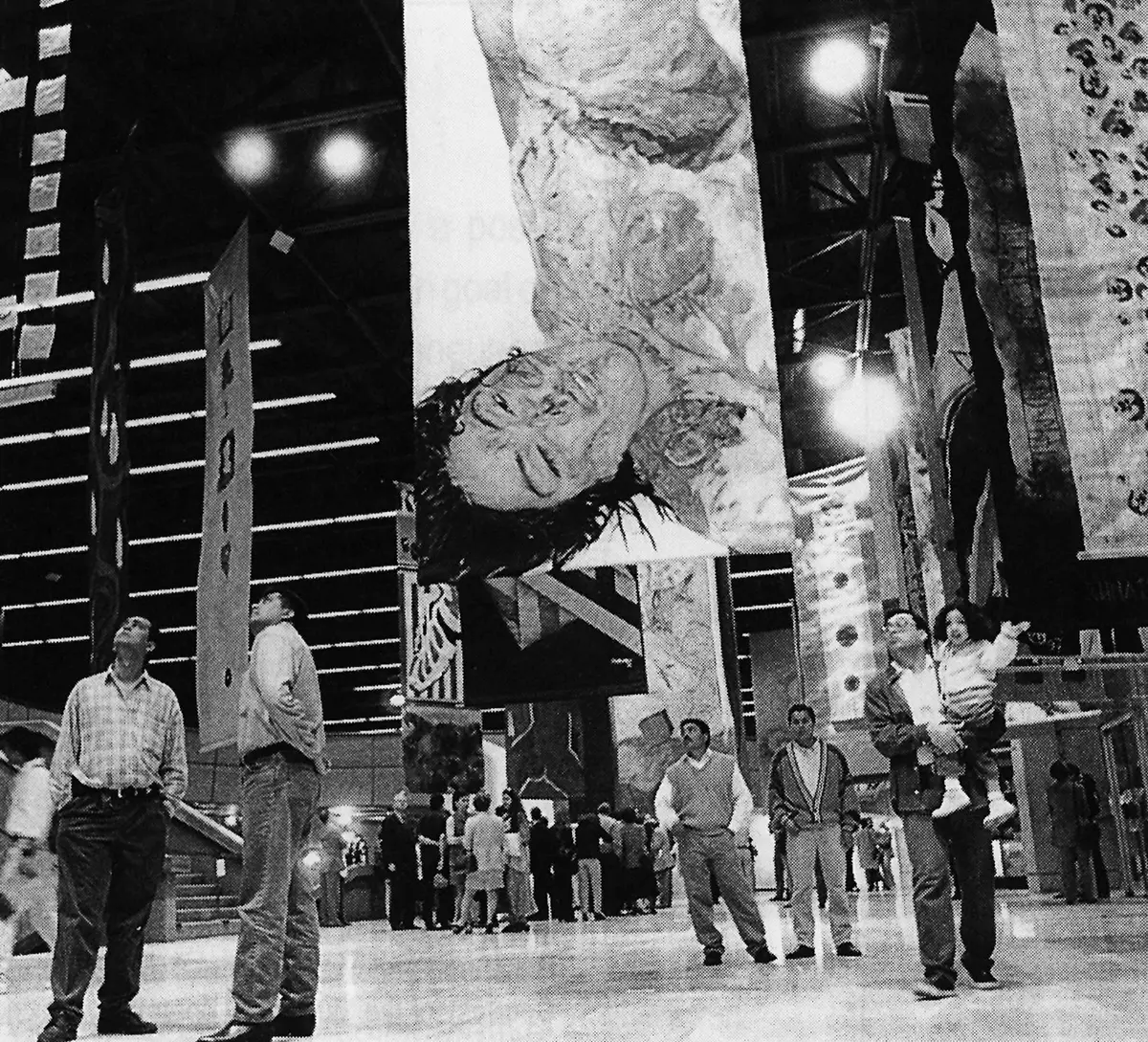
The jury members of this second edition (ES97) were Luis Caminitzer (who along with the Peruvian Eduardo Tokeshi obtained the first prize at the previous Salon), Andrea Giunta, and Jorge Alberto Manrique. They reviewed the works presented by 39 artists from 13 countries, and awarded three honorary mentions: to Flavio Garcialandia of Cuba, for a work in ink on paper titled Something is happening in my black beans or Ad Reinhardt in Havana, Martha Hellión from Mexico for a mixed work on tom paper, The Frontier, and to Julio Orozco also from Mexico, for a print, based on a number of fragments, of a digitalized photograph titled Gravity. The second prize (worth 36,000 pesos or just over $4,500) went to Irma Palacios from Mexico for a painting on paper titled Autumn-Winter. The first prize (70,000 pesos) was awarded to John M. Valadez from the United States, the only Chicano participant in the event. His painting on canvas titled Face Downwards referred to the violence, which often becomes murder, that so many women are the victims of in the border regions of Mexico and the United States, and to the social role of prostitutes to which so many of these women are assigned.
Just one year after its establishment, the Salon is already raising important questions, which have been encouraged by the organizers and coordinators of the event through panel discussions prior to its opening. This year, Shifra Goldman pointed out during the panel discussion that although works with the characteristics and size of those which had been presented were of a public kind and had been shown in a private institution (after Tijuana, the works will move on to Guadalajara, Monterrey, and Mexico City), it was a contradiction that no plans had been made for them to be shown in outside settings. She also noted that the physical rigidity of most of the flags (a result no doubt of a literal interpretation of the entry rules) contrasted with the mobility that they would have acquired with the effect of the wind. In addition to mentioning matters whose solution lies in the hands of the event’s organizers, Goldman also discussed factors participating artists themselves were responsible for, such as the need to simplify the formal elements so that the flags could be seen from far away; the concrete relationship between subject and form to ensure that the interpretation was not unnecessarily complex; and the fact that the works would be presented as a whole, rather than individually.
Is this the beginning of a new art form? Even though there might be some truth in this, it would seem pretentious to confirm such a view as the seeds of new art are to be found in several trends in contemporary art, and not just in this example. For the moment, it is sufficient that the organizing and curatorial team of the International Flag Salon, as well as those who actually participate in the event, should be able to make use of the experiences gained from such sources as historical Mexican mural painting, and its more recent offshoots, including large-format street art and "media art" experiments, such as those of Les Levine in the mid-1980s, or the continuing subversions of the Guerrilla Girls.
In line with the views set forth by Shifra Goldman (which I share), I believe that the best flag in this exhibition was Untitled on Red by Liliana Porter from Argentina. Its primary elements consisted of a Mickey Mouse silhouette, a star, a hammer and sickle, and across, all of which were superimposed on a red background. Special mention must also be made of a work titled Runa-tuna-runa-luna by Manolo Escutia from Mexico, an untitled flag by Leopoldo Maler of Argentina that dealt with the political concepts of left and right, a work titled Painted by both sides the Venezuelan Julio Pacheco Rivas that was painted on both sides, and a work by Daniel Ontiveros from Argentina, titled J. Perón Dixit. All these four pieces made use of various typographical elements.
CARLOS-BLAS GALINDO