
In 1994, during the selection of galleries made by Kevin Councy to represent the guest country (United States) at ARCO 95, Carla Stellweg wrote to the North American commissary to propose the participation of her New York gallery, Carla Stellweg, Latinoamerican Art. According to Ms. Stellweg, Mr. Councy replied in terms that unequivocally identified her gallery as being outside the scope of contemporary art proper in the United States, even though her gallery was at that time located in Soho in New York City, or more precisely in Broadway (it is still in Soho, although now in Houston Street). Mr. Councy, persuaded no doubt by the stable of artists in the gallery, saw the latter as a kind of branch representation of Latin American art. Two years later during the process for the selection of galleries to be invited to the Latin American section in ARCO (1996), the Fair Committee rejected my proposal for the inclusion of three North American galleries in the final list, including the Carla Stellweg Gallery, on the grounds that the United States had already had its opportunity.
lt seems appropriate to point out that the role of the ARCO fair is only incidental to the subject examined in this article.1 In this sense, ARCO is merely the backdrop against which the events concerning the Carla Stellweg Gallery can be set, and which are symptomatic of the paradoxical situation in which a good deal of the contemporary production of Latin America is discussed.
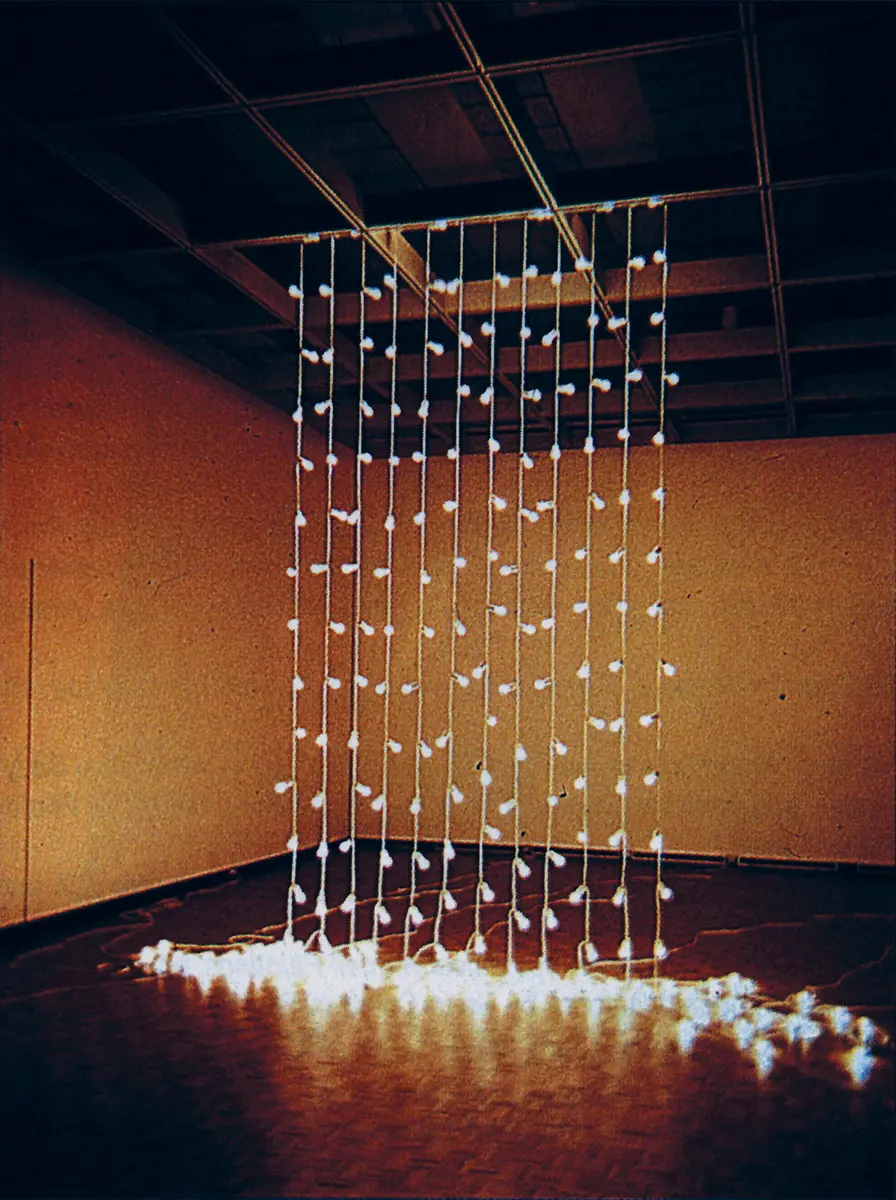
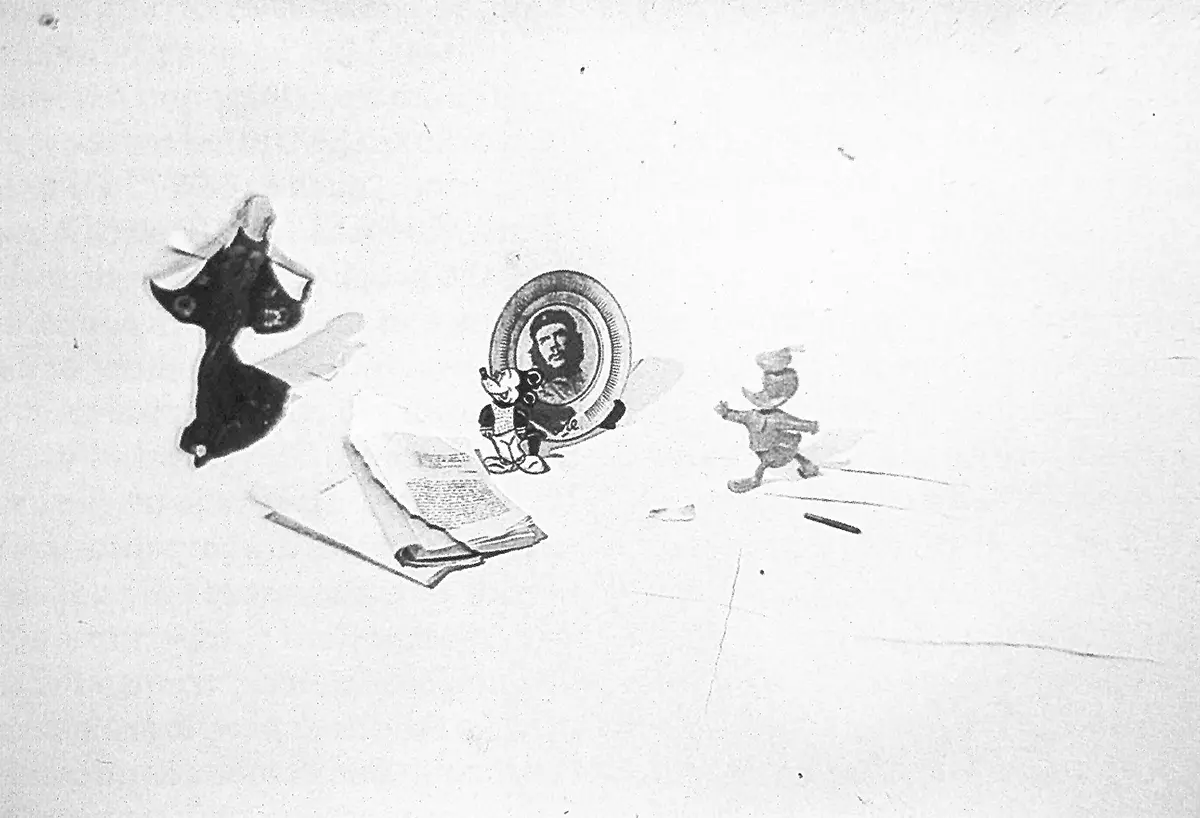
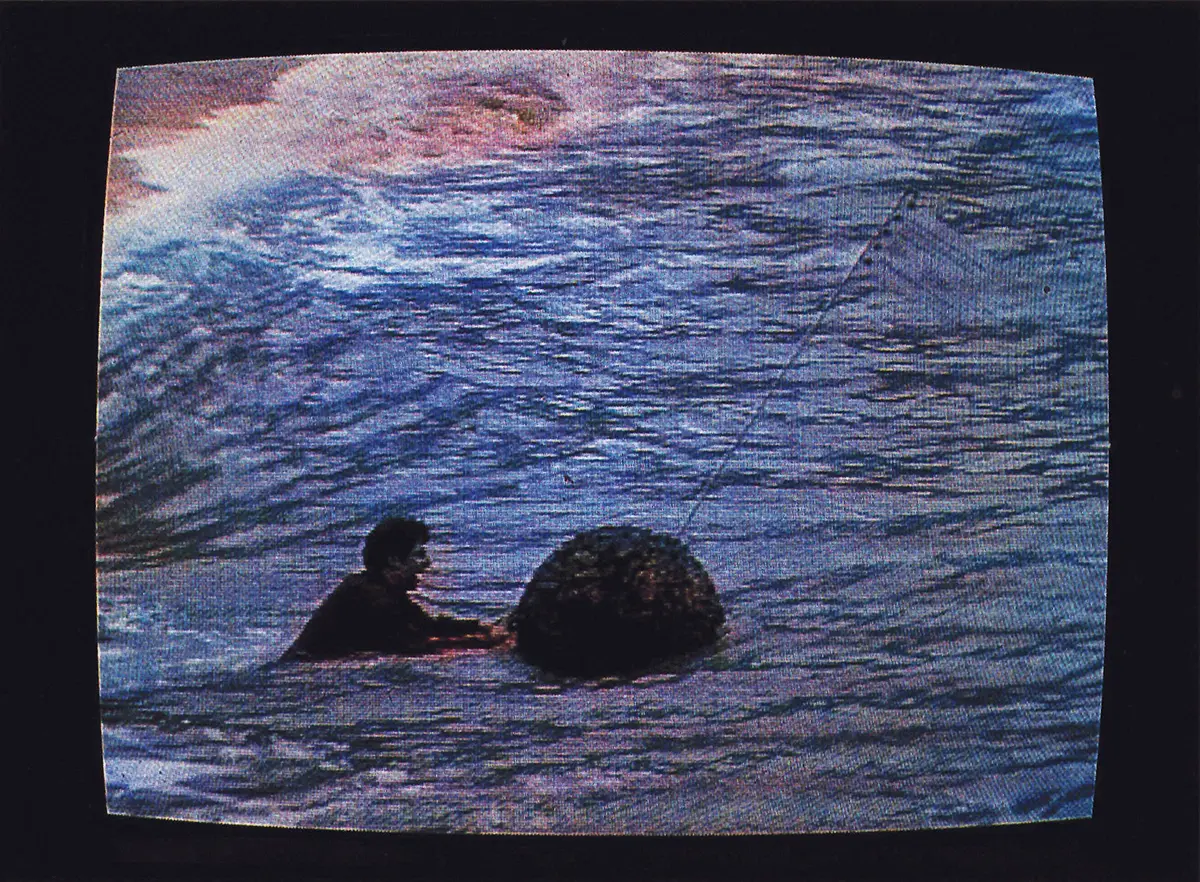
To do this, I must first explain the nature of the gallery in question. Indeed, the artists which it represents are of Latin American origin, and include Luis Camnitzer, Gerardo Suter, Carlos Capelán, Cisco Jiménez, Clemencia Labin, Eugenia Vargas, Milagros de la Torre, Carlos Garaicoa, Jesse Amado, and Luz María Gordillo, currently live in New York. Others come from Latin American countries which are different from those in which they live, such as the Chilean Eugenia Vargas, who lives in Mexico, or the Uruguayan Carlos Capelán, who after more than twenty years in Sweden, now lives in Costa Rica. Apparently, the fact that the Carla Stellweg Gallery was a New York gallery was not sufficient reason to include it among those invited to represent the United States pavilion. That the art of the United States should be the product of the immigration on which the country is based was not even an element taken into consideration. Apparently, the artistic production of the United States and its galleries were part of a homogenous and essentialist territory in which no representation was possible for even a few of the thousands of Latino and Latin American artists who work in New York, Chicago, Austin, Santa Fe, Houston, Philadelphia, Miami, Boston, Los Angeles, San Francisco, and so on.
This same essentialist view led to the discriminatory decision of the ARCO Committee. For that Committee, the contemporary artistic production of Latin America is coherent, limited, and compact. In geographical terms, it is also supposedly isolated, and therefore, cannot be contaminated, even when the artistic production of Latin America is the result of confrontations, impositions, assimilations, grafts, and appropriations vis à vis the various indigenous and foreign cultures. For the Committee, what is produced outside that territory, even though it is the result of activities by those who were or are its inhabitants or their descendants, is not essentially "Latin American."
Thus, the Carla Stellweg Gallery (and again, this case is only a symptom of an existential paradox), relocated to a place where it does not "belong" and displaced from another where it is no longer recognized, is a de-territorialized entity, apparently suspended between its origin and destination, its point of departure and point of arrival, in perpetual transit.

Both decisions are the result of anachronistic conceptions of culture and art and do not take into account the concerns of the previous generation: the economic, political, and cultural project of the universalizing homogenization of modernity, the consequences of neo-colonialism, the invasions and wars, the invention of television (to say nothing of radio and the telephone), the influence of such globalizing elements as catholicism and communism, and the beginning of emigration and mass tourism. Both positions are reflected in out-of-date ideas on language, common origin, bloodlines, and other various ethical considerations on the one hand, and on the other, principles of territorial sovereignty which go back to the agreements linked with the Peace of Westphalia of 164 ft-all premises which are difficult to reconcile with contemporary reality. However that may be, the concept shared by both positions is an attempt to resuscitate an isomorphic and compact idea of territorial organization and ethnic and cultural considerations both in the United State and in Latin America.
Both positions impose an arbitrary kind of closing in on their respective subjects, the United States and Latin America. ln both cases, the art which should represent them is seen as something fixed and stable, without change or history-in other words, not as a space-time expression, but as a purely spatial one. This space is not conceived in terms of inter-relationships, but rather as the simultaneous coexistence of social links at every spatial level, from the local to the global. Neither is this space seen as a moment in the intersection of the resulting social relations, that is, as a dynamic space. But reality itself is already proving such positions to be irrelevant in the contemporary cultural discourse.
An approximation to the theme of the growing "Latinization" of the United States, on the one hand, and the emerging globalization (which some call "Americanization") of Latin America on the other, without pretending to examine, even superficially, problems which alone would merit an entire series of lectures, would easily show how the cultures of the United States and Latin America can be understood only in terms of the dynamic and simultaneous coexistence of the economic and social relations which give rise to them. But obviously, this conceptualization could be applied indifferently to any contemporary culture.
According to official population census data covering the period from 1980 to 1996, the Latin population nearly doubled, rising from 6.5% in 1980 to 12% in 1996, which means that there are some 30 million Spanish speaking persons in the United States, only 9 million less than the entire population of Spain. For the year 2050, according to forecasts by the Census Bureau, the non-Latin white population of the United States, which in 1980 accounted for 80% of the total, will have fall to just over 50% of the total, with the Latin population has doubled again, to over 25%. The African-American population will have stabilized at around 14% and the Asian population will triple, from 3% to 9%. In the state of New Mexico, the Latin population is already close to 40% and in Texas, it has already passed the 25% mark. In California alone, this sector of the population has increased by almost 70%, from 4.4 million in 1980 to almost 8 million in 1990. This is an astonishing increase when we remember that the population of the state as a whole rose by 25% during the same period. In cities like San Diego and Los Angeles, the figure is more than 70%, with devastating effects on the political map of the state. Last November, in the general elections in Orange County, one of the most recalcitrant bastions of conservatism in the entire country, which had been represented by the veteran ultra-conservative Robert Dornan (characterized by his anti-immigration and anti-gay fundamentalist policies) now elected an unknown deputy who had just entered California politics, Loretta Sánchez. In Arizona, which had not voted for a President of the Democratic Party since 1948, the Latin vote ensured Clinton's victory, as was the case in Florida, where Cuban exiles, normally conservative, changed political parties.2
Speaking of Florida, the Sunday edition of The New York Times last summer, devoted the main article of its "Arts and Leisure" section to Miami as "the Hollywood of Latin America", a place where Argentineans, Costa Ricans, and Mexicans had to go if they wanted to be stars in their own countries.3
Miami is also the corporate headquarters of Univision and Telemundo, the main Hispanic television network s in the United States. Cable TV stations, such as MTV Latino and Gems, also broadcast from Miami, as does the program with the largest TV audience in Latin America, Sábado Gigante, and the talk show of Cristina Saralegui, the Hispanic Oprah. Sony Discos and WEA Latina, the Latin music divisions of the most important record companies in the world, operating out of Miami, along with most of their competitors, songwriters, studio technicians, and producers. All these people are not only capturing the consumer market of the entertainment industry in Latin America and the growing flux of Spanish and Portuguese speaking tourists, but also the local Latin market, which is becoming increasingly heterogeneous, and which now accounts for more than 50% of the two million people living in the metropolitan area (whereas twenty-five years ago, Cubans accounted for 90% of the Hispanic population in the city, it has now been estimated that half of the population is made up of Colombians, Brazilians, Venezuelans, Peruvians, and persons from Central America).

l have not yet referred to the Chicano component. This would require a review of their history throughout the century, references to the problems of the frontier culture, and the primordial role played in this transterritorial dialectic, all of which should be addressed in a separate study. However, for the purposes of the present article, it is necessary to note that the frontier areas (which also include the Puerto Ricans and Dominicans who live between New York and their countries of origin, as well as the Cuban exiles in Miami) are spaces of cultural creolization, places where crossed identities have been forged on the basis of previously homogenous identities, zones where the residents, as Norma Alarcón points out, often refuse the geopolitical univocally of the lines.4 Thus the culture which makes up the frontier goes beyond the reconstitution of the space because as Gloria Anzaldua "a borderland is a vague and undetermined place created by the emotional residue of an unnatural boundary. It is in a constant state of traditions."5 An intellectual laboratory and at the same time a conceptual territory, the frontier, in the words of Coco Fusco, "deconstruct (s) binary opposition."6 Thus the frontier is a space where the process of deterritorialization that affects both the so-called political realities of the First World and the so-called Third World, both individually and in their inter-relationship, occurs more clearly. However, as Fusco notes, borders, like diasporas, are not just places of imaginative intermingling and happy hybridity for us to celebrate. As Coco Fusco warns us, borders are equally minefields, mobile territories of constant clashes with the Eurocenter’s impositions (understanding this as Europe and the United State's hegemonic culture)7 The frontiers are places of alienation and loss, pain and death; "spaces where formations of violence are continuously in the making".8
Thus even though l have avoided discussing the presence of indigenous populations, Afro-Americans, and Asians in this article, it seems to me not only obvious and undeniable that the so-called cultural homogenization of the United States is a meaningless fiction, but that the analogies and equivalencies to which the presence of so-called Latinos and Latin Americans are reduced in the United States are an equally chimerical endeavor.
As regards Latin America in particular, it is clear to everyone that there is no unanimity concerning the meaning of this term. While some people seem to give priority to countries in which Spanish is the official language, others emphasize the Iberian influence, i.e. Spain and Portugal. Similarly, while many cultural critics associate the term with the indigenous populations as well as with the people from Central America and the Caribbean-populations displaced or relocated in the north, African-Americans, Chicanos and South Americans, including both French and English speaking peoples-others exclude or ignore the English or Dutch speaking countries. Whatever the case, if there is something that unifies Latin Americans, it is of course not a single traditional culture, a common religion, or, as we have seen, a common language, or a single-dimensional understanding of reality and history. Latin Americans do not even belong to the same race so the unanimity of representation often ascribed to them is once again a mere cultural fabrication.
What seems really ironic, as Mónica Amor has pointed out, "is the fact that the word "Latin," coined in France to legitimize Western culture through the aesthetic tradition and thought of the Romans and Greeks, was used to define the absolutely different reality of nineteenth-century "America." In fact, the term "Latin America" was in common use before 1860."9
According to Oriana Baddeley and Valerie Fraser, it was used for the first time in France "at a time when, in the north of the continent, the United States was claiming for itself the word "America" (despite its historical origins). The origins of the terms thus lie in the historical reality of the hegemony of the south European peoples in Latin America."10
Amor adds: "the term was incorporated into a cultural sphere made up of Spaniards and Portuguese, Africans and indigenous peoples, within a tradition that was originally alien to it. To recognize the Latin element, in its modern European configuration, requires forgetting the remaining elements of the equation, i.e., to fundamentally annul the pre-Columbian past and place the origins of the continent at a moment of intervention by the Latin element. The term also has the connotation of submission by the colonies to the mother country. We should not forget, Amor points out, that the word "America" is in itself an alteration of the name of Amerigo Vespucci, one of the seafarers who accompanied Columbus on his voyage of "discovery." The Latin adjective encourages the creation of a line which, originating in the Mediterranean world, allowed the West to claim its dominion over the new territories."11
Furthermore, the heterogeneity of the cultural phenomena of Latin America is the result of the different degrees of modernization achieved in the various countries. ln, most Latin American countries 60-70% of the population is concentrated in the metropolitan areas and connected, as Néstor García Canclini has said, "to the national and transnational networks, which means that the contents, practice s and rituals of the past, including those of peasants who have emigrated-are re-ordered in accordance with a different logic."12 This logic reflects, on the one hand, the hegemonic patterns of the multinational and transnational corporations and, on the other, the actual dynamics of segmented and differentiated participation in the global market... in accordance with the local codes of reception.13 Simultaneously, with the emergence of "global localization" as a market strategy introduced by such transnationals as Coca Cola and Sony, particularly in the 1980s, as a means of avoiding national frontiers and infiltrating transnational corporations into a country as if they were "inside," Rob Wilson and Wimal Dissanayake believe that the emergence of a "critical regionalism" as the aesthetics of rearguard resistance re-articulated community identity as a means of confronting the global technologies of modernization or the cultures of the postmodern image.14
Even so, both the economies of the so-called Third World and the First World are increasingly subject to global forces. While the Third World seems irredeemably conditioned by the consumer culture ("Coca-colonization" or "McDonaldization") which apparently deprives it of its identity, giving a mercantile dimension to both the material and non-material (including art and thought), the First World is becoming increasingly like the Third World, as we have seen. What this means is that in the current accelerated pace of the globalization of the economy and culture, there is no dominant element that functions as a "meta-narrative," in the sense used by Lyotard, but a continuous flow of relations and connections (ideas, information, compromises, values, and tastes) which are mediated through mobile individuals, symbolic signs, and electronic simulations. But this does not mean that conflicts do not exist: quite the contrary. Though, as Gómez-Peña has said, "the New Age movements and the Third World adventures of David Byrne and Paul Simon seem to be saying that there is a genteel way out of our race, class, and nationality, that we can all become friends in the safe and neutral space of polyethnic music, weekend meditation seminars, and "primitive" memorabilia."15
Arjun Appadurai's argument on the global cultural economy identifies various fields in which these developments are occurring: the distribution of individual motives (tourism, emigrants, refugees, etc.), the distribution of technology, the distribution of capital, the distribution of information, and the distribution of political ideas and values (for example, freedom, democracy, and human right). According to Appadurai, "the central feature of the global culture is the politics of the mutual attempts by equality and difference to reestablish their mutual relationship, and thus proclaim the successful sequestering of what is triumphantly universal and incorrigibly particular, the twin ideals of the Enlightenment."16
However, as Celeste Olalquiana points out, instead of transforming reality into a dream, which is what she says happens through the dominant communication media in the United States, in Latin America, the North American myths are re-articulated to resolve Social and labor situations. She gives the example of Superbarrio, "a strange masked figure who appeared as a result of the Government's failure to deal effectively with the effect of the 1985 earthquake which destroyed large areas of Mexico City. While in the United States figures like Superman and Batman do little more than promoting consumer products and strengthen the national ideology of the good against the bad, in Mexico City, the popular appropriation of the superhero has replaced idle consumption with the need for basic products and the schematic narrative with the street struggle on behalf of the basic rights of the poor. 'Our enemies are not imaginary but real,' says Superbarrio. Consistent with the popular power that makes his existence possible, Superbarrio maintains his mask which gives him a collective identity."17
We might continue here by mentioning other similar symbolic examples in other cities in Chile or Brazil. But what should be emphasized once more is the fact that we cannot continue to refer to Latin America as a "confined" space, the prisoner of a process of essentializing representation-what Appadurai calls "metonymic freezing"18 which an aspect of the life of a people is used to exemplify it or represent it in its entirety, thus constituting its theoretical niche within an anthropological taxonomy. Because it is not only that no single "Latin America" exists: there is also no monolithic Cuba or heterogeneous Colombia. The example of the former Argentinean President Raúl Alfonsín is eloquent in this respect: "Mexico opened the doors to the Free Trade Agreement three years ago, marching towards the north; it found itself with its own hidden face in Chiapas and discovered that it would have to direct its policy inwards and make a radical transformation of its institutions."19
Thus in the constant cultural flow affecting both aspects-origin and destination, departure and arrival-the search for stable points of reference, which after all is what makes possible any critical reflection or choice, becomes increasingly difficult. It is precisely in this atmosphere that the invention of tradition (ethnicity, relationship, and other identity markers), as Appadurai points out, "may become a slippery task, while the search for certainty is constantly frustrated by the fluidity of transnational communications."20
While the past of peoples and groups is being rapidly transformed into museum artifacts, and items in exhibitions and collections, both at the national and international levels, culture and art are also becoming less a sphere of practices and representations which can be reproduced than one of conscious selection and practices, of representations designed, with increasing frequency, for a multiple and heterogeneous audience that is both de-localized and transitory.
In the final analysts, as Mari Carmen Ramírez noted in a recent issue of the Boletín Arco Latino, "it is up to Latin Americans themselves to she goes on, I believe that much care needs to be taken, both with the mainstream and with the proposals of postmodernity which fail to recognize what is really important: the economic and power structures … I believe that the only way in which Latin American art, to which I am totally committed, can achieve a level of legitimization both within artistic institutions and the international circuits, will be through paradigmatic proposals based on research... For all of us who come from marginalized areas, who are trying to determine our cultural capital, it will be easier to penetrate into the power center if we try and do so through difference and identity. It must be emphasized that identity has been proposed as a means to acquire power. Beyond that, it does not define anything."21
NOTAS
1. In order to prevent any kind of speculation on this subject, it must be pointed out that the management of ARCO had nothing to do with these particular decisions. After all, it was ARCO that encouraged the series of lectures, with the participation of, among others, Mari Carmen Ramírez (Austin), Susana Torruella Leval (New York), Marcelo Pacheco (Buenos Aires), Gerardo Mosquera (Havana), Cuauctehmoc Medina (Mexico) and Paulo Herkenhoff (Rio de Janeiro). Furthermore, I should like to mention that it is, without doubt, regrettable that it should have been an art fair which took the initiative to consider and update in Spain the proposals and problems of the contemporary art of Latin America. I should also like to emphasize that, with the exception of individuals such as Vicente Todoli, Jose Miguel Uillán, and Fernando Castro Flores, the Angel Romero Gallery, institutions such as the Centro Atlantico de Arte Moderno of Las Palmas, its publication Atlántica, and more recently, the MEIAC of Badajoz, the artistic discourse of democratic Spain has completely ignored the work of the contemporary artists of Latin America found in London, Berlin, Graz, New York, Copenhagen, and Milan.
2. B. Drummond Ayres, Jr., "The Expanding Hispanic Vote...", The New York Times, November 10, 1996, Cover & p.21.
3. Lartry Rohter, "Miami, the Hollywood of Latin America," The New York Times, Arts and Leisure section, August 18, 1996, p.l.
4. Norma Alarcón, "Anzaldua’s Frontera: Inscribing Genetics," in Displacements, Diaspora and Geographies of identity (Durham and London, Duke University Press, 1996) pp. 41-50.
5. Gloria Anzaldua, Borderlands/La Frontera: The NewMestiza(San Francisco, Spmters/Aunt Lute Foundation, 1987) pp. 41-50.
6. Coco Fusco, "The Border Arts Workshop/Taller de Arte Fronterizo. Interview with Guillermo Gómez-Pena and Emily Hicks", in Thfd Text, No. 7, London, pp. 53-76.
7. Fusco, ibid.
8. Alarcón, ibid.
9. Mónica Amor, "El Parafso Revisitado", Atlántica 15, Las Palmas, Canary Islands, Centro Atlantico de Arte Moderno, 1996, pp.48-53.
10. Oriana Baddeley and Valerie Fraser, Drawing the Line. Art and Cultural Identity in Latin American Art (London, Verso, 1989) p.l.
11. Amor, ibid.
12. Néstor García Canclini, "Cultural Reconversion" (Holly Staver), in On Edge: The Crisis of Latin American Culture, George Yudice, Jean Franco and Juan Flores (eds.) (Minneapolis and London, University of Minnesota Press, 1992) pp.29-43.
13. George Yudice, “Postmodernism and Transnational Capitalism," in On Edge, op.cit., pp. 1-28.
14. Rob Wilson and Wimal Dissanayake, “Introduction: Tracking the Global/Local", in Global/Local. Cultural Production and the Transnational Imaginary (Durham and London: Duke University, 1996) p.4.
15. Gómez-Peña, The New World Border..., p.10.
16. Arjun Appadurai, "Disjuncture and Difference in the Global Cultural Economy,” in Colonial Discourse and Post-Colonial Theory, Patrick Williams and Laura Chrisman, (eds.) (New York: Columbia University Press, 1994) pp.324-339.
17. Celeste Olalquiaga, Megalopolis. Contemporary Cultural Sensibilities (Minneapolis, MN: Minnesota Press, 1992) p.87.
18. Appadurai, ibid.
19. Raúl Alfonsín, "Las dos caras de la globalizacion", El Mundo, Madrid, February 8, 1997, p.4.
20. Appadurai, ibid.
21. Victor Zamudio-Taylor, Interview with Mari Carmen Ramírez, Boletines de ARCO, Madrid (in press).
OCTAVIO ZAYA
Art critic and curator based in New York since 1978. Associate Editor of Atlántica (Spain) and correspondent for Flash Art (Italy).