
This recent one-man show by Florencio Gelabert at the Fort Lauderdale Museum of Art consisted of eleven installations and sculptures reflecting, through a variety of aesthetic alternatives, a discourse closely linked to Gelabert’s experience as a Cuban artist in exile in the United States. The show began with Prisoner of oneself (1997), an installation combining four independent objects. The first was a solid metal ball with points and a patina of oxidized colors, balanced on a thick wire ending with two small spheres. The object, which suggested a medieval weapon, was placed on the floor alongside a metal shield with a patina in green tones. Seen from the front, the third object in polished wood, evocative of an oar or a string instrument, contrasted with the metal parts. Seen from behind, the rough surface of the untreated wood, with small golden tacks in it, reinforced the tension generated by the first two objects. This tension was repeated formally in the last link in the installation, a wire running from the walls that framed it and which, furthermore, produced various shadows that were positively incorporated into the work as a whole. The strength and elegance of this installation made it a highlight of the show.
The second installation, Immediate Geography (1997), was more anecdotal. Gelabert presented a map of Cuba, done in sealing foam and painted red, and a rustic wooden table covered with nails. The idea of the map referred back to an earlier work, La Fidelisima (1992).1 On the other hand, the use of a flexible, material like foam was a novelty since the artist has generally worked with more solid materials, such as metal and wood. It is a viable alternative within a process of experimentation, that also includes the use of color as contrast, rather than just a simple finish.
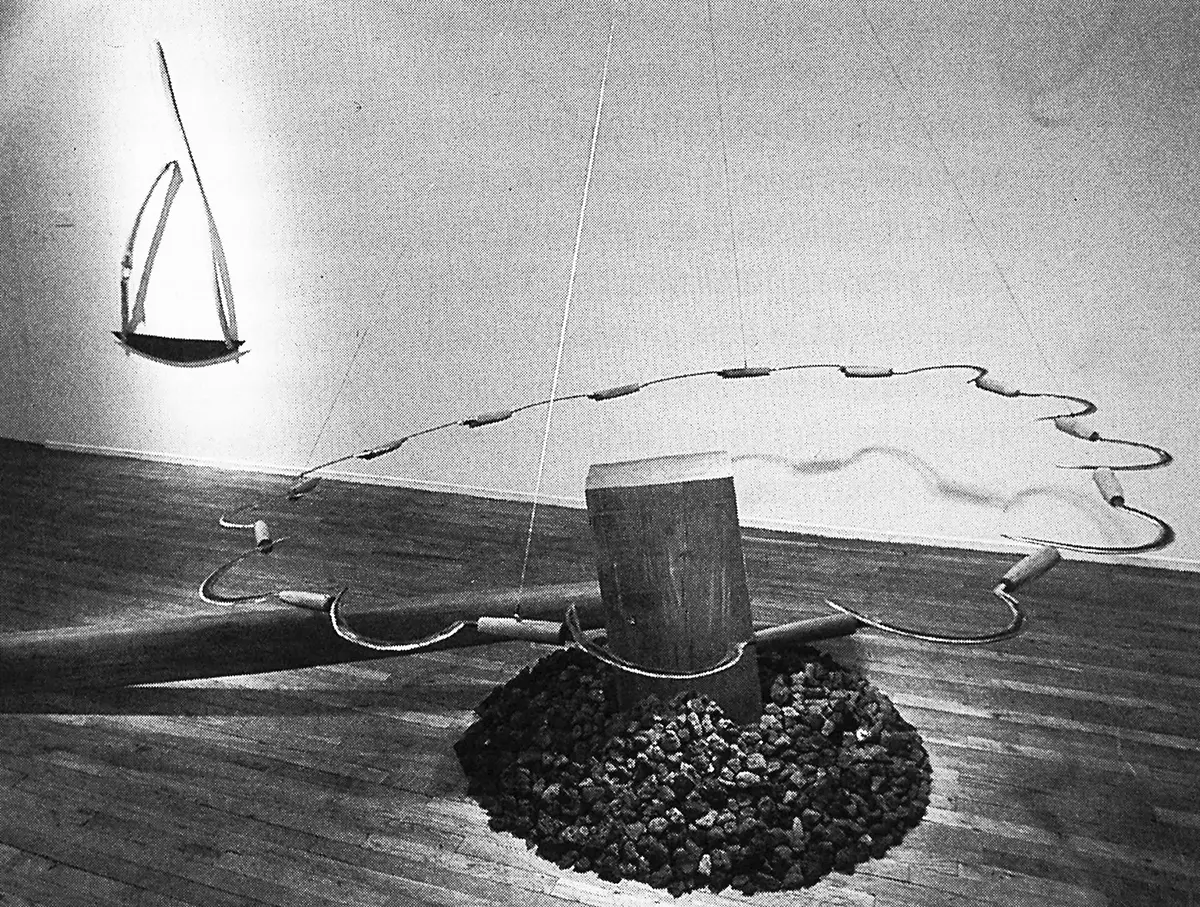
In Holy Work (1996), the third installation in the exhibition, originally done for a one-man show titled The Seasons (Intar Gallery, New York, February 1997), a halo made of sickles and supported by virtually invisible wires, adorns a gigantic wooden hammer, painted in red, which crushes a little heap of volcanic rock. In this work, which some critics have praised as a strong and well-resolved installation,2 the artist comes close to a more conceptual discourse based on objects which, both in expression and symbolism, clearly refer to manual labor.
In addition to the installations, Gelabert presented eight wall sculptures, illustrating the development of his recent work. The oldest piece was For the Dead (1993), a large beam of elegantly polished, varnished wood containing an iron knife in the form of a piece of bamboo in its inner part. Along with Existential Logic (1994), a sarcophagus made of oxidized mesh, and Boat (1994), a piece of wood shaped like a boat with solid knives of cast iron crossing it, refer to the problems of exile and in particular, the boat people. Antidialectics (1966), a propeller made from a metallic shield and eight arms ending in oxidized machetes; Fusion III (1966), a handsome piece made with a stick in the form of a forked pole supporting a semi-circular iron knife; and Fusion IV (1966), a forked pole whose handle is enclosed by barbed wire, and the branches of which end in two sickles, dealt with the same theme from a more conceptual standpoint. Untitled (1997), a long beam of black painted wood, placed vertically on a metallic buckle, conveyed the same message from a purely minimalist angle.
The final piece in the show, Eulogy of Violence (1997), was a metallic beam with three nailed axes, the handles of which were covered with black feathers—an unusual composition in the show. Although it reworks certain formal elements from earlier pieces, it added a new dimension to Gelabert’s sculpture. There was greater elaboration both in the choice of materials and in the message conveyed. Although the latter continues to be clearly political, it also includes social or religious references, depending on the context in which they are interpreted, especially if an account is taken of the shadows involved in the work, created by the meticulous and successful use of lighting.
NOTES
1. This installation, composed of a map of Cuba with nails and a post supporting a hammer and sickle, is reproduced in the exhibition catalog, Recent Sculptures, Frederic Snitzer Gallery, Coral Gables, FL (January 1993).
2. Cotter, Holland, “Florencio Gelabert," The New York Times, Friday, February 21, 1997, and Turner, Elisa, "Hayarle en lo emotional," Miami Herald, Sunday, May 4, I997, l(I) and 8(I).
FRANCINE BIRBRAGHER