
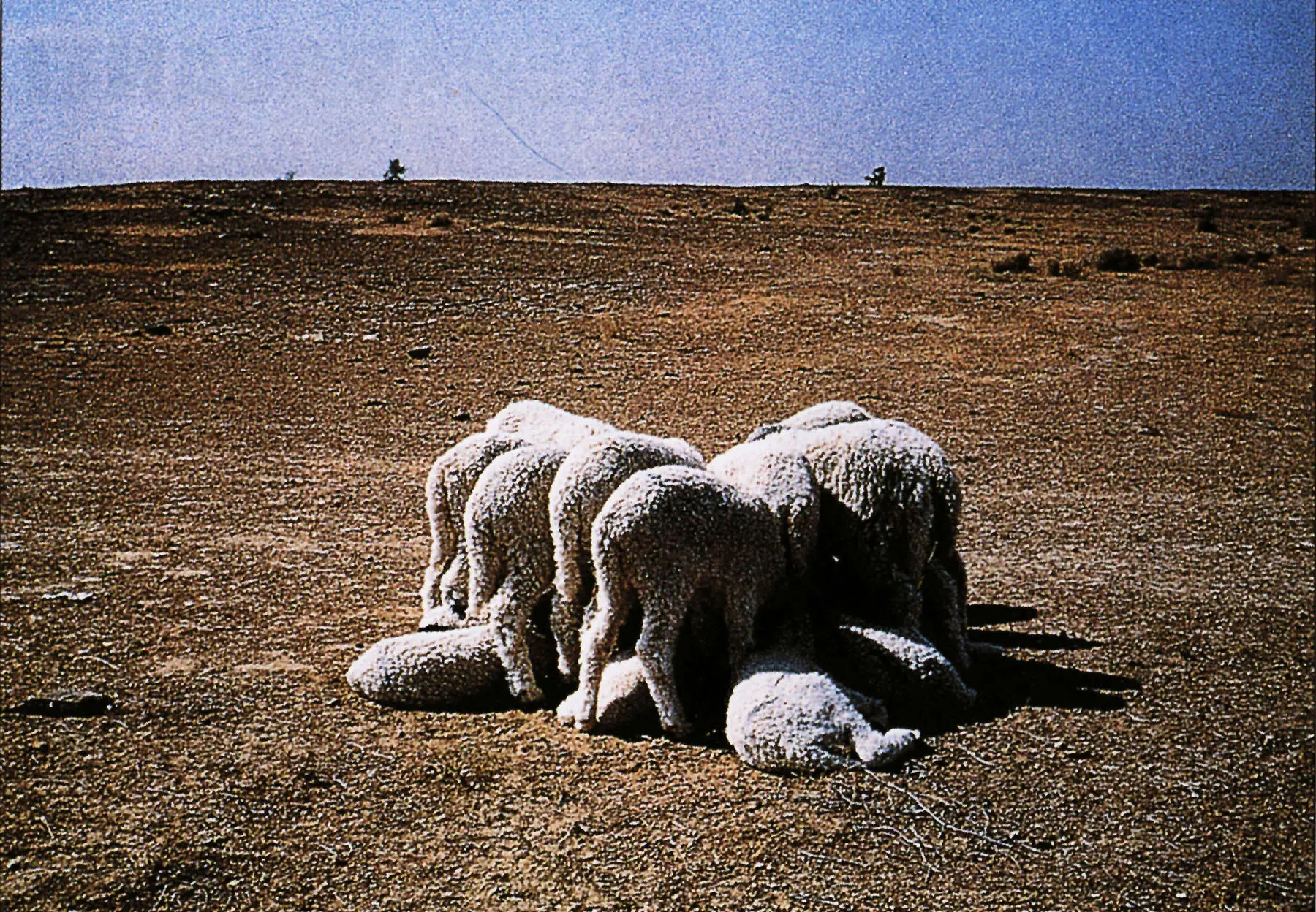
People often mistake him for the Mexican muralist painter, but Gabriel Orozco is an artist in his own right and, probably doesn’t want to be called “Mexican”. Since the early 1980s, he has displayed a will to fight the establishment by not conforming to ethnic expectations. He is convinced that making loud statements such as those of the muralists or presenting an idiosyncratic art is bound to seem worthless in a world dominated by fast-food culture and Hollywood-style art.
Gabriel Orozco (b. Veracruz, Mexico, 1962) has opted for a subdued approach to art. Art that is not thrilling but sensuous, organically minimalist, seriously fun, and yes, subversive. This is what we see in Placement, Displacement, a collection of Cibachrome prints now on display at the Present Time room at the Art Gallery of Ontario (AGO).
Orozco, who has been living in New York since 1992, has had a career that reads like an aesthetic manifesto. He began as a painter and gained notoriety for his baroque renditions of nothingness: his large canvases of the early 1980s depict nothing but gilded adornments of gothic fashion. He then went on to analyze the Flemish school of painting, curious to learn what the old masters knew about materials and detail, and in the mid-1980s created a series of very small paintings done on raw pine wood. They featured details of fine robes, fabric, carpets, and even graphic marks taken from works of artists such as Jan Vermeer and Adriaen Brouwer. Orozco was documenting the small variations of tone in the painting, shifting the emphasis from the painted atmosphere to that of the smallest details, for example, the position of a finger or the stitching on a dress.
Not a typical painter in the traditional sense, and rebelling against the market for precious art objects, Orozco produced work that grew increasingly poetic. In 1986, in a residence at the respected art center Circulo de Bellas Artes in Madrid he focused on the sculptural nature of his work. While the hype of media-based art and graffiti art was at its highest, Orozco simply began to record the minutise of life on the streets. He used a small camera to picture his alterations of the environment and constructions made of found material. From this period I recall seeing assemblages such as a sleeping bag stuffed with banana tree leaves, wooden boxes piled on a stairway, and a group of lit flashlights placed on several ceramic tiles. Orozco’s work was set in its original context, where it went almost unnoticed. From this period there exist photographs that are investigative studies and others that are sketches for pieces he later carried out in his studio.
In the early 1990s, I visited his studio in Mexico, a fifties house in shambles, where he and his dog Tunga wander around all day. The first thing that struck me was the disarray of objects that were lying casually about in the former family house. Orozco would pick up a red brick with an oblong shape, take it into his hands and turn it into a red heart. He would arrange several lengths of chain on the floor to compose a snake. It seemed to me that things lay there just waiting to be noticed, annotated, or punctuated. For him, the camera became one way of creating sculptural objects or installations or of rendering something visible, such as his print Dog Urine in Snow, which depicts just that.
Although hard to categorize, there is some low-key, funny stuff to look at in Orozco’s work. At first sight, one may think of Art Povera, Marcel Duchamp, or Robert Smithson. The photographs on exhibition at the AGO underline an apparent familiarity with all of them, but they are photographs. The objects they depict are sculptural objects that will never make it to the museum, actions that we cannot see in a gallery, or tongue-in-cheek comments on the nature of art.
Most of the photographs concern ideas —ideas that can only be defined with a camera for they come right from the realm of reality. But although the photographs depict streets, markets, and landscapes, Orozco is not directly intimate with realism but with the “fracture" of the real. Ideas flow through the camera lens onto the prints, and he pursues them back into objects. It is in the tridimensional works that he gets close to the rhythms of culture and its effect on nature.
Take Autumn Umbrella (1993), which shows the bare wires of a once-working instrument in a shameless condition lying on the street; Sleeping Hose (1995), depicting a limp hose lying on a snowy sidewalk; and Migration (1993), which shows a photograph from a magazine depicting flying birds carrying putty balls that the artist placed on each of them. These works concern the small shifts or tiny rearrangements of daily life. They leave the viewer wondering whether these are faux images, visual documents, or both; Orozco’s view can be tricky because it focuses on revealing details, sometimes creating the details.
His work has two phases; first, his intervention on the space and then the actual record of the action, In regard the first, it is easy to see that his actions, as has been the case with Marcel Duchamp, Robert Smithson, and Ana Mendieta, mark specific strategies. As Matthew Teitelbaum the curator of the show points out, they echo, transpose and edit reality.
In a series of photographs from 1993, Orozco recorded his interventions in a supermarket, placing potatoes on top of a bin displaying notebooks and displacing some half a dozen cans of cat food and repositioning them on a pile of watermelons. His installation at the Museum of Modern Art in New York consisted of nothing more than a few oranges placed on the window sills of a building located in front of the museum. Wrong number, another piece in that exhibition, consisted of several yellow pages hanging from a staircase in the museum. The ordinariness of the action, combined with the authority of the museum, gives the pieces a powerful subversive character.
But Orozco does not depend solely on the institution (as most Conceptual artwork usually does) His installation at the top of the Popocatepetl volcano, in Mexico, consisted show of sand and balls placed on the remaining beams of a shanty house. In his action pieces at the Monterrey Museum, he made a putty ball the size of a tire which he rolled through the streets of the city, collecting dust, dirt, and small pieces of garbage. Less is more, one would feel tempted to say, but the artist is working more; and his actions get increasingly complicated, yet they look simple. For a show in Paris, he cut off 10 centimeters from the entire length of a Citroen car and then reassembled the two halves; the resulting vehicle looked slimmer, strangely narrow. For a show at the Chicago Art Institute, he had an elevator car trimmed at the top by less than 10 inches, making it look abnormally low. This is not art for connoisseurs but for appearing transposed. While looking at the picture River of Trash, I question what it is we are looking at; the debris polluting a dry riverbed or the traces left by a culture running through nature. Or is it just the landscape, as a form of recording the transient and the permanent? Orozco’s art has attracted attention because the aesthetic he uses is so mattered of fact, that it is hard to believe art can deal with such a sheer precision and economy of means. But then again it is the simple drop of water falling continuously that breaks down the hardest rock.
JOSÉ MANUEL SPRINGER
He is a visual artist and writer living in Toronto.