
In a constant process of encounter and fusion between the imaginary and the real with memory, the installation presented by Gladys Triana in 1995 at the Bronx Museum of Art was the decisive step which allowed her to return to painting. It exorcised an enormous emotional agitation and allowed her to confront her current work in relative peace.
Triana, a Cuban American artist who lives in New York presented her work in Paris for the first time at the Espace de Nesles. The exhibition, titled Jeux de Mémoire, was an attempt to structure and establish, through 16 drawings with collages and 16 oil paintings, the instability of the ephemeral, a firm and delicate persistence within her divided identity. In these new works, the conception of mental space is articulated through the superimposition of various surfaces or spaces—geographical and mental, pictorial and technical, historical and esoteric, political and poetic. In this way, the ludic dimension becomes the true metaphor of the meaning of the work. This wandering through time is subject to the domination of the wheel and the circle, symbols which appear as obsessive icons in the argumentation of her discourse on transformation: the desired or dreamt of transformation of her island, which she both loves and detests, a symbolic nostalgia which configures the reconstructive change in the cultural identity of the painter.
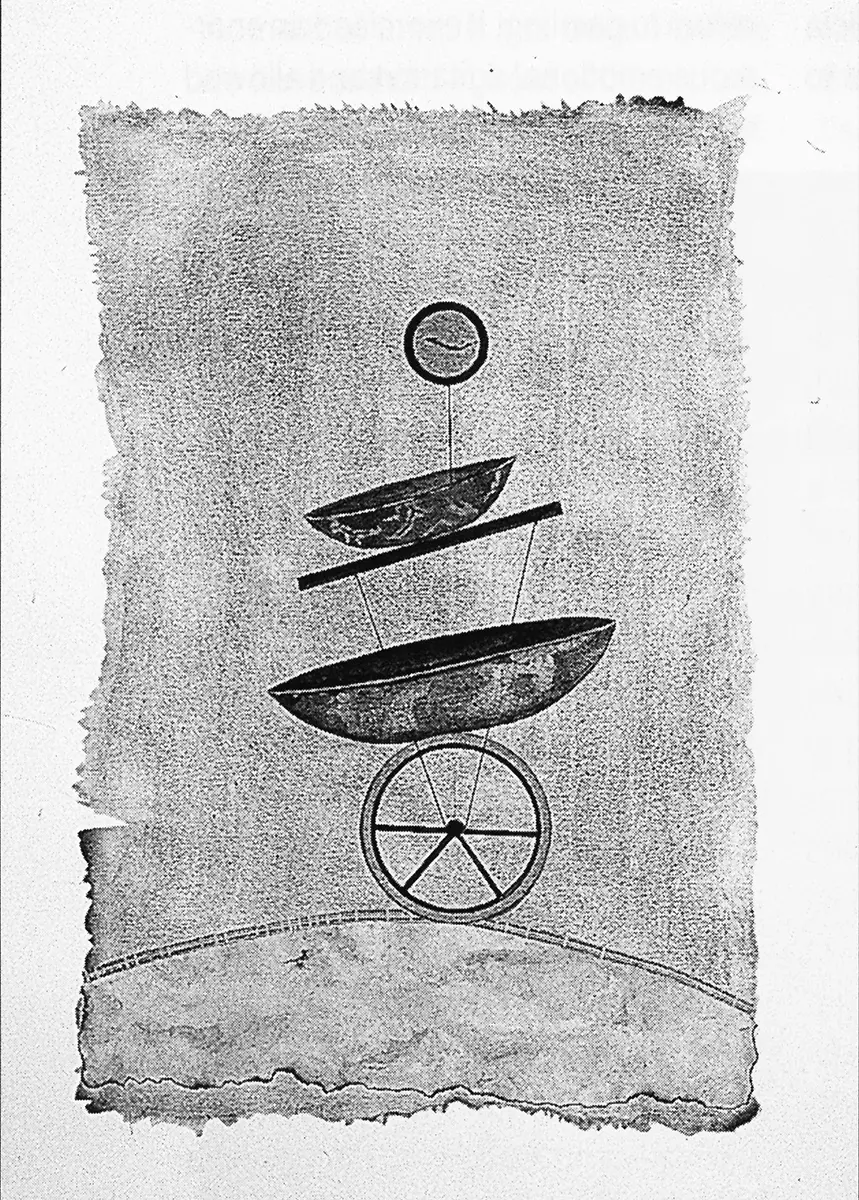
Other indications contribute to the evocation of the slippage of time and the ineluctable nature of the role of these mixed memories: first, the technical resources, whether the use of paper, irregularly cut sheets like parchment, or milky Japan paper, in particular, to which Triana applies glue, and on which she draws and paints, creating transparency which accentuates the sense of timelessness; the transparency of the plastic discourse is further emphasized by the exclusive use of muted colors, with a nuanced range of ochers, bluish-greys, or soft greens. There is also a recurrent use of figures such as wagons, labyrinths, wheels, medallions, and world maps, plunging us into a duality which is that of a world in which the artist—like the island to which she constantly refers—oscillates between a posture of closure and opening up, synonymous of her precarious affective and mental freedom. It is a personal kind of work that is both philosophical and critical, shot through with dreams, ideology, and a sense of play. In another image, the central eye of the work (the eye of the devil?), is the map of Cuba. Omnipresent, it appears upside down and always leads us towards the conceptual and explanatory thread of the work. This sculptural meditation, which could be that of a survivor of a shipwreck, is neither aggressive nor violent. Gladys Triana has chosen a gentle language to communicate to us her truths through short stories or tales which are conceived as mental and visual constructions that we can assimilate to the exquisite corpses of the surrealists.
In these enigmatic, almost musical variations on the difficulty of relating place and memory, there is a delicious mixture of irony, humor, and tenderness. Of fortuitous similarities with Klee and the work of Xul Solar, and even reminiscences of surrealism, and an identification with a certain Asiatic conception —somewhat Zen-like— of space conceived as a place of meditation. It is work that speaks of that poetic region in which we find ourselves as a result of the unbalanced equilibrium established by the to and fro of memory.
CHRISTINE FRÉROT