
Guillermo Núñez is a Chilean artist who has, since the 1950s, been well known in his country, where he had a comprehensive retrospective in 1993, titled Spoken Portrait, at the Museum of Contemporary Art. For a number of years, he lived in Paris, and on several occasions, he has presented his work in various countries in Europe, as well as in North and South America. Now, for the first time, he has just had a one-man show in Bogota. The exhibition, which ran from February to May, was made up of two works that reflect his most recent interests: Alchemy and the installation, What is there at the back of your eyes? which essentially make use of serigraphy and drawing. They are expressionist kinds of work based on memory and consciousness, with importance being attached more to the process than to the finished work, and in which, above all, the artist seeks the active participation of the spectator.
The montage occupied two spacious longitudinal rooms. Given their characteristics, in one of them, the space became a kind of corridor invaded by a succession of unframed serigraphs attached directly to the wall and a number of central panels-the multiplicity of images created a kind of flattening effect, which was further emphasized by the vigor of the linework and the forms predominating in each piece. In the second room, at the back, there appeared two works from the series What is there at the back of your eyes?
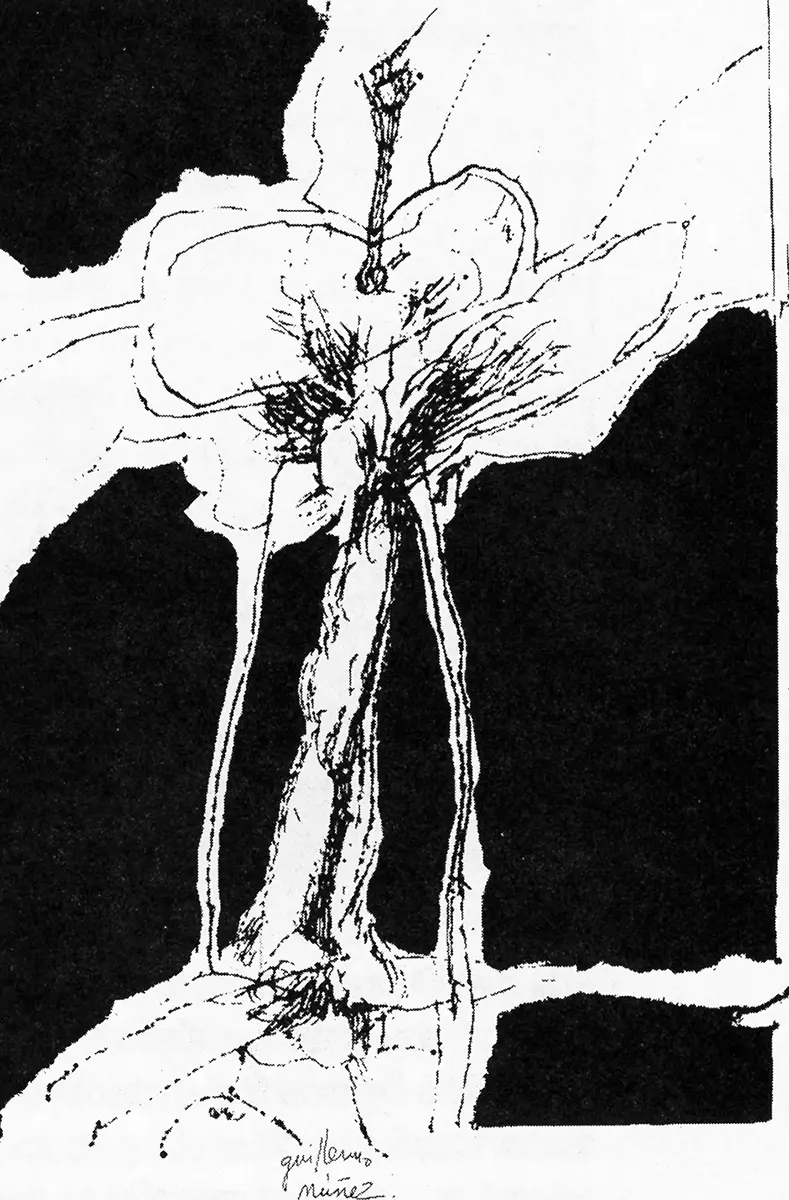
Alchemy is a project which the artist began in 1993. During its preparation, a literary endeavor was combined with an artistic one. Through the writings it is composed of, we learn of the proposals made in Núñez's work, his interest in processes, and the destiny of his experiences which are activated by the power of memory. These experiences are recuperated as memories and subsequently transformed into markedly expressionist images bordering on abstraction. Alchemy is made up of gestural pieces with a powerful sense of line work; it is surprising that this proliferation of succeeding gestures at no time suggests exhaustion or repetition-on the contrary, there is an overwhelming vitality that seems to perpetuate this infinite process of images that have the potential to be transformed by Núñez or others. In this way, the project also included the serigraphs intervened upon by some Colombian artists who were invited to participate in the process, including Manuel Hernández, Gustavo Zalamea, Maria Elena Bernal, Maria Angelica Medina, Pedro Pablo Ramirez, and Liliana González, each of whom transformed, or completed, each in his or her own way, a serigraph by Núñez.
The abundant writing material which is part of the artist’s work also evoked nefarious memories of the difficult Latin American experiences of recent decades-the pain and fear associated with torture, the traumatic experiences which have left deep scars on the consciousness and memory of the continent-memories and experiences which are given form in the installation What is there at the back of your eyes? This is a work that, in the artist's own words, "exorcises these images, allowing life to be possible once again, with love and laughter putting an end to torture and hatred."
The two projects reflect an expressionist attitude that attempts to encompass art and life, but neither of the two is exhausted in the expressive act which culminates in a final image because for Núñez the most important elements are the process itself and the spectator’s participation in it. For this reason, in this second work, he invites the spectator to enter into an active relationship. This was encouraged by the provision of a table with pencils and paper that enabled the spectator to participate directly through writing and drawing, motivated by the succession of images with the eyes covered and by phrases that form the central components of this project.
This work reflects two essential features which have been important in the art of this century: art as expression and art as the reception. In each case, emphasis is no longer placed on art as a purely formal act, as pure vision, but rather on art that involves human action linked to consciousness and memory, the vital experience of both the artist and the recipient of the work. In this way, the crushing presence of Núñez’s serigraphs offers a journey that may, according to the participant, have different meanings. And if someone takes the risk, it could be a journey towards the discovery within oneself, and through the other, of the value of art as a means of self-expression.
MARTA RODRÍGUEZ