
Early last November, a traveling exhibition of new paintings, sculptures, and painted constructions by the Uruguayan artist Ignacio Iturria opened at the North Dakota Museum of Art in Grand Forks, North Dakota. This is the same city in the north-central part of the United States, near the Canadian border that was recently devastated by severe flooding. Iturria's show opened during a week-long winter blizzard and was on view through January of 1997 before moving on to Plug-In, a well-known, alternative art space in Winnipeg, Canada, and finally on to the Museum of the Americas in San Juan, Puerto Rico.
In this selection of new works produced mostly in 1995 and 1996, Iturria continued developing the themes that have long dominated his work, as well as the technical aspects of his painting and sculpture that have distinguished it for many years. In particular, Iturria's new, wall-mounted painting-constructions of wood, wire, and oil paint, and his related oil-on-canvas images of single, lonely portraits of anonymous individuals suspended by a thread or wire in inexplicable voids, alluded to and emphasized some of the themes that the artist has been exploring for over a decade. These include the existential isolation of the average person in the modern, technology-driven, bureaucracy-controlled world; the search for personal identity in today’s media-saturated, technocratic society; and the enduring value of a sense of community both as a shaper of culture and identity, and as a refuge from modernity's anxiety-generating harshness.
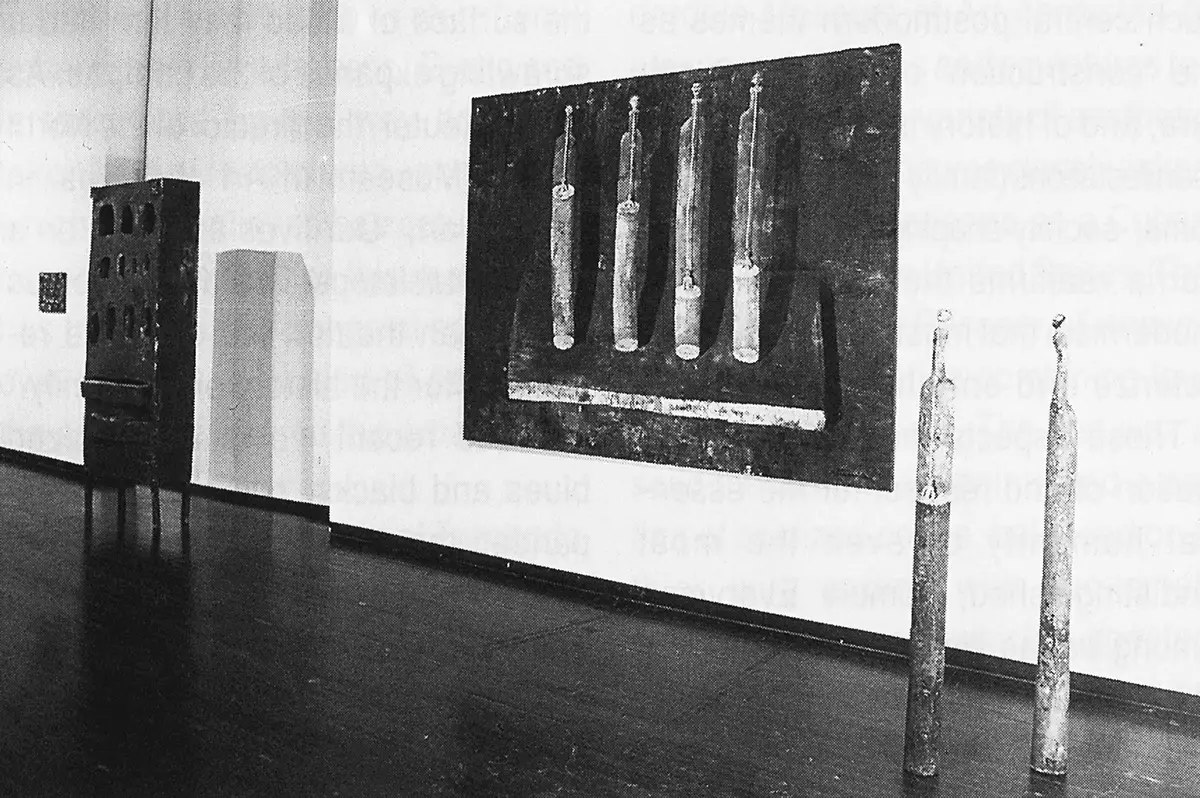
Each of Iturria’s paintings on canvas, cardboard, or paper, and his papier mâché or mixed-media constructions may be seen as essays expounding on the philosophical outlook by a deeply humanistic observer of this late 20th-century, postmodern times. For Iturria visibly shares his belief that, for all of us, things of the spirit can and should come first. Ironically, it is through an investigation of such central postmodern themes as the “construction” of identity or culture, and of history in its most personal manifestations (family trees, social customs, society-shaping traditions) that Iturria reaffirms the basic tenets of modernism that most powerfully characterize and enrich his work.
These aspects include an appreciation of and respect for the essential humanity of even the most undistinguished, humble Everyman among us, as well as a belief in the spiritual value and transcendent power of a common, identity-defining culture. Iturria's concern for these modern/postmodern themes is evident in the new works presented in Grand Forks, Winnipeg, and San Juan. Consider, for example, his paintings of speeding trains, whose passengers stare out of their windows with a combination of helplessness and longing; or the wooden panels covered with little blocks of wood, each of which Iturria has marked with a little face or figure, often squeezed directly out of his oil-paint tubes; or his dark grids of portraits lined up in neat rows, in which the paint has been scratched and incised with fine, wiry lines for extra texture.
This latter, collective portraits that display anonymous groups of people —are they all related in some way, perhaps neighbors in a town?—are done in a manner that simultaneously recalls documentary photography and evokes the aura of a well-organized family picture album. His figures include gauchos, men in tuxedos, children in their school uniforms, an astronaut on the moon, soldiers, and a pair of newlyweds on top of a wedding cake.
As usual in Iturria’s art, everyday objects are transformed into the physical and conceptual spaces for his dreamy, melancholic landscapes featuring amusing, ambiguous depictions of men and women dancing, sitting, standing, making love, or of children playing, or of animals interacting with their bemused human companions. A bathroom sink may become a lake, or the surface of a bed may turn into a sprawling expanse of the pampas. As Laurel Reuter, the director of the North Dakota Museum of Art observes, in Iturria’s art, “Our lives are lived on a series of tabletops. The table becomes the human theater, the chair the repository for the history of the family.”
These recent works emphasized blues and blacks and generally expanded the earthy palette of muddy browns and murky whites that has been a mainstay of Iturria’s art for many years. Intense daubs of blue in a young man’s jacket, or of red in a toy soldier’s uniform, energized his grid-based compositions. Iturria also experimented with spray paint to create a pattern of cloud-like dark rings in one especially abstract picture with many figures that seemed to float freely in a luminous, endless sky.
“I don’t like to travel. I really don’t even like to drive.” the reclusive artist, who lives and works in Montevideo, has said. Still, as the new works in this traveling exhibition once again showed, Iturria is an inquisitive visual essayist with a uniquely thoughtful perspective on the nooks and crannies of the human spirit that he likes to explore. For viewers who come along for the ride, the excitement lies in learning to see the world through Iturrian eyes.
EDWARD M. GÓMEZ