
In the 1980s, there seemed to be an explosion in the number of visual artists in Santo Domingo. Practically every exhibition introduced a new name, including Jesús Desangles, who has just had an exhibition at the Galeria Último Arte.
There was indeed a “Desangles phenomenon.” His work, from 1984, proposed an unusual kind of image. Prizes came one after the other, and he was chosen to inaugurate the MARCO Museum in Monterrey. Critics were enthusiastic, and it was even rumored that the complete show sold out before the inauguration. Reality or myth?
Since that tempestuous period of successes and surprises, things have calmed down. And Jesús Desangles has retained his position as a solid and deferent painter, an intuitive and research-oriented artist, faithful to his roots yet thoughtfully contemporary. The referential links with what is outside are transformed into pictorial introspection, with the artist giving free rein to an unusual brand of expressionism. Revelation and rebellion have come together in the formulation of signs, which do not seek to become symbols. They represent a personality and a culture.
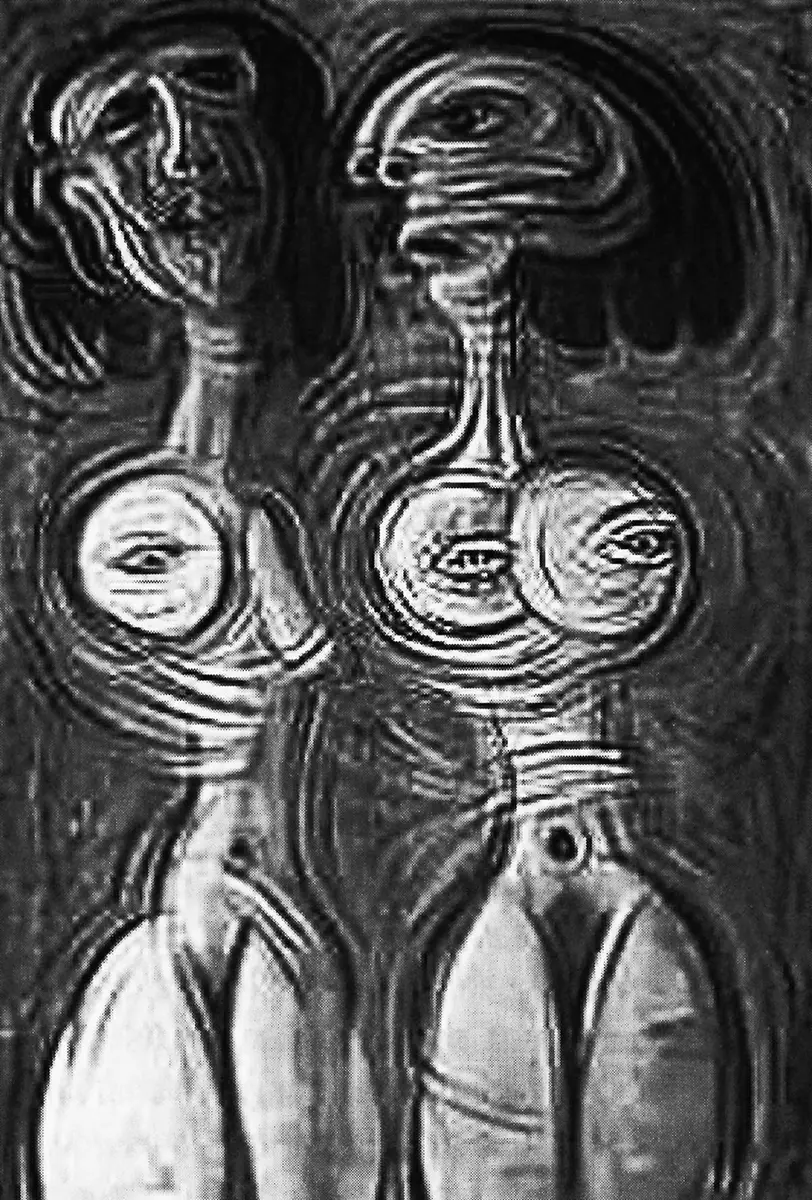
Jesús Desangles is as good a draftsman as he is a painter, perfectly combining both roles. If his drawings are marked by the transformation of inner forms into rhythms, vibrant and energetic line work becoming a kind of hypnotic contemplation, his painting technique is curiously either slow or rapid, depending on how he feels, requiring a participatory eye, and an unprejudiced kind of reception. He is not interested in clear and meticulous execution or the traditional canon of the beautiful.
With this ludic freedom, there is a delight in the ugly and in fascinating monsters. Acrylic and oil come together in the same canvas. The gestural brushstrokes may become calm within an unexpected series of short strokes. The audacious touch suddenly becomes lighter. The aggressiveness of the forms gives way to tenderness of color. What is another artist might be a contradiction here becomes affinity, an inspired and finally controlled kind of freedom—a characteristic not only of Desangles, but of contemporary Dominican painting.
The interpretation and demystification of the human figure are carried to the point of paroxysm. As the writer Manuel Núñez rightly pointed out in 1992, "the painter makes ironic what is egregious, laughs in order to differentiate himself from the seriousness of others, fills himself with excrescences and baroque ingredients..." Jesús Desangles has not changed. The force of his work, which is freer and richer than ever, is a far cry from any facile kind of transformation, whether caricatured, mythical, unknown or familiar, existing or imaginary.
However distant his figures may be from reality, with their special anatomies and very strange faces, they do not cause the spectator any unease, nor do they suggest any necessary verisimilitude. We identify with these strange creatures, the sole presences on the canvas that often fill up all the space, dancing in twos or threes. The eyes are directed towards the invisible. The magic is working and the links are created.
It is the energy of the Caribbean, with its sensuality, its rhythm, its light, that appears in these pictures, whatever their size (they are of many different dimensions, with perimetric variations). An impression of monumentality; a drawing or a painting by Jesús Desangles stretching upwards or sideways, like a mural, a barely magnified face, is always startling, possessed of cultural and ritual forces of its own.
The characters are the experiences of the neighborhood, of the Antilles, taken from the surroundings, the street, a party, or carnival. This is a world to which the artist naturally belongs so he is able to communicate authentically. A distant inheritor of the work of Paul Giudicelli and occasionally, of Ramón Oviedo, he is an uncontainable expressionist who is capable of winking his eye to the revered masters of many centuries, simply because he wants to. Jesús Desangles has distinguished himself by his refusal to accept any pre-ordained aesthetic patterns. He has expressed his conviction that he is a painter, although he has undoubted gifts in sculpture and three-dimensional work as well. He becomes more humorous and full of fantasy: he bursts out laughing, well-constructed laughs, about this escapade, which for him is proof of other options which, when he, and only he decides, can lead to new proposals like the mural outside Último Arte that astonished many spectators.
MARIANNE DE TOLENTINO