
"The real is, at first sight, food," wrote the distinguished French philosopher Gaston Bachelard. He might have added, "for the artist." Art nourishes itself on many other things, fortunately, but what interests us here is its unlimited appetite, its gasteromorphous alchemy. Absorption, digestion, deglutination, reproduction. In its feat of historical, aesthetic, and intellectual devouring, artistic creation assimilates/rejects and acquires the essence itself of its indestructible intimacy. One Hundred Years of Modern Art to which Julio Villani, a Brazilian artist living in Paris, recently invited us is a visual bacchanalia that projects and multiplies the primordial obsession with duality towards a well codified referential multiplicity, in which art wanders in total freedom.
The table is set in honor of the artists who are the major references for Villani, and the imaginary menu is an emblematic allusion to the works. The artist delights in quoting Malevitch with little white and black cakes; Mondrian, with a white, red, yellow, and blue purist cocktail, and van Gogh with ears on lettuce. Light bulbs decked out as éclairs au Chocolat recall the birth of the electric light, while the furry and tacked cutlery evokes both Meret Oppenheim and the dadaists. Cézanne and many other artists are thus combined for our visual delight, but the real master of ceremonies is Marcel Duchamp. The reader will recall the infinite number of metaphoric works linked to eating art during previous decades—whether those of the Swiss artist Daniel Spoerri and the edible works in his extravagant gastronomic rituals, the North American Judy Chicago inviting us to her sexual-cannibalistic dinner party, or the symbolic and edible dinners of the Mexican Raymundo Sesma (1993 Venice Biennial). Artists fascinated by the primitive ritual have accustomed us to the sarcasm and humor characteristic of the Brazilian cannibalistic model.
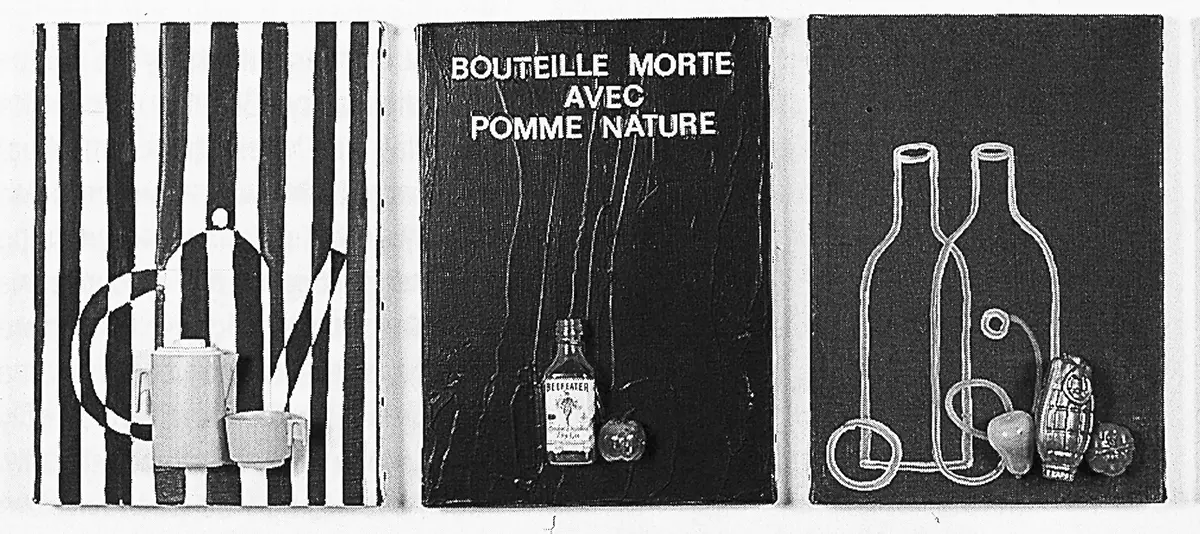
Villani continues to play with the transgression of all kinds of taboos and delights, and in overturning all sorts of totems: he copies, quotes, mixes, superimposes, rips out, and imagines whatever he likes. The banquet formed the axis of his show in which he developed an infinite number of variations on the methods of capturing an object, in this case, a bottle. From his Naturicasso to his Naturelitz, as well as Plastic Nature, Naturaleza Ivre Morte, and The Death of Nature, his sense of humor, and his love of painting and words are on full display. A visual and intellectual correspondence is established between the banquet, and the works arranged around it, giving material expression to the concept of his artistic-museographical project. Villani superimposes representations, meanings, references, and metaphors in a to and fro movement between the object and the painting, with a constant interplay of images and words, symbols and meanings. In this cannibalistic chain, the artist reveals a multiplicity of interpretative worlds, both satiric and parodic, of the reference to irreverence, based on a conceptual axis that perpetuates the multiple sources used, whether artistic, cultural, amorous, or familial. Behind the humor lurks a questioning of the distance and proximity of the limitless worlds with which the artist is confronted in resolving the viability of his own identity.
The exhibition opened with the question of origins in a painting entitled Quand le titre devient tableau (When the title becomes a picture) from 1988—All the other works were done in the last two years—where Villani describes the foundations of any personal culture. At the same time, he breaks any barriers that still remain: he eliminates the centers and peripheries (if any remain) so that the exhibition becomes an invitation to all possibilities. What interests the artist is this permanent balancing act, that underpins his creative freedom, between painting and installation, object and painting, word and object, and vice versa. Everything overlaps and comes together in this “great feast of human thought.” The "short story" in tribute to Fontana, the last work in the show, is about a waking dream inviting us to share this healthy separation of body and spirit.
CHRISTINE FRÉROT