
There could not have been a better place to present this exhibition, titled Deadline, by Luis Cruz Azaceta, than Miami, a city where violence, political oppression, and exile are discussed from the start of every day over a Cuban coffee. The space was a hit, too: a high-roofed warehouse with rustic walls and a concrete floor that makes up the new Fred Snitzer Gallery. The seven works in the show created a strong and even uncomfortable kind of reaction in the visitor.
In Cuban Icarus (1996), the image of a winged and dismembered man appears at the top of the composition, trying not to fall into a black hole in a sheet of corroded tiles covering the lower part. The figure’s face, done with considerable drawing skill, is a self-portrait. Head Trip 2 (1996) reproduces a similar idea, with a head almost falling into a black hole full of human bones, most of which are covered by a metallic sheet. These two works follow the line of Azaceta’s most recent work, wherein expressionist style he explores themes closely linked to his personal experience, such as feelings of loss, and the ideas of displacement and oppression.
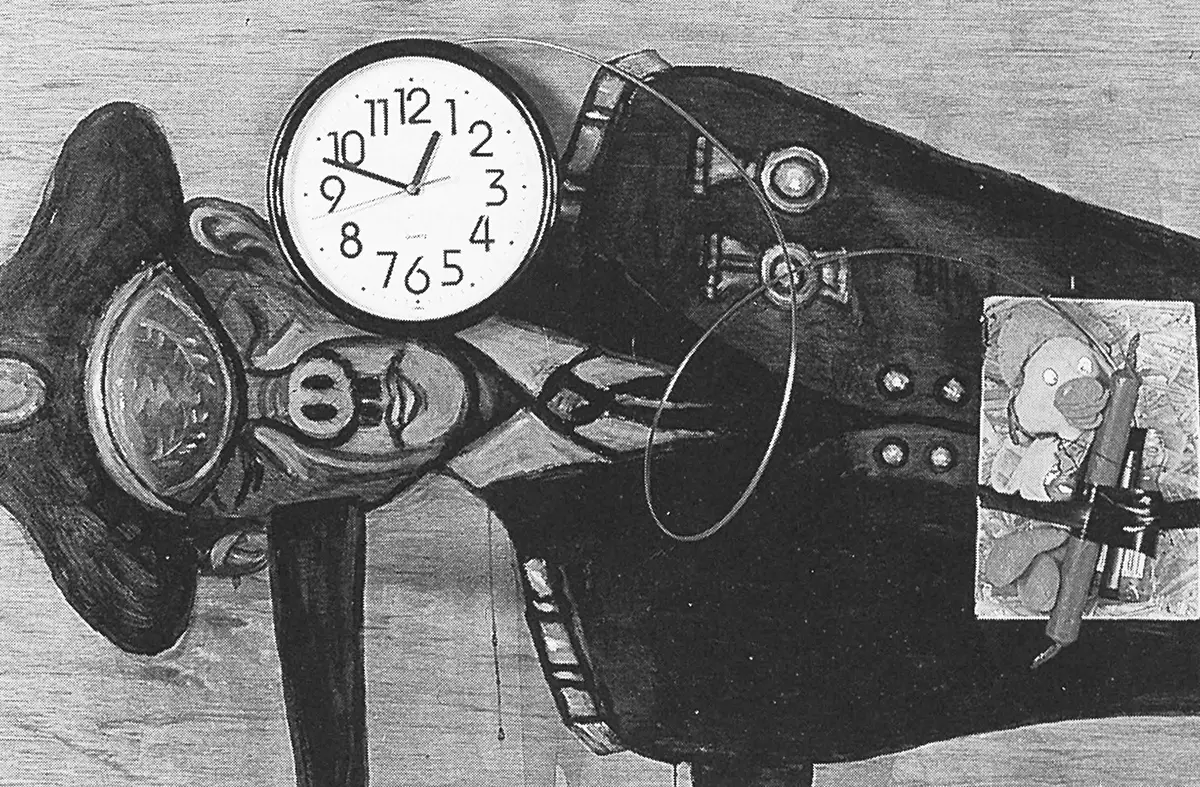
The reason for feeling this way, or at least one of the reasons, is the theme of Deadline (1997). In this enormous work (60 in. x 96 x 12-1/2), a caricature of a dismembered general lies on all fours. The dictator, recalling Hitler with his characteristic mustache and pig-like features, is tied to a bomb made with a felt duck (the stomach full of sweets), a stick of dynamite, a plastic bottle, and an enormous wall clock. The hands of the clock move slowly, perhaps warning "almost time” or “until when?"). In the same room is another large format piece titled Sell Explosive (1997), featuring the torso of a dismembered man, placed on wheels and tied to two bombs: one on his chest, made up of a felt bear and sticks of dynamite; the other on his forehead, made of plastic bottles and a packet of El sublimado tobacco, a very subtle reference. In this case, the clock is painted and the hands do not move— perhaps the wait has become too long and time has become frozen.
There follows The Wait I (1996) and Waiting (1996), self-portraits which repeat the typical image in fetal position with a fixed and desolate stare, in front of a black hole much like a drain, or on a sheet of oxidized, dripping tin-plates, that is gradually disintegrating. These are hard and powerful images from someone who expresses his anguish through his visual world.
FRANCINE BIRBRAGHER