
Of German origin, but fully integrated into the Venezuelan art scene since 1955, where she won national prizes for drawing in 1967 and for painting in 1982, Luisa Richter is an outstanding figure in the contemporary art of the country. She began her career as a teacher, which allowed her to come into contact with young Venezuelans, but she has also maintained an intense rhythm in presenting her work to the public in exhibitions, for which she has gained widespread recognition. She has written a number of texts on art and her creative production includes painting, drawing, and collage. During the months of April and May, her work in these three media was once again shown at the Museo de Bellas Artes in Caracas.
The titles Richter uses reveal her fine sense of communication. For example, The Mirror of Appearance and The Invisible Remains show that her conception of the image is based on doubt, provocation, the sequence of surfaces, and the possibilities of the visible; as she herself has said in connection with the title of one of her drawing-collages, Each result is promising and is a kind of process. Art is therefore an unending metamorphosis, a persistent window or eye. It is not by chance that her favorite formats are the oval, circle, or the circle within a square.
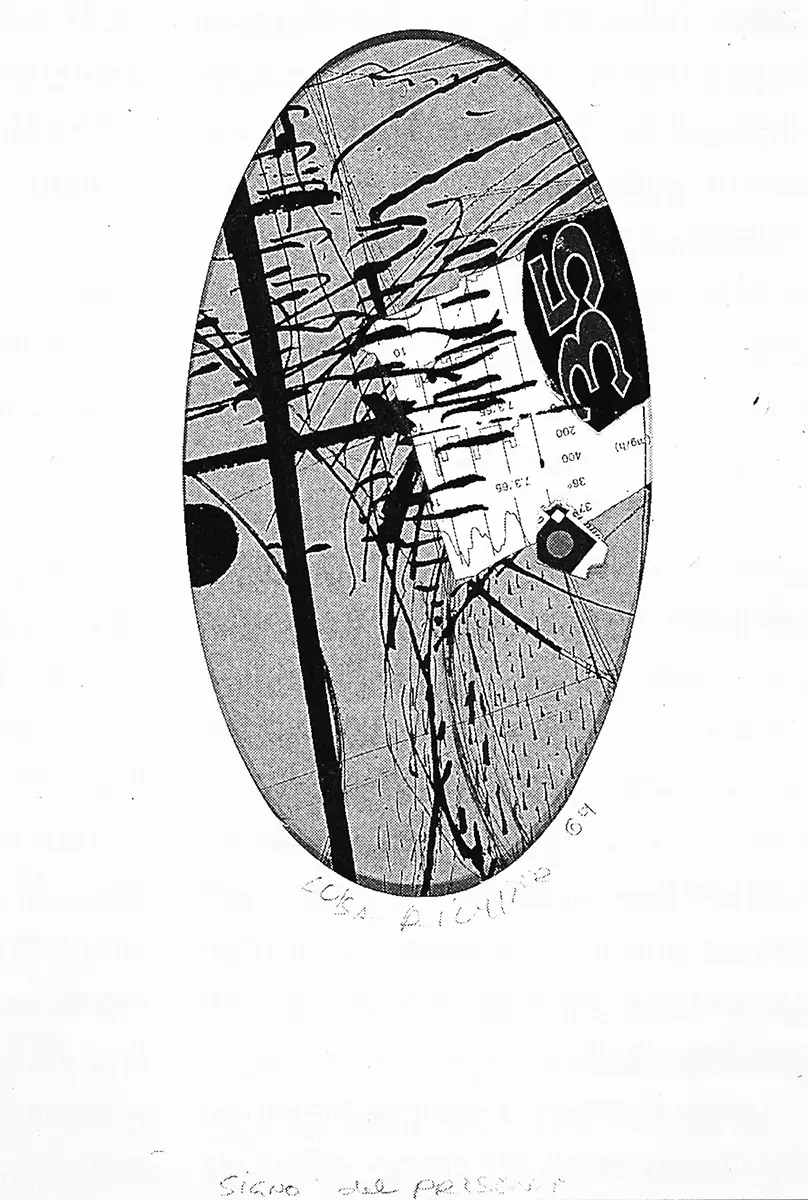
Reflection is therefore one of the foundations of her poetics: spatial elements, white marks, the interplay of horizontals, verticals, and diagonals become themes in her work, as do composition, structure, contrast, through the illusion of painting and the vision of a pictorial and humanistic culture.
Reflection in Richter’s painting also has the quality of indefinite time, a sense of imprecision achieved between what is inside and outside the image, the oneiric present captured through measuring instruments, architectonic drawing, and furniture elements, in situations of bare space. Richter’s work is divided into elements that reappear with new formats and structures. It is therefore a multiple, where each detail becomes part of the whole.
“The work of the artist is one of recuperation,” as Roberto Guevara has pointed out. Her collages are on canvas or paper and her brushstrokes do not mask this process of aggregation. Earlier drawings by Richter, from the early I970s, recall oriental writing and graphic elements, lines on white space, full of energy and definitive, or barely present on the paper. Sometimes, they are more than just ink stains, undulating, full or strength or delicacy, so we are able to distinguish a nude or a crucified Christ. Others seem to embody the vault of space and seem to be an initial definition of artistic and conceptual failure.
Thus words, phrases, and calligraphic elements persist throughout her work. The word as a drawing in the midst of the composition or a phrase expresses the thought of the artist: “Doing depends on personal risk.” The surfaces, lines, constructive and illusory meanings of color are not an end in themselves but rather encourage continuities within the painting itself.
Luisa Richter, a central figure on the Venezuelan art scene, offers us the age-old art of brushwork on a surface, creating a constant dialogue between a canvas, paper, and poetry.
JUAN C. PALENZUELA