
The “Black Prince” —the name by which Rolando Peña is known— has become the main protagonist on the Venezuelan art scene during the first part of the 1997 season. This is the result of his two simultaneous shows at the Museo de la Ciencia and the Museo de Bellas Artes, as well as his powerful presence at the group exhibition organized by the Galena de Arte Nacional (GAN) under the suggestive title of The Invention of Continuity. Added to this was his selection, with the unanimous endorsement of an ad hoc jury, to represent Venezuela at the Venice Biennial this year.
His one-person shows at the Science Museum and the Museo de Bellas Artes were titled Menespace, a combination of two asymmetrical words: space and the word mene, an indigenous term used to refer to a black substance produced by the earth in some regions and was used to caulk canoes and sometimes for medicinal purposes.
The Museo de la Ciencia exhibition included three installations. The first, Black Gold, consisted of the modular presence and compulsive repetition of the image of a golden oil barrel floating against a black background. The second installation, The Black Sea, comprised a piece of black plastic hanging from the dealing and extending for a considerable distance, brought to life and given a dramatic and menacing kind of movement by the action of ventilators. This atmosphere was emphasized by the presence of a number of video monitors which projected images of the burning oil wells during the Gulf War. The final installation, titled Digital Mene, was made up of a plethora of computerized resources, including an Internet page, a CD Rom, four light boxes, seven bulletin boards, eleven prints with computerized images.
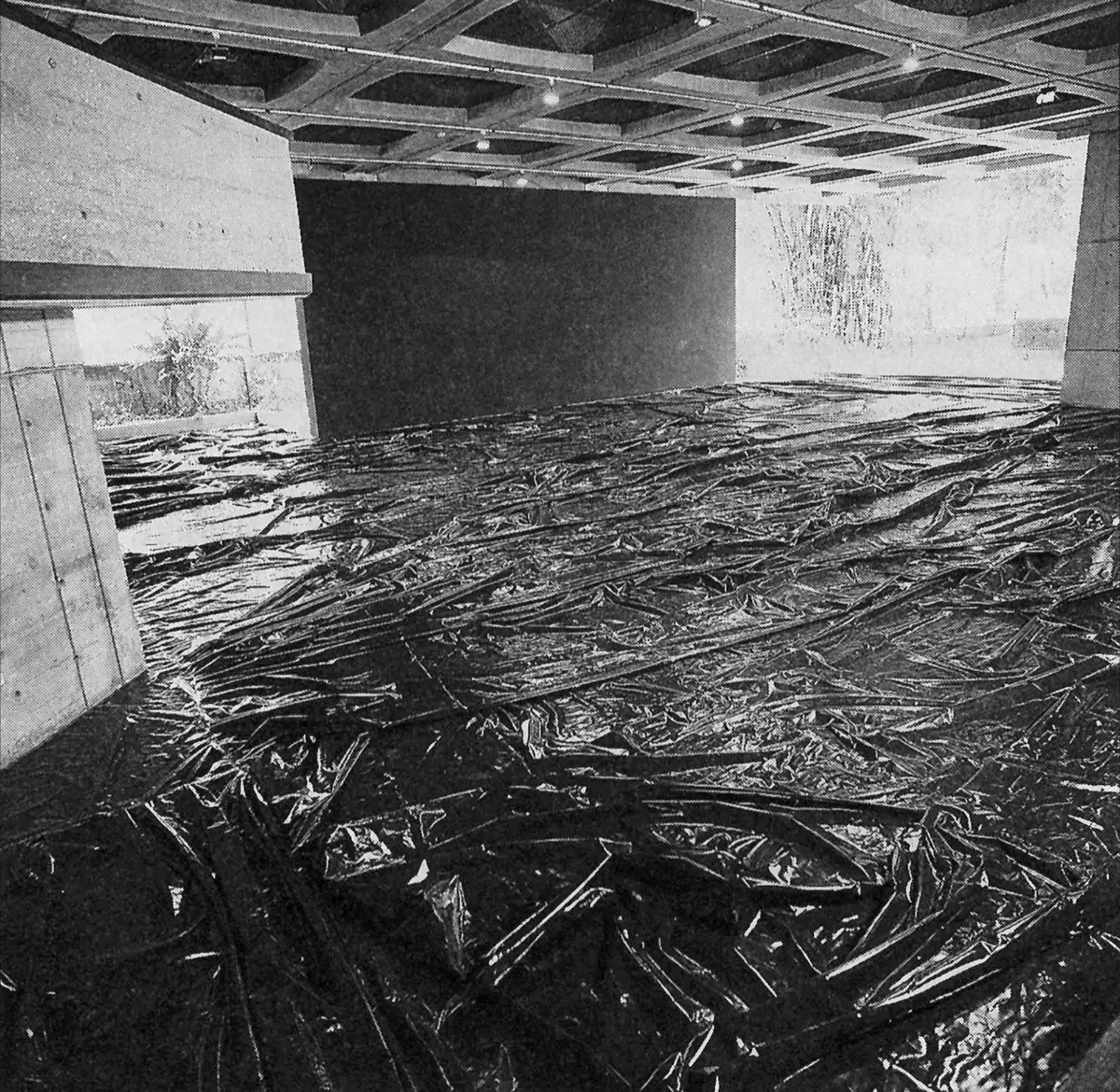
The exhibition at the Museo de Bellas Artes explored different aspects, although it undoubtedly complemented the other show. It included The Spill, which consisted of a broad expanse of black plastic covering more than 1,000 square meters and which, through its folds, curves, waves and irregularities, suggested an enormous pool of spilled oil. The sensation of desolation and hallucination of these effects was heightened by the dirt which was progressively added to create an atmosphere of strong reflective content. But the impact of the work was further strengthened by the presence of a video which visualized an oil spill, as well as cosmic music recorded by NASA - strange and unusual sounds full of enigma and uncertainty. The Museo de Bellas Artes exhibition also included another installation, identified as Koyaanisqatsi. This expression taken from the language of the Hopi Indians can be translated as -worlds in turbulence-. The work consisted of a large format photographic triptych, with a transcription of the Hopi prophecies on images reproducing the surface of The Spill.
Amongst other things, these prophecies warned: “if we extract precious things from the earth, we invite disaster. As the day of purification draws nigh, webs will be woven from one side of the sky to the other...”.
Rolando Peña’s presence on the exhibition scene has not been limited to his one-person shows. He was also represented at a group exhibition at the GAN, curated by Luis Enrique Pérez Oramas and Ariel Jiménez. Here the artist presented two works which constituted an unavoidable point of reference in Venezuelan art. One was his Miss Venezuela (1968- 1975), made up of a series of conceptualized and surrealized photographs of himself. Each of the photographs is intervened with the clear intention of emphasizing the cosmetic deviations and ritualistic distractions offered up by this kind of circus activity to people who have more vital needs. The other work was The Music Box (1979) which, in the conventional manner of such boxes, produces a harmonious range of sounds while a see-saw evokes the pumping movement involved in the oil exploitation process. An interesting feature of this work is the fact that was the first explicit reference in Venezuelan art to the oil theme.
Many observations can be made about the development in general of the “Black Prince” and the specific characteristics of these shows, although lack of space will restrict us to mentioning just three points. Firstly, on the basis of an undeniable and revitalized line of continuity, Rolando Peña has managed to broaden his thematic range, diversify his resources and materials and deepen the conceptual essence of his proposal. This unalterable line has been oil, in its most comprehensive dimensions and its fullest expressions. This interest, of course, reveals an intrinsic historical value, as well as a referentiality in the development of national art. There is no doubt that the decision to adopt and explore the element which serves as an axis to a large part of the country is an act of vision and intuition. But this value is not limited to the simple historical and socio-political casuistry of having defined and developed a field of exploration. Its major attributes concern rather the possibility of not exhausting the subject or his personal capacity to use and reuse oil as a theme, as a resource for resolution and as a basis for a concept. Perhaps this is one of the most superlative challenges which an artist must assume to validate his aesthetic meaning and artistic contribution. There are very few artists in the world who have remained faithful in this way and there are even fewer who have managed to prolong and enrich their legitimacy without abandoning their intimate relationship with a theme, resource, or concept. However, Rolando Peno has managed to do so through his unswerving sense of continuity, from the 1960s down to the present. But the most interesting aspect is that when we look at the works in these shows, we can see that far from any sense of exhaustion, there is a sense of the potential richness of the proposal and the vitality of someone who still confronts his work with the sense of challenge that characterizes young artists. This attitude is the best guarantee for the continued growth of a register which remains open to fruitful recodification.
From the aesthetic point of view, oil has been an inward-looking resource for Rolando Peña, a symbolized icon, a metaphorized event, and a profound kind of reality. An extensive argument could be developed on the meaning of these remarks, but for now, I would like to limit myself to merely noting them. In the same way, we could say that from the personal point of view, oil for Rolando Peña is the trench from which he launches his siege, it is a resource of combat, an idea of resistance, and the code of his individual and aesthetic affirmation.
I cannot resist the temptation to elaborate a little on these remarks in order to emphasize that Peña’s relationship with oil is not of a pamphleteering or denigratory kind. He does not adopt the pedestal pose of the fundamentalists which only caricature and fragment the meaning of oil in Venezuela and the world. Peña's links with oil can be defined rather as a relationship of critical fidelity and problem-seeking loyalty. Neither the artist nor his work can be separated from the theme of oil. To paraphrase Ortega y Gasset, we might say that just as man is himself and his circumstance, so Peña is himself and his oil. In this critical and problem-seeking relationship that the artist establishes with oil, there is neither joy nor rejoicing about the subject, and neither is there any sense of objection or censure. Beyond such superficial, accomodating, and opportunist interactions, Rolando Peña establishes a more fundamental relationship with his subject. And here we can link the fundamental with the content which Wittgenstein attributes to the term “foundations”: “When you want to go beyond the last stage, the search is not for causes, but for the foundations.”
I should like to add another remark to emphasize the meaning that oil has in the origin, nature, and purpose of Rolando Peña's aesthetic proposal. I should like to use a metaphor that I once came across in connection with good translators. The metaphor in question said that a good translator is not a person who masters another language, but a person who lets himself be dominated by the other language. Only through this deliberate and existential decision to allow himself to be possessed by that which is being served can there be a guarantee of assimilation, processing, and faithful transmission. I believe that something similar happens in the link between Peña and the theme of oil. His existence is inextricably linked with the theme and oil is inseparable from his experiences. For that reason, he dresses absolutely and impeccably in black, and for the same reason, he is known as the “Black Prince” and produces brilliant works based on the blackness of oil.
I should like to conclude by mentioning a remark made in a book by Theodor W. Adorno which helps us to focus these remarks on the work of Peña. The philosopher says that "in order to be able to exist in the midst of extremely dark reality, works of art which do not wish to sell themselves as a facile kind of consolation must be equal to that reality. Radical art today is the same as a dark art, art whose fundamental color has to be black".
VICTOR GUÉDEZ