
The art of Jamaica has been rarely discussed in the pages of Arte en Colombia/ArtNexus, yet it is significant to point out that the visual heritage of this country has much in common with that of the Caribbean Islands which are given extensive treatment in articles and reviews in this publication. The National Gallery in Kingston possesses a small yet very rich collection of Taino objects produced by the earliest inhabitants of the island. Jamaica was a Spanish colony from the days of Columbus's second American voyage in 1494 until it was formally ceded to England in 1670. While Jamaican art and architecture did not flourish in colonial times (either Spanish or English) as brilliantly as it did in, say Cuba, there are nonetheless, a number of important works by visiting British artists from the 18th and 19th centuries present in Jamaican public and private collections.
Modern art in Jamaica is often said to have begun with the arrival in Kingston in 1922 of British sculptor (partly of Jamaican descent) End Manly. Along with several other artists of her generation (including the sculptor Alive Marietta and painters Albert Hue, David Potting, and Ralph Campbell), Manly had the first exhibitions of painting and sculpture on the island and introduced many of the international avant-garde aspects of modernism to the country. Manly was also an important teacher who was instrumental in founding the Jamaica School of Art and Craft (still in existence today as the End Manly School of Visual Arts), and in educating some of Jamaica's most influential younger artists. By the 1930s the first generation of those self-trained artists who came to be known as the Intuitives (including John Dunkly and David Miller Sr. and Jr.) began exhibiting their work. The contemporary Intuitives (Leonard Daley, Everald Brown, and others), as discussed in the writings of David Boxer and Veerle Poupeye-Rommelaere, are highly influenced by Afro-Christian cults and Rastafarianism.1
In recent scholarship, there has been a tendency to consider the Caribbean nations not as individual units, isolated from each other by geography, language, political affiliation, or differing colonial experiences, but as components in an area with numerous historical and cultural characteristics in common. The Jamaican cultural critic and historian Rex Nettleford has recently written,
"The Caribbean, like all of the Americas, is the creation of that awesome process of cross-fertilization resulting from encounters that occurred in Europe, Africa, and Asia, and the ancient Amerindian civilizations ... The island nations of the Caribbean… are conscious of the dynamic of their own development. It rests firmly on an agonizing and challenging process... In this region of the world, the result is an emerging Creole lifestyle, a nascent ontology, mu! nu epistemology that will speak to the Caribbean experience and to existential reality."2
In the pages of Arte en Colombia/ArtNexus, Cuban critic Gerardo Mosquera has pointed out the many points of shared African heritage in the visual arts of the Caribbean, a subject which has also been the focus of the research of Cuban Scholar Yolanda Wood.3 Jamaican art richly partakes of these common points of contact with the rest of the Caribbean.
In recent years there has been a serious scholarly interest taken in Jamaican art (and Caribbean art in general), as witnessed by several large-scale exhibitions. Touring throughout England in 1995-1996, the show New World Imagery: Contemporary Jamaican Art gave the British public the chance to see the work of eight significant figures in the contemporary art world of the island. Jamaican artists have participated in the Havana biennials as well as in the Caribbean and Central American Biennial held at the Museo de Arte Moderno in Santo Domingo. The ambitious show Caribbean Visions: Contemporary Painting and Sculptures, currently touring the U.S., has a large number of Jamaican participants. An important exhibition was seen in Spain in 1995, Otro País: Escalas Africanas (Another Country: African Stop-overs) made the logical connections between events in the art worlds in Africa and those in the Caribbean. The Jamaican participants in Otro País included Robert "African" Cooklhorne and Stanford Watson.
The contemporary art world in Kingston (where the majority of Jamaican artists who reside on the island live and work) is highly pluralistic in terms of media; yet the painting is still, perhaps, the preferred mode of visual expression. The rawness and visceral power of many of the painters, who often employ vivid color and emphasize texture as a principal element in their vocabulary should not be necessarily linked to, and certainly not confused with the international neo-expressionist tendencies of the 1980s. Although emotional content may be analogous between the Jamaica ns and their counterparts in both European and North America, artists like Stanford Watson incorporate signs and symbols derived from Afro-Caribbean and African pictorial languages. As artists in a country in which, like others in the Caribbean, the African presence provided a keystone in the development of culture, Watson, Cookhorne, and others such as Milton George and the late Eric Cadien, partake, to one degree or another, of the "Africa consciousness" that has been a (sometimes debated) element of Jamaican self-definition. Yet this is only a part of the story. As Jamaican critic Petrine Archer-Straw has noted, "In the thirty-three years since Independence, Jamaican artists have been slowly orienting themselves away from Eurocentric concerns ... towards a sense of identity more rooted in Caribbean experience. Sources such as Africa and Rastafari now vie with dance-hall culture, cable television, island politics, and a new wave of interest in the Caribbean and the Americas as 'home.'"4
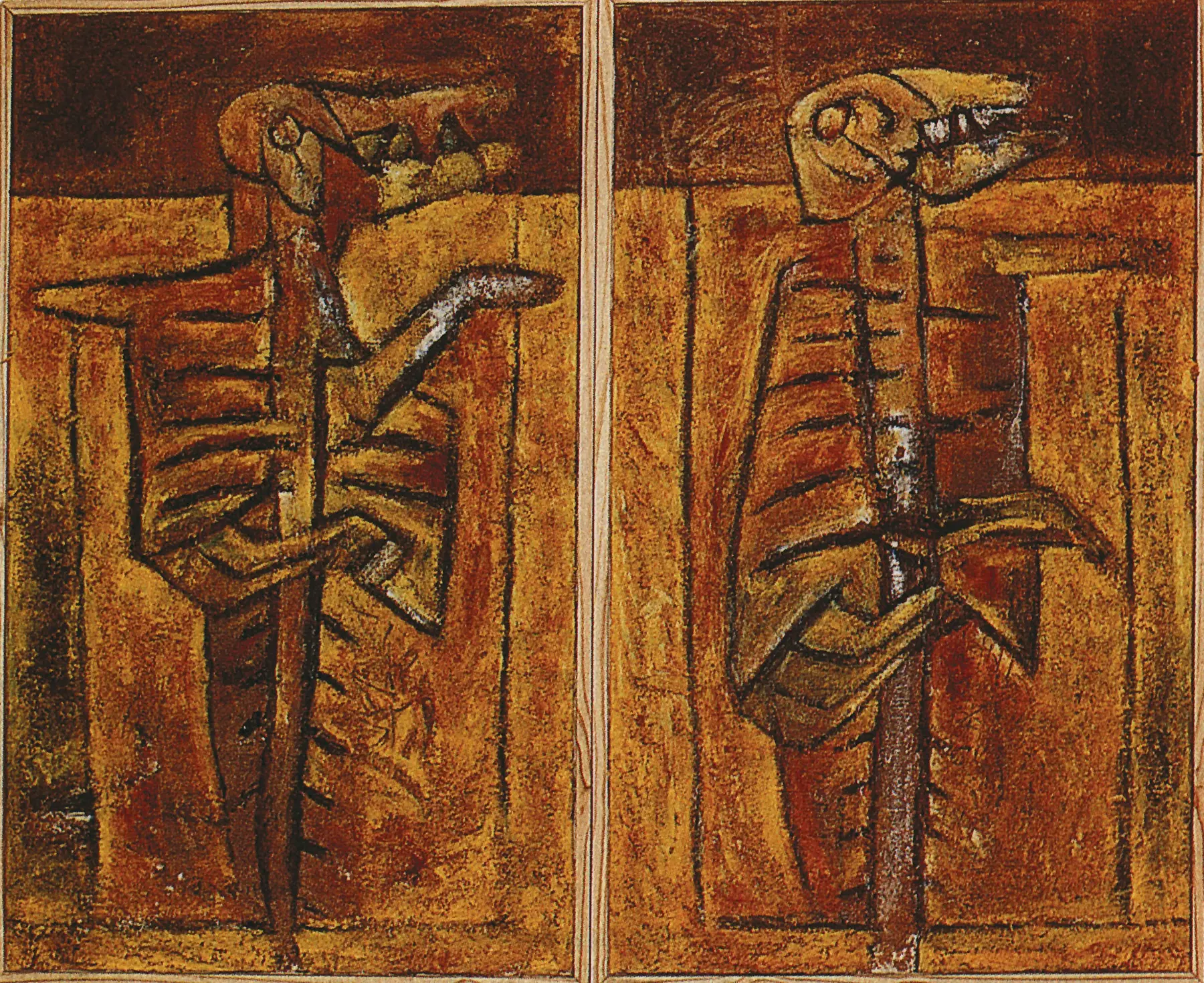
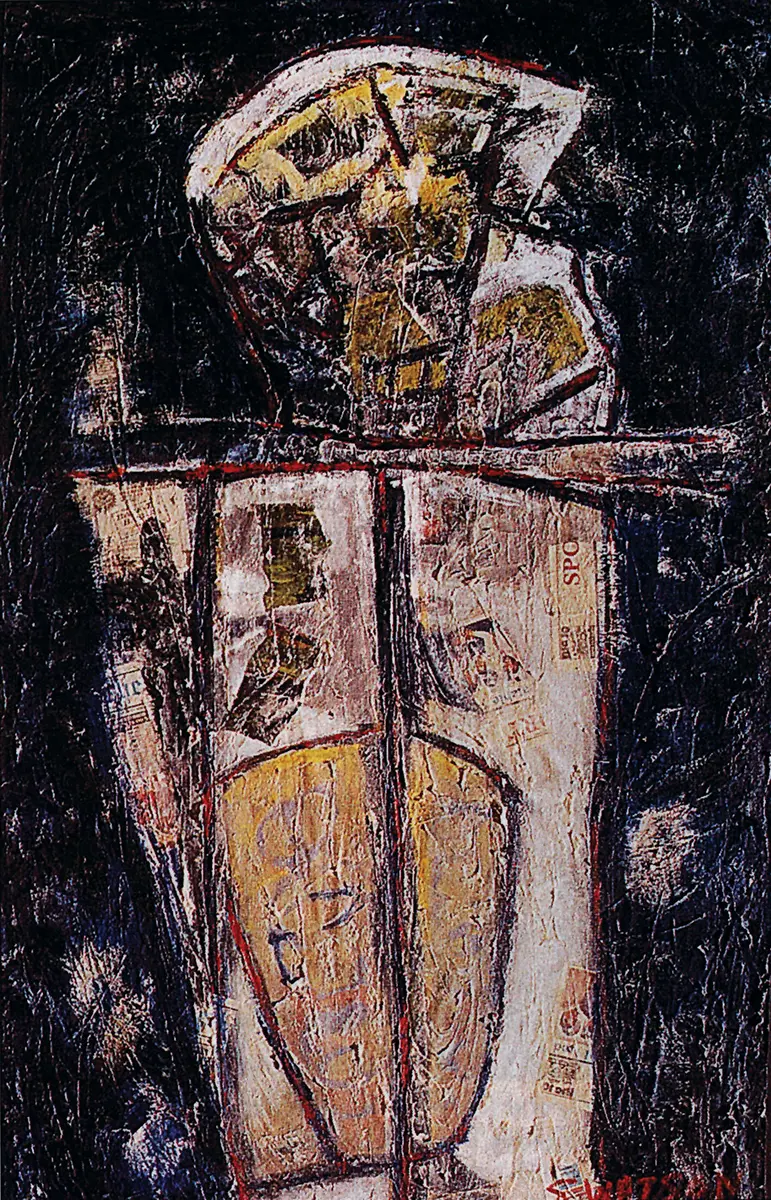
The work of Watson embodies many of the contradictions, ironies, and conflicts that characterize much contemporary Jamaican painting while, at the same time, demonstrating his commitment to the continuing development of his own distinctive voice.5 Watson's work may be read, on one level, as socially committed, highly critical of topical problems and dilemmas in Jamaican society (which can, in turn, be comprehended as metaphors for strife experienced on a much broader societal level). On the other hand, he has also developed a vocabulary that employs totemic forms and iconic shapes which, combined with his vigorous handling and application of the paint to build up rough, almost slashed, and manipulated textures creates a dramatic impression for the viewer.
Watson has been called a «ritualist» painter whose principal themes are starvation, revolution, and violence.6 The strikingly theatrical and varied results of his efforts were plainly visible in his most recent solo exhibition at the Mutual Life Gallery in Kingston (February-March, 1996) in which he presented 18 paintings, drawings, and collages entitled, collectively, Thoughts, observations and Me II. Watson graduated in 1983 from the Jamaica School of Art, and since then has exhibited in group shows abroad, including the Caribbean and Central American Biennial in Santo Domingo and the 1955 South African biennial in Johannes burg, as well as in galleries in Los Angeles, Miami, Berlin, and Barcelona. But the recent solo show was his first since 1987 and it revealed an artist who is both mature and secure in his medium and subjects.
There was a constantly disquieting feeling as one studied his most recent exhibition. Several major themes reverberated throughout. The head of artist Eric Cadien was transformed in a semi-abstract way, suggesting suffering and trauma. Some of the pieces used color as a main path of expressiveness: reds and yellows predominated (the pieces in which blue was the primary tone were perhaps the least convincing). Some of the single iconic figures (such as Sentinel), which the artist himself has described as appearing "more carved than drawn" tend to remind us vaguely of Wilfredo Lam's use of the totem as an Afro-Caribbean symbol with quasi-religious overtones. One does not sense in Watson's works, however, anything resembling a direct homage to either Lam or any other Caribbean master.
In an artist's statement written to accompany the exhibition, Watson asserted that his second solo show
reiterates themes first formulated in 1987 that still persist in his art today. "This body of work speaks of change, confinement, desperation, deterioration among so-called third world people, and especially among black people."7
One of the themes (and picture titles) that has recurred consistently throughout Watson's work is that of the Malnourished Dog From An Independent State: A Third World Dilemma. The genesis of this symbol derives from the artist's personal experience:
"The dog was first used as a symbol in 1988. This arose from an incident one morning in 1988 when 1 woke up to find my yard swarming with police officers. I was searched and nothing illegal was found. The police officers went around the back of the house where a small dog was barking. One of the officers pulled his service revolver and shot the dog at point-blank range killing it on the spot. This happened at a time when the Suppression of Crimes Act gave the police unlimited power ... This dog's life and death were similar to a lot of people in this world who are unrepresented, unprotected, and are also cowards."
An odd mixture of viciousness and despair is present in these works. Their effect is like that of some of the paintings by the Mexican artist Rufino Tamayo who, during the years of the Second World War, employed the images of wild animals (often dogs), to vent his despair before the world.
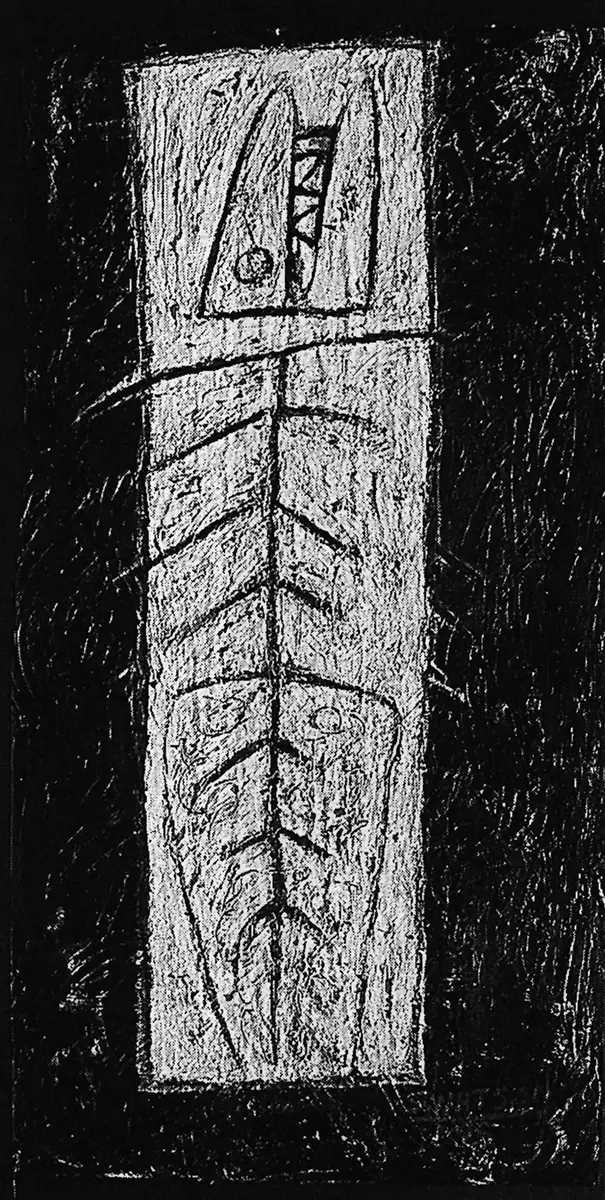
Dogs are the only living things introduced into Watson's works as carriers of a mood of cautious pessimism. In Fish, Pet Fish! Friend (?) Enemy (?) The Story of our Lives, the profile of a fish conveys an iconic message of uncertainty. The highly schematic nature of the representation of this creature immediately reminds us of prehistoric cave paintings. Although no specific references to Taíno pictographs are present, we sense this to be an important component of the artist's storehouse of symbols that lies just slightly below his consciousness and are available for gleaning at any time.
The painting of Stanford Watson represents the vigorous prowess of the visual culture of Jamaica, a nation whose artistic traditions are among the most diverse in the Caribbean.
NOTES
1. The historians who have been most active in charting the course of Jamaican art have been David Boxer (artist, art historian, and Director of the National Gallery in Kingston) and Veerle Poupeye-Rammelaere. Among the most significant sources are Boxer’s, Five Centuries of Jamaican Art (exhibition catalog, Kingston, National Gallery, 1976), The Inluilive Eye (exhibition catalog, National Gallery, 1979), and Jamaican Art: 1922-1982 (exhibition catalog, Washington D.C., S.I.T.E.S., 1982). For a concise history, see Poupeye- Rammelaere’s essay in the exhibition catalog Otro pais: Escalas atricanas, Las Palmas de Gran Canaria, Centro Atlantico de Arte Moderno, 1995, pp. 37-46.
2. Rex Nettlerford, "Caribbean Cultural Identity" in the exhibition catalog Caribbean Visions: Contemporary Painting and Sculpture, Alexandria, Virginia, Art Services International, 1995, p. 37.
3. See the series of articles by Gerardo Mosquera in Arte en Colombia beginning with No.45,1990 on the subject of the African presence in Latin American art. See also Yolanda Wood, De la plastica cubana y caribeña, Havana, 1990, and Wood (ed.) Las artes platicas en el Caribe, Havana, 1993. See especially pp. 12-14.
4. Petrine, Archer-Straw, "Many Rivers Crossed," in New World imagery: Contemporary Jamaican An (Exhibition catalog), London, National Touring Exhibitions, 1995, p. 15.
5. There have been few essays written on the art of Watson. See the exhibition catalog Otro país (op cit), p. 173.
6. Andrew Hope, "Stanford Watson: A Courageous Artist," Splash (Kingston, Jamaica), Friday, 8 March 1996, p. 23.
7. Personal statement, provided to me by the artist.
EDWARD J. SULLIVAN
He is a Professor of Art History and Chairman of the Department of Fine Arts at New York University.