
To approach the work of Teresa Serrano involves a skillful hermeneutic exercise if we are to capture the superimposed line of argument which extends over various themes and repeated concerns already reflected in the artist's earlier work. Behind the formally reductive and minimalist appearance, there is a discourse that does not shun controversial arguments about gender, conceptual framework, or political implications. In reality, the separation of these areas of thought, although useful at the analytical level, is the first point called into question by Serrano's work, with its anti-Cartesian sensibility calling out for an indissoluble fusion between body and soul.
This attitude is reflected in the anthropomorphism implicit in the artist’s desire to construct an object whose appearance is industrial and self-referential, to pervert its essence by covering it with a mantle of lace, or to keep a pair of woolen, hand-made gloves in it, endowing with a pink light or adding a useless tube of glue which gainsays any functionalist hypothesis.
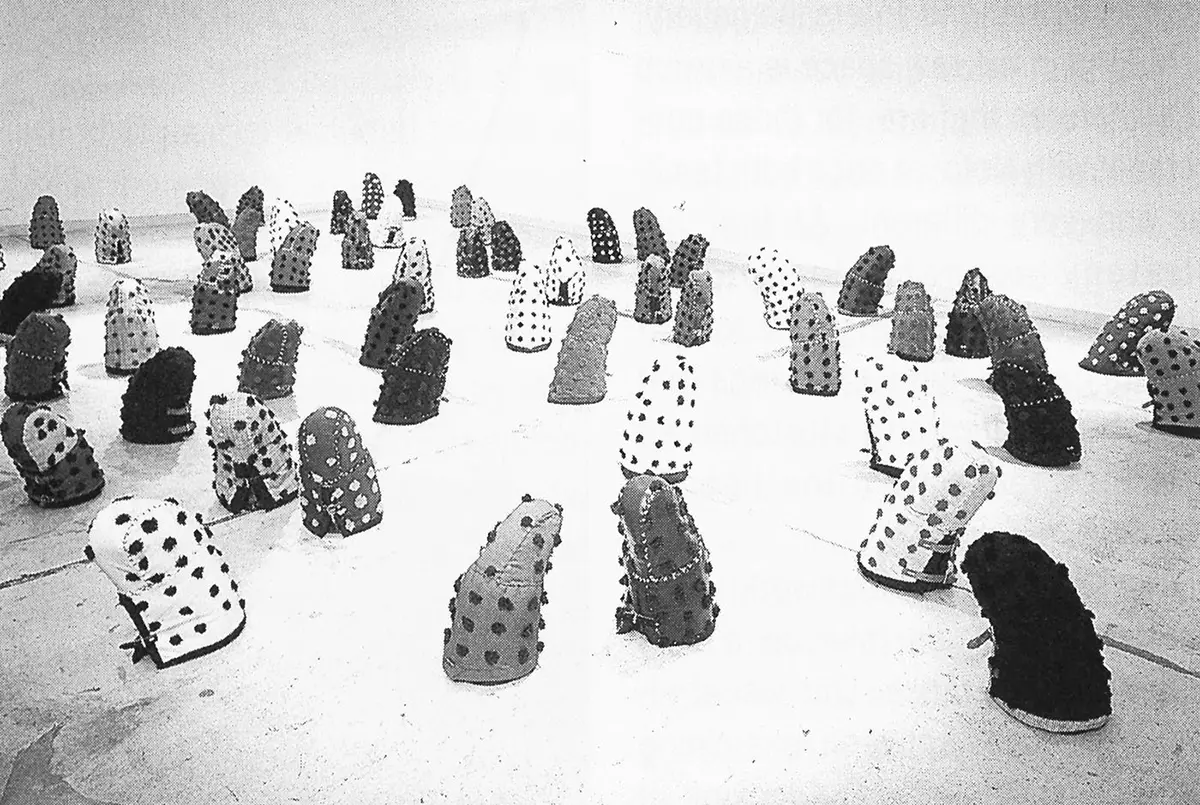
Boxes with an explicit geometry, pieces of polished metal, and mirrors already herald the imperfections in the finish, pulsations which will increase as the contents become containers. These boxes, which contain human, female, erotic, and organic elements, open up to show the inside in another installation work, titled 52 Weeks, 52 Years, where the embroidered mantle is once again the protagonist, and the metallic structure embodies the hidden soul. These little mounds emerge from the earth to form a growing landscape which, in the words of the artist, is a reflection on the themes of "nature, femininity, protection, and strength." There is something of the baroque in this change in the location of the gaze, in this interplay of points of view and options in visual syntax which gradually establish a specific and personal discourse.
This installation can be traced back to such works as The Mountain, the River, and the Stones, in which the bedspread recalls the protection used for horses in bullfights. Traditionally carried by men, although the manual sewing would seem to suggest an exercise of feminine cultural domination, these mantles evoke disturbing analogies with life cycles.
The desire to make her objects into “traces left by a thinking body” leads the artist along the transgressive path of the union between opposites. From the use of a color code in which symbolic representation is an obvious feature, to the manipulation of handicraft techniques in which the manual nature of the work is omnipresent, there is a clear attempt to fashion a complex cultural construction within a minimalist context where readings are by definition, unlikely. From the intertextual references to the system and the construction cycle of the Aztec pyramids, or visual features based on the colonial heritage, to the more recent proclamations of the modernist avant-garde movements, ideological support makes no concession to simplification: the resulting fabric is a dense mesh of historical and social circumstances.
Teresa Serrano belies the myth of intelligence as synonymous with the male, hyper-rationalist imperative, and she does so with a sure sense of gesture, which is full of life, intellect, sensitivity, irony, and even a dash of benevolence.
ANA TISCORNIA