
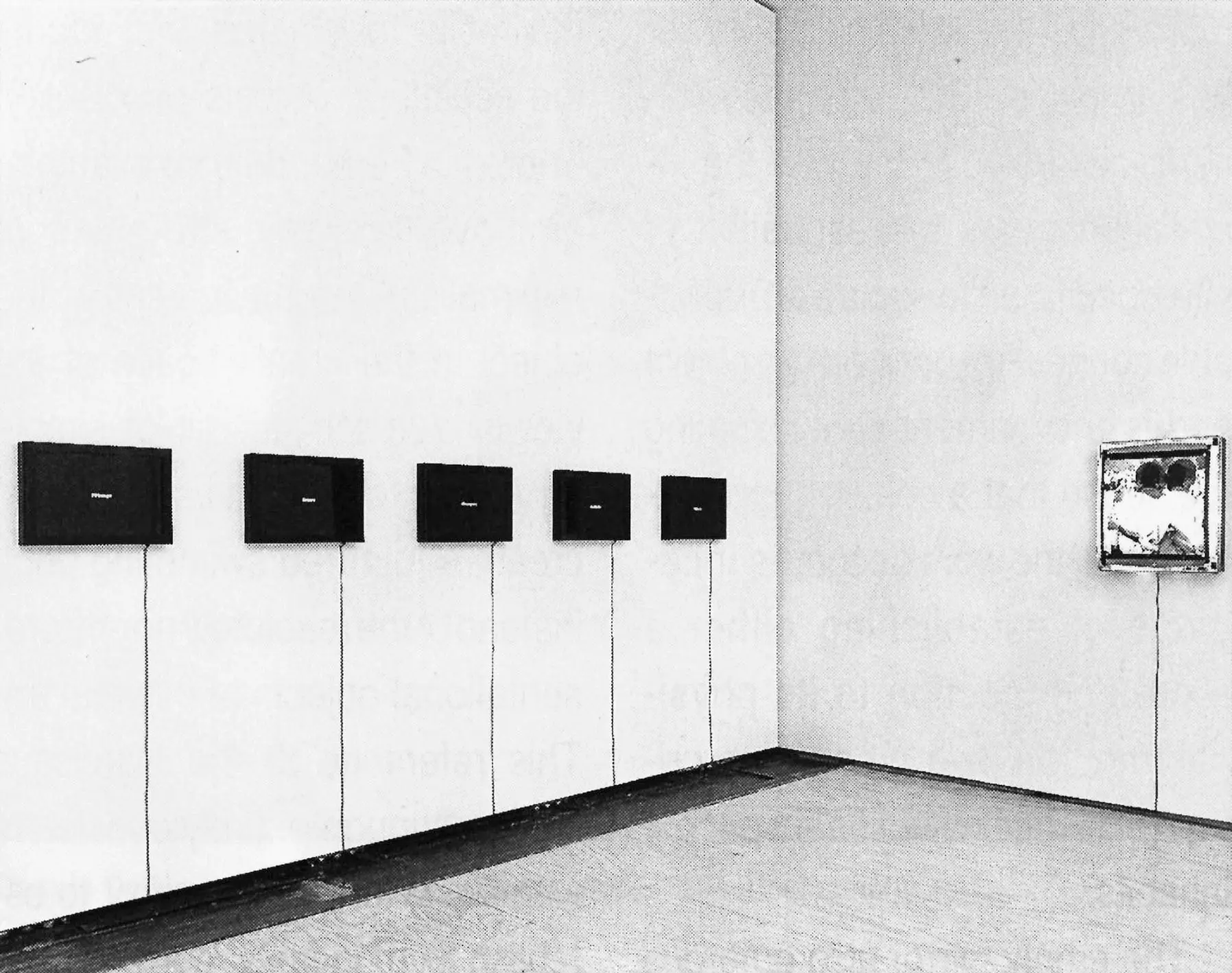
Organized by Carlos Basualdo, independent curator and senior editor of Trans>arts. culture. media, The Crystal Stopper brings together ten contemporary artists who, although diverse in nationality and age, share a common aesthetic discourse that blends aspects of post-minimalism with conceptual art. The artists represented are equally united by their interest in self-reflection and reflective surfaces, and the word "crystal" in the exhibition’s title refers to the material substance of its theme-the mirror. But like all mirrors, this one has two faces (at the very least).
The first, which might be called the mirror of the passing glance, confidently reflects a number of ideals to which the institutions of art currently aspire. For example, through the choice of its participants, The Crystal Stopper promotes a view of contemporary art as inherently international. And much to its credit, the show falls back neither on the tokenism of elevating “exceptional" minorities to a European tradition nor on the reductions of multiculturalism, whereby the work of an artist is conflated entirely with the fact of his ethnicity. Instead, in a postmodern twist on the utopian goal of a universally accessible language of abstract art, the mirror serves as a new transnational category, in relation to which such culturally diverse practitioners as Dan Graham, Alfredo Jaar, Sophie Tottie, and Andre Tarkovsky all carry equal weight.
The goal of expanded dialogue around a particular theme is further reflected through The Crystal Stopper’s emphasis on collaborative work. This appears most obviously in the exhibition’s inclusion of two artist-teams, Quisqueya Henríquez and Consuelo Castañeda, and Dolores Zinny and Juan Maidagan, but are also enacted on a more subtle level in Basualdo's curatorial approach, which combines the selection of pre-existing pieces, such as Dan Graham's Body Press from 1972 and González-Torres’ 1992 Untitled (Fear), with ones commissioned and conceived specifically for the show. An accompanying text, Under Glass, offers a poetic account of the dialogue that ensued from Basualdo’s query to a group of artists "to think about mirrors," and the results of this encounter are works that respond not just to their stated theme, but also to the objects that surround them, and the gallery space as a whole. Indeed, the elegant orchestration of silvery surfaces and minimalist cubes unites the show as much as its meditation on the mirror.
It is easy enough to experience The Crystal Stopper entirely on the level of the passing glance, quickly registering its formal coherence, international scope, and interest in site-specific work. But this would be to miss the show's deeper reflection on its theme, which can best be described as the construction of the empty mirror. For, as Basualdo himself observes, the works presented either refuse to return the viewer’s gaze or erase him entirely from the field of their reflection.
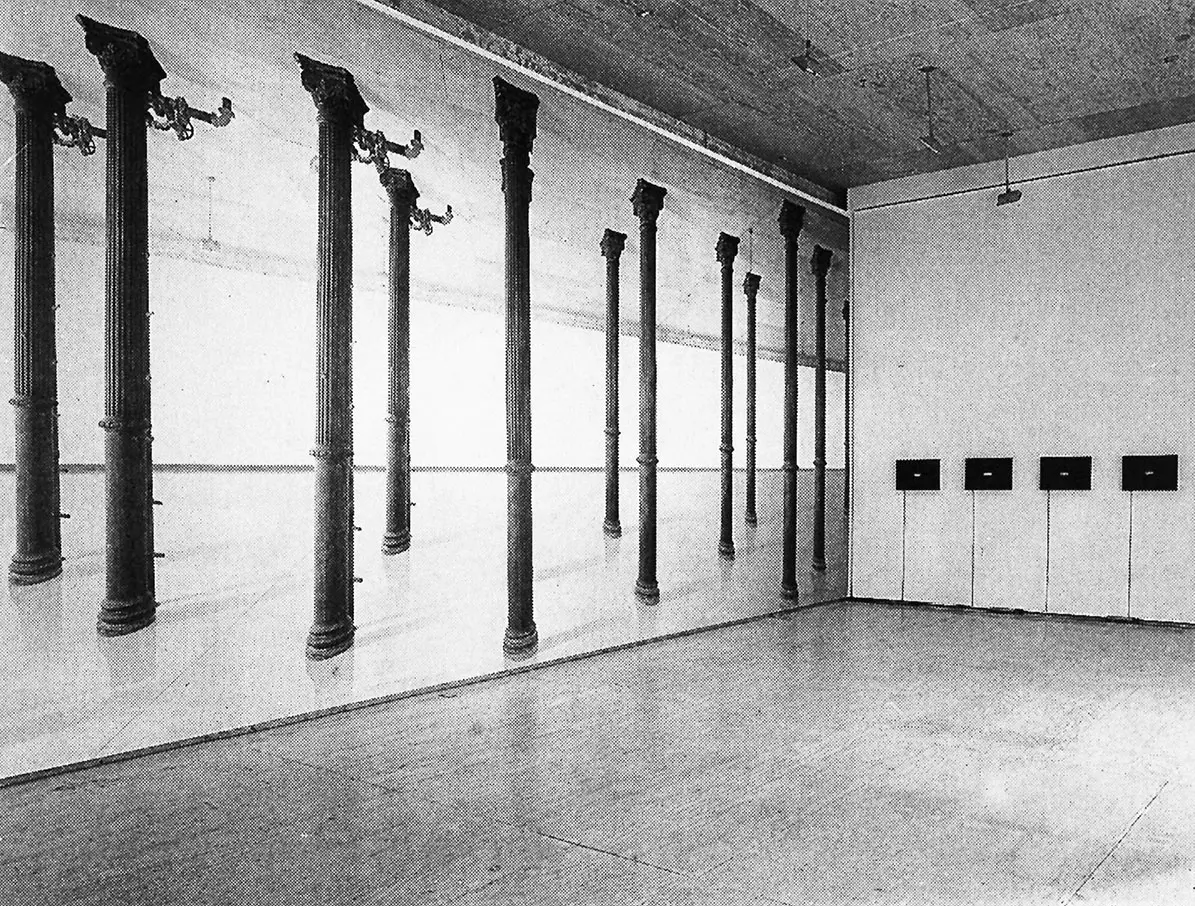
The mirror's function is most insistently undermined by one of the show's two site-specific installations: Untitled by Henríquez and Castañeda, a photographic mural lining both walls of the gallery’s main room that replicates the architectural contents of the space (columns, floor, ceiling) and then multiplies them ad infinitum as they pass from one side of the room to the other. The effect is a hall of mirrors, but one in which the viewer has no place. Still, perhaps even more disturbing is the way the installation treats the aspiration of site-specific art to secure an irrefutable connection between an object and its environment. By eliminating the sense that a coherent site exists at all, the work becomes incapable of establishing either a rooted connection to its physical location or a discursive critique of the institutional space it inhabits.
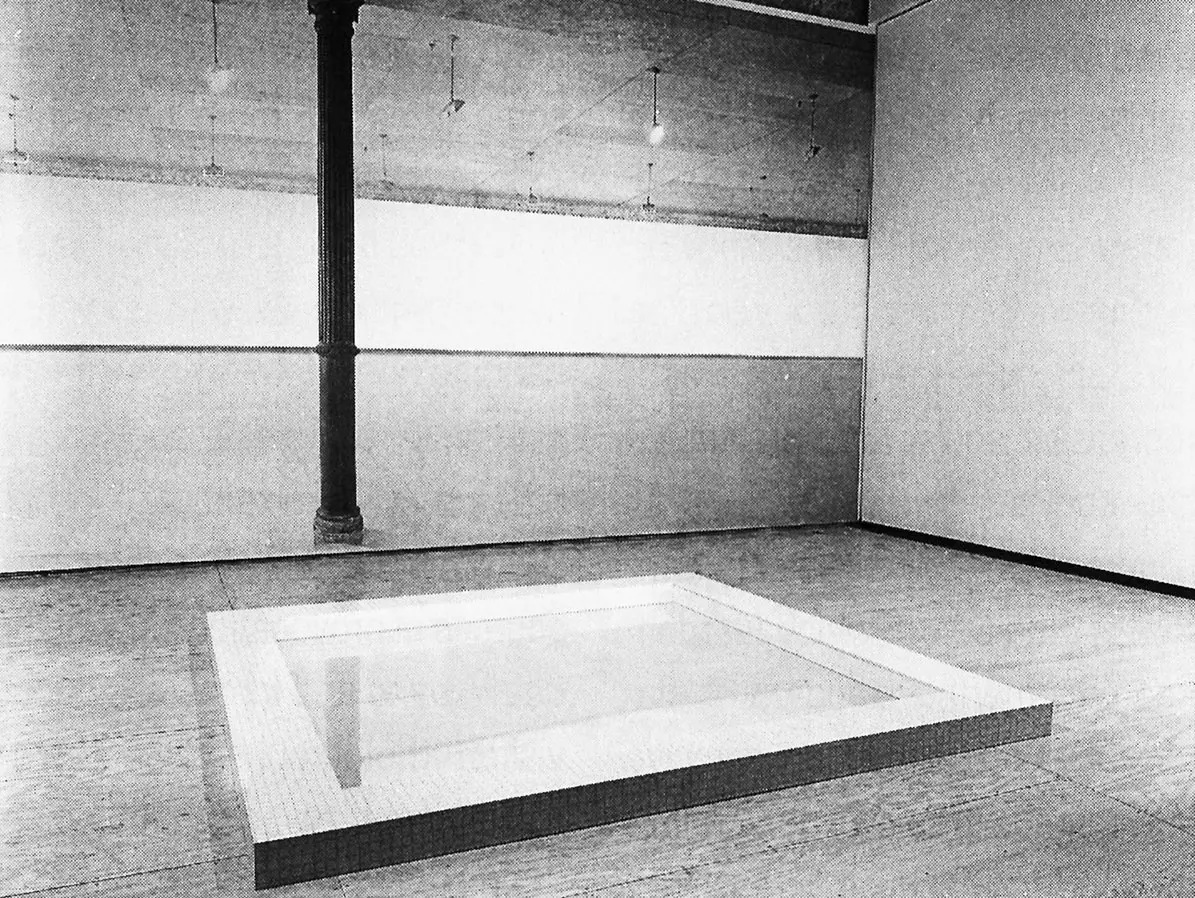
The empty mirror also emerges through the pictorialization of minimalist aesthetics that marks the sculptural objects on display. Theresita Fernández, for example, employs two key strategies of minimalism-the placement of the object in the "real" space of the viewer and the gestalt of simple geometric forms-but uses to create a mirrored swimming pool, instead of the resolutely non-representational objects of minimal art. This reference to the Narcissus myth, although entirely consistent with the failure of the mirror to establish fixed identity, goes entirely against minimalism’s grain, which strove precisely to overturn the illusionists mode of representation associated with Narcissus in favor of a phenomenological model based on the mutual physicality of artwork and viewer.
Indeed, the aesthetic discourses to which the works in The Crystal Stopper refer site-specificity, minimalism, and conceptual art-share the common goal of establishing a new communicative function for art (and a new form of self-knowledge for its viewers) that does not depend on the tradition of the mirror. By transforming these models into empty mirrors, The Crystal Stopper addresses the failure of contemporary art to reflect those who produce it on the most profound level possible. Although alluding to a hall of mirrors, The Crystal Stopper feels more like a graveyard-one where both the traditional illusionistic function of art and the strategies devised to oppose it, assert the failure of their aspirations with the silent tenacity that is the dead’s last recourse to speech.
MARGARET SUNDELL