
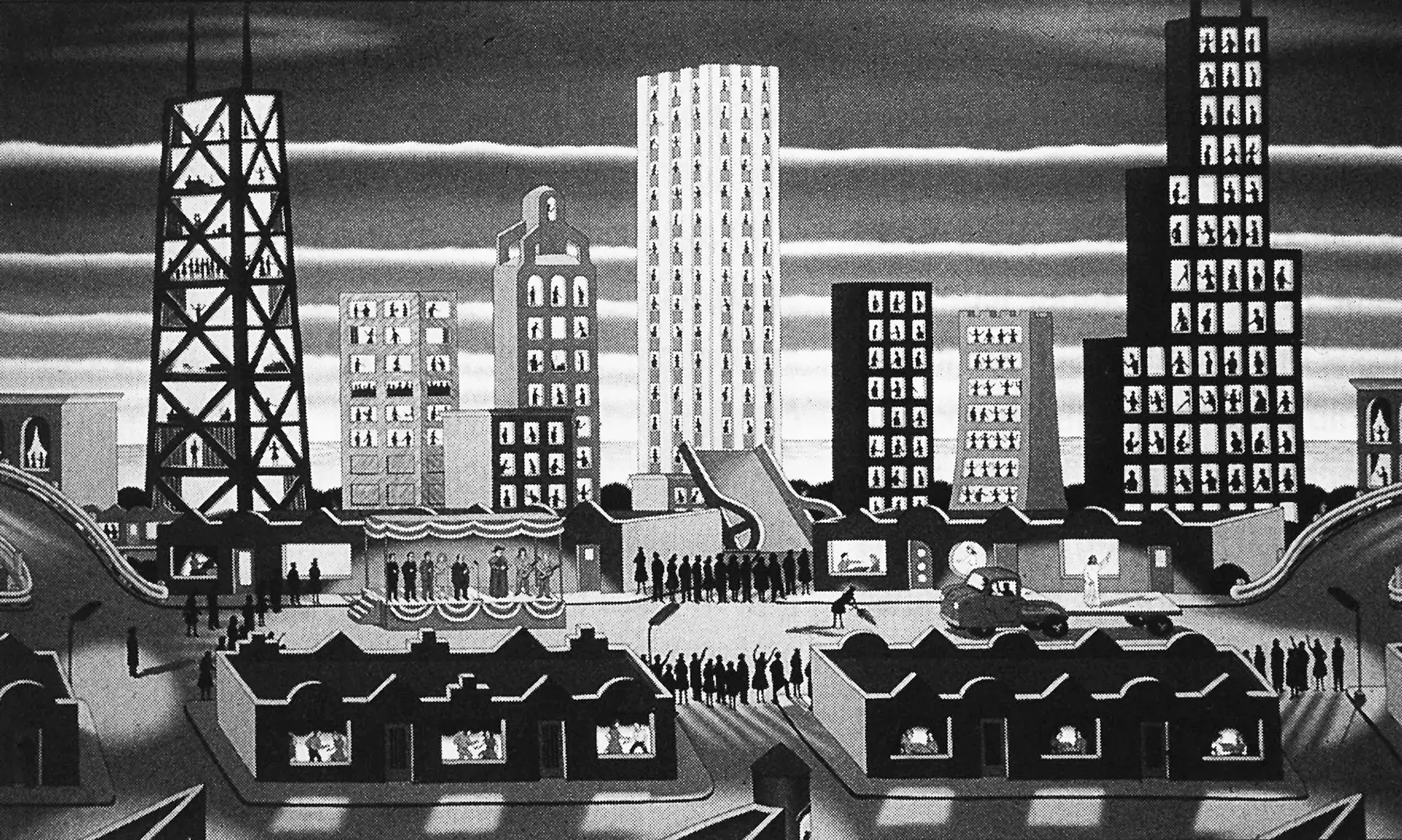
The recent exhibition Art in Chicago: 1945-1995 (November 16, 1996-March 23, 1997; organized by Lynne Warren) occasioned debates both about the existence (or not) of Chicago Art and (yawn), about whether anyone really cares about the question. The former took the shape and temperature of a family feud, with virtually every newspaper and magazine in the city arguing about who was and was not included, which works were, or should have been selected, and so forth. The latter, meanwhile, reflected a perennial ambivalence about the specificity of being "regional" rather than “international" much the same as this question spawns elsewhere in secondary markets in the art world. What is perhaps most interesting about the show, however, is the way that it embodied an ideological position that can be said to characterize its host institution, the Museum of Contemporary Art, as it cements a new identity to match its new $47 million building.
In keeping with current trends in exhibition practice, Art in Chicago was heavily contextualized. An informative chronology introduced each section of the display, taking care to give ample political, art historical, and socioeconomic information within which to locate the works on view. The show was amply “diverse-paying special attention to African-American, Latino, outsider, gender, and political "issues." A certain didacticism could be noted, along with a display strategy that was apparently reflective of the pressures to include works lacking it.

It is hard to imagine a suitable method for summarizing or elucidating the art of a city or the artistic identity of a city. Critiques of this show centered on its historiographic exhibition method which sacrificed the austere clarity of more typically modernist display, i.e., its segregation of “Time Arts” (performance, film, and video) into a physically and aesthetically separate realm; its mixture/conflation of (depending on who you ask) different artistic categories including those of art school-trained and self-taught or “Outsider-artists; its inclusion of way too much art, not enough artists, or too many artists, its defensive localism in the face of NY-centrism. It has also been noted that Art in Chicago made extensive use of the MCA collection in compiling the show’s checklist (about one-third of the show), possibly encouraging reading of it as a history of the MCA rather than a history of Chicago art. Each possible curatorial approach is obviously limited by its own parameters, a more focused selection, for example, would doubtless have been subject to even more intense criticism of exclusion, while the encyclopedism of Art in Chicago left it open to the many complaints about its messiness. In fact, the show’s sprawl and eclecticism raised the question, at least on formal grounds, about whether or not there was any sensible way to talk about a “Chicago" art. Does Chicagoism make any sense? The answer provided by the exhibition fits perfectly into contemporary postcolonial discourse: yes and no. Yes, at one time, it did and no, today it no longer does.
Art in Chicago traces a general history that moves from Imagism, the Hairy Who, Outsider Art, and other local signatures to a Neo Conceptualism currently practiced by Chicago artists. The first, heavily inflected by figuration, a penchant for the grotesque, and a local collecting tendency that had leaned toward Surrealism, is generally conceded to be the “Greatest Hit” of Chicago art, the city’s most recognizable pictorial icon. Imagist history, as described in this exhibition, is constantly looking over its shoulder to the east (New York, that is), going into tailspins on the occasion of bad reviews and/or inattention from that center. But the Neo Conceptualist works which lie at the end of the exhibition’s trail, are made by artists who describe themselves specifically as practitioners of an «international language." They live here, they work here, but the art is not of here, or of anywhere else that is defined by the parameters of place. In other words, Chicago Art since World War II has moved, broadly speaking, from "Chicago" to “Beyond."
It is worth noting the position of Art in Chicago within the context of the Museum of Contemporary Art in its current trajectory. Art in Chicago is the second exhibition to fill the new MCA’s galleries, following the former Chief Curator Richard Francis’ intellectually ambitious, globalizing exhibition Negotiating Rapture. It is tempting to read the two as a pair. Rapture with its insistence on the use of an “international" voice to open the doors of the city's new museum, took place amidst a seemingly endless stream of press releases trumpeting the size of the building—the largest, we are assured, devoted to contemporary art in the whole of the United States, (a newly-announced Website is also apparently in this category) The (relatively) extreme particularism of Art in Chicago, the edifice’s second inhabitant, stands in marked contrast to the expansive discourses staked out by its predecessor. But don’t worry-the local, it turns out, is no smaller or less important than the global, if you approach it in the right way.
I have been struck by the parallel position that the MCA, as an institution, has gone about declaring for itself vis-à-vis the world. It is here in Chicago, yes. But it is always described in terms that relate it to the world beyond the city. Its exhibition program panders neither to local histories nor local constituencies, but rather insists on global citizenship at its core. Art in Chicago, then, can be seen equally as an articulation of the institutional strategy of the MCA itself, alongside the exhibition’s more pedestrian function as a survey of artistic practice. It argues for an understanding of Chicago as important in itself precisely by virtue of its ranking as a “world-class" city. It has transcended the need for local identity.
The history we have before us, then, is a parable about location. Once upon a time, we believed geography to be important, even central, in defining who we are as artists and as a public. In the 1970s, the last time that Chicago had a visual "look" that was identifiably its own, that very look was developed in defiance of the second class reputation according to the city by New York and absorbed into a local complex. Chicago’s scrappy ambition to turn the city into an artistic destination now seems sadly out of date; its dream of local fervor and singularity replaced with a savvy recognition of the local advantages that come with the adoption of global rhetoric. It is perhaps a parallel phenomenon to the shift in curatorial voice, from idiosyncratic narrative to institutional platform.
RACHEL WEISS