
Apart from the official exhibition places, such as the Georges Pompidou Center, the new rooms of the Jeu de Paume, and the Museum of Modern Art of the City of Paris, the French capital has a serious lack of non-commercial spaces in which to present modern and contemporary art. There are no important alternative venues, not sufficiently large and well-located places to house "historic" shows or to present the work of artists important to art today, especially when they are absent from the network of the large contemporary art fairs.
The Couvent des Cordeliers (constructed in the fourteenth century, with a chaotic history, particularly during the Revolution), was opened as an exhibition center in 1991 and is one of the rare places outside the museum network where artists can show their work in Paris. Managed by an association linked to the Paris Town Hall, it has an atypical kind of programing, unhindered by commercial demands or passing fashions, and has endeavored to present, in a spirit of diversity, the history and artistic adventure of the twentieth century. Tending rather show work by artists who have to belong to the School of Paris —whether French or foreign— it has offered several exhibitions related to this period. Artists from the South have had a more modest place, although one of quality: in 1992, there was an exhibition of work by seven artists from Oaxaca, including Franciso Toledo and Sergio Hernandez; and a few months ago, an African program with musicians and plastic artists, including the Ethiopian Bethe Sélassié and the Moroccan Mohammed Kacimi.
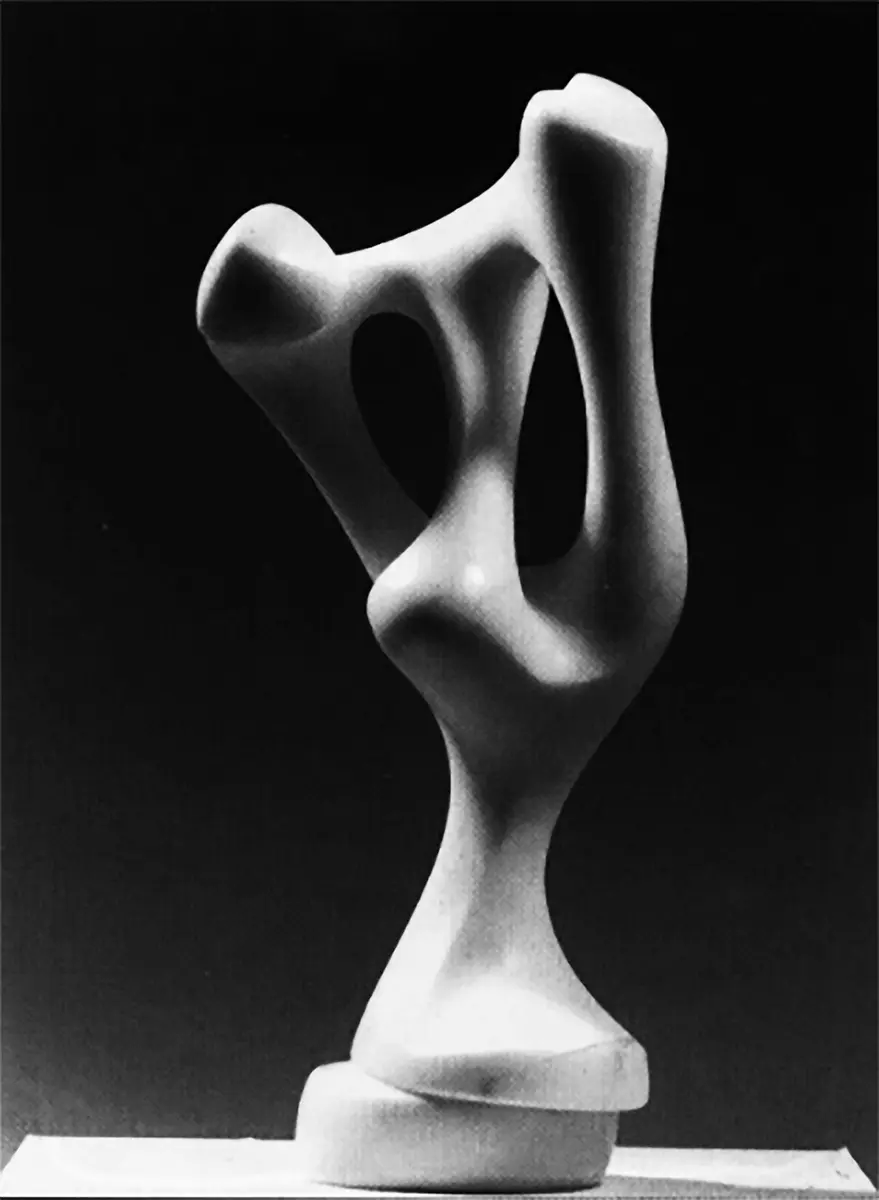
The current exhibition of work by Agustín Cárdenas confirms this healthy eclecticism. The retrospective was prepared on the initiative of Ms. Cárdenas-Malagodi, using exclusively private funds, and has come to Paris after being first shown in Milan. Ms. Cárdenas, who is also the commissary, was also the only person who loaned works for the show.
Cárdenas is a member of a generation of young Latin American artists who chose to take up residence in Paris at the beginning of the 1950s. In most cases, these artists stayed for a limited period, including Jacobo Borges (1952), Lygia Clark (1950), and José Luis Cuevas (1955), amongst other young artists who were to establish contacts with older artists who had definitively settled in Europe, such as Roberto Matta and Wifredo Lam. This group was an active and invigorating ingredient in the Paris life of the time, very integrated through various exhibitions and the support given by French writers, with that of André Breton being of capital importance. After having written on Lam, Matta, and Tamayo, Breton was to write about Cárdenas’ work on a surrealist group show which he organized in Paris in 1956 (L'Etoile Scellé Gallery). This was to be the first major exhibition for the Cuban artist in the French capital. "From his fingers, there has sprung an enormous totem in flower which, better than a saxophone, throws back its shoulders like a beautiful woman." In its reference to Africa and nature, Breton’s evocation emphasizes the erotic-poetic dimension of the sculpture of the young Cárdenas which was to become one of the touchstones of his work.
The retrospective at the Couvent des Cordeliers was both courageous and of a high level, although the presentation would have benefited from a tighter mise en scene. The 39 years of Cárdenas’ residence and creation in Paris are represented by an excellent selection, with works in wood reflecting Africa alternating with others of a more organic kind, in bronze or marble, close to the surrealist current. The show presented 38 sculptures along with 40 drawings, ink works, and gouaches. They included certain magnificent pieces in white and black marble from the 1970s, such as Dogon (1971), La Question (1973), Le Corps (1974), as well as Iroco (1967), and Le repos d’Orphée (1980-1981). In some of the last works from the 1980s, there is a sort of shrinking, a weakening of the organic element which lacks the joyful and magical communion and sense of soaring characteristic of his earlier sculptures. Various techniques —wood, bronze, marble— and different dimensions alternate, making the chronology sometimes a little confusing to follow, with the show offering a kind of fragmentary view of the work, the principal vector of which is its sense of aesthetic pleasure. The visitor may also be somewhat put off by what was almost a forest of sculptures (in this case, the museography had to cope with the disadvantage of the line of thirteen huge wooden columns which hold up the roof, giving a longitudinal rhythm to the main room the rectangular form of which is barely interrupted by four perpendicular moldings). The drawings were all of the high quality; some were in the purest tradition of the automatic writing of the surrealists, others were preliminary sketches for three-dimensional works. They should have perhaps been shown in a more intimate room, separate from the sculptures - a solution adopted at the simultaneous Fernand Leger retrospective at the Georges Pompidou Center. The major work - i.e. the sculpture, in the case of Cárdenas - would therefore have had more space to breathe, and such an arrangement would have provided the visitor with greater visual tranquility, more conducive to both the mind and the eye. It would also have allowed a reflexive and distanced recentering of the stylistic, linear, and spatial solutions of the artist.
One of the essential qualities of Cárdenas, which this exhibition highlights, is his capacity to move from the smallest level to the largest, to change material and technique without any problem in the scale or status of the work. It is in a spirit of duality —day/ night, black/white, inside/outside— that he creates horizons which are at the same time mythical, sensual, and spiritual and in which Cárdenas expresses himself with a characteristic erotic force to create a space-time impregnated with the three cultures which are his - the African, the American Indian, and the European. This vital, phallic-ovoid tumult is in the line of Brancusi, Moore, Tanguy, Dalí, and Miró... But it is in the African inspiration that Cárdenas finds himself and reaches us, the spectator. The African dimension attains the universal, and as Edouard Glissant pointed out in 1968, "even more by the tranquil challenge to time which presses, by the faultless presence and the shadow under the branches. Consider its slow progress from the first night, see how it denies disintegration and completion. See how it assembles the memory of the future." Something which French surrealism alone could never have given him.
To pay just tribute to the work of Cárdenas, who is today very ill and living in Cuba, is a welcome initiative, in a city like Paris which is often ungrateful, where this generation of Latin American artists with links to surrealism is now a little forgotten, as in the case, for example, with the Mexican painter Alberto Gironella. Cárdenas' last great one-man exhibition, titled Thirty Years of Sculpture, was presented in a private gallery (JGM) in 1988.
CHRISTINE FRÉROT