
The Botello Gallery recently exhibited a collection of drawings and mixed media works by Antonio Fonseca Vázquez. Each piece was based on situations that fluctuated between reality and fantasy, with the artist revealing his virtuoso skills as a draughtsman in each work. The variety of optical effects achieved by the linework managed to keep the spectator’s eye in a constant process of moving through the different variants of the artistic discourse.
The artist skillfully inserts details or hints which allow us to explore the motivation behind his inspiration. The work can be seen as a response to existential demands which have been worked in a spontaneous manner.
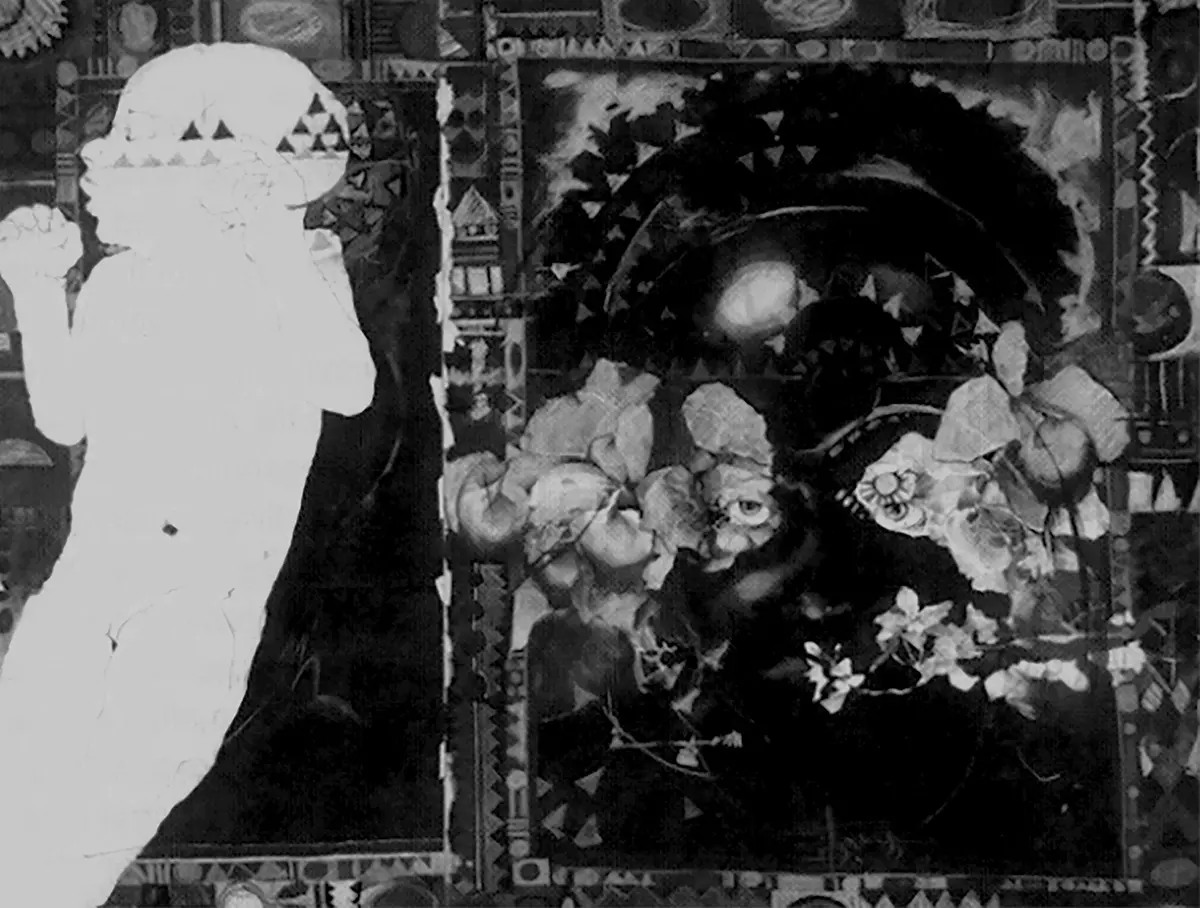
There is a tendency in these works to use all the space provided by the surface. Occasionally the charcoal is alternated with a well-orchestrated chromatic flurry, as in Psycho, a work which breaks the established canons concerning format as it is intended to be shown in a corner. The composition overflows onto the wall, reflecting the artist's intention not to remain confined by hackneyed formulas that have become atavistic. Another interesting aspect is the artist’s tendency to allow his figures to fade gradually into white backgrounds. Since white synthesizes all shades and at the same time, concentrates light, it oscillates between flashes of resplendence as if sculpted by them.
In other words, Vázquez resorts to more secular traditions, as in Baquiné I, a gathering of little angels which offers an interpretation of an Afro-Antillean ritual practice: he shows the child in the act of ascending to the celestial realm. The child is white, like the child lying on the table in the famous scene by Francisco Oiler. Fonseca divides the space in two, as if about ancient pagan beliefs which separated the world of the living from the world of the dead. The frontiers between the two spheres are full of hieroglyphs taken from the indigenous legacy of the Americas. In the area corresponding to the mortals, there appears a dark face whose scrutinizing eyes seem to be trying to peer into the beyond.
The tonalities in the mixed media works are warm, creating a pictorial kind of tropics that alternates with the depicted silhouettes. One of the artist's objectives is of a critical kind, as in the work titled Pretext for not finishing nature off. For the artist, the title refers to the well-known case of persons who verbally defend the environment but do nothing to protect it. For this reason, they are shown with their arms folded. At the far lower left, there is an effigy of the dollar bill which for the artist is the most denaturalizing agent of all. Confronted by the power of don dinero (Mr. Money)—to use the name coined by the seventeenth-century poet Francisco de Quevedo—human weaknesses flourish and grow until they smother our own nature. So, the protagonists in the picture seem both sad and threatening, perhaps because they are afraid of showing the contradictions of their conduct.
The somber other-worldly atmosphere in which the figures are placed suggests that we are in the presence of the living dead. Fonseca likes to depict contradictory elements in response to real experiences, as in Descorazón Ado y Descorazón Ada, where he explores the theme of the problems of love. The spectator can see the struggle which has taken place between the artist and the images captured on the paper.
JOSÉ ANTONIO PÉREZ RUIZ