
Rosa Olivares writes: "Photography has become a means of interpretation and artistic explanation, a working method that has led artists to probe deeply into territories that without a doubt are located between art and the analysis of subjectivity. Perhaps the difference emphasized in a study of the importance of photography at this moment in history would focus on the visual power of its existence and on the similar power applied to the analysis of the individual and the society in which he lives."1
Eduardo Medici is one of the Argentinian artists who at this moment are turning photography into one of the sharpest instruments of inquiry into the individual and his experience of this moment in history, causing connotations to reverberate in an extraordinarily rich play of language.
A play of language that, furthermore, never pauses to consider itself for its purpose is to attain an objectivization as complete as possible in its nearly ungraspable capturing of the most profound aspects of life as it is lived.
As Gianni Vattimo says, it is a matter of: "Rather, the effort to produce new dimensions wide open with possibility as well and, above all, through techniques [...] Thus, to expose oneself to the experience of these slippages, far from constituting an innocent game, is to engage in risk-taking and the dangers that accompany the shock of an encounter with the truth of being that transcends not only the confines of the genre but rather, and above all, the confines of the serene mastery of any pure and simple aestheticism."2
The work of Eduardo Medici was always startling because of the depth of the problem is posed. From the start, he displayed his humanistic interest through tortured figures that recalled Giacometti. Later, he produced an explosion of color and an investigation into painting as a domain of questions into which he had to insert his own language. In the series The Crucifixions, the human figure appeared covered in signs that revealed, defined, or conjured up his existential angst in being separated from Nature. Present there was the theme of the lacerated, stigmatized body. The body is the surface of the inscriptions of events.3
For him, the body-soul or spirit-flesh opposition, already present in the ancient medieval "Debates", never existed. For him, the body was never separated from its spiritual aspect in a wholeness that exalts the human condition and gives meaning to sacrifice. Sacrifice and ritual are themes that are related to those of eroticism and death, cause for constant reflection throughout his work.
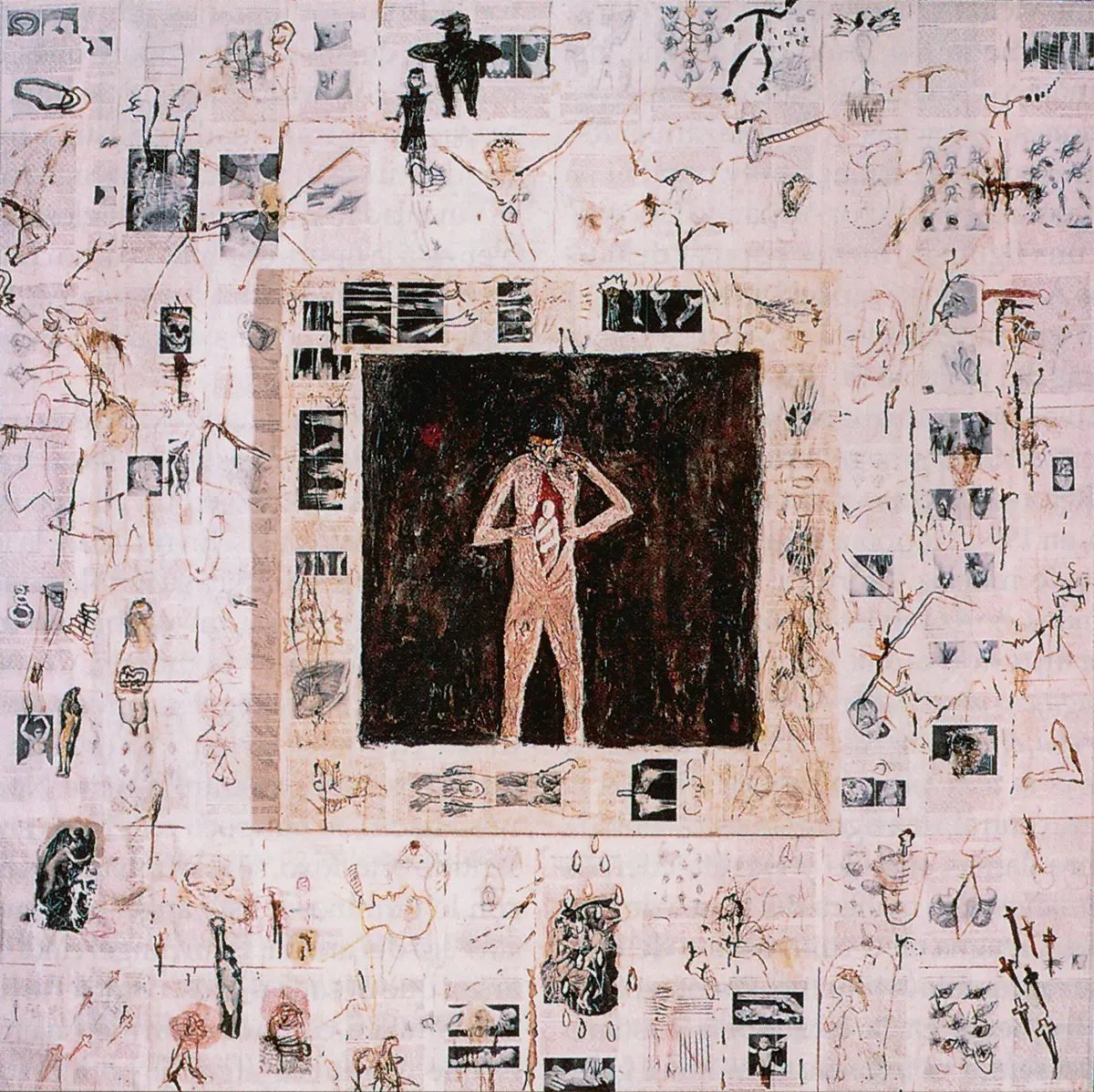
In Autopsy (1992), he organizes the space into three panels, one included in the other. In the central panel, a figure opens its innards to offer up something of itself that gives meaning to its life and its death. As Merleau Ponty says: "he is offering his body to the world that the painter changes the world into the paint. The meaning of the artist's creation is boom precisely out of his ability to see, to illuminate—painfully—that which resists being illuminated and surrendered." To emphasize this reference to the body and to sacrifice, Medici sets in opposition within the exterior panels of this piece, illustrations, and texts from old medical books of operations and wounded bodies. The back panel is covered with transparent vinyl as if by protective skin.
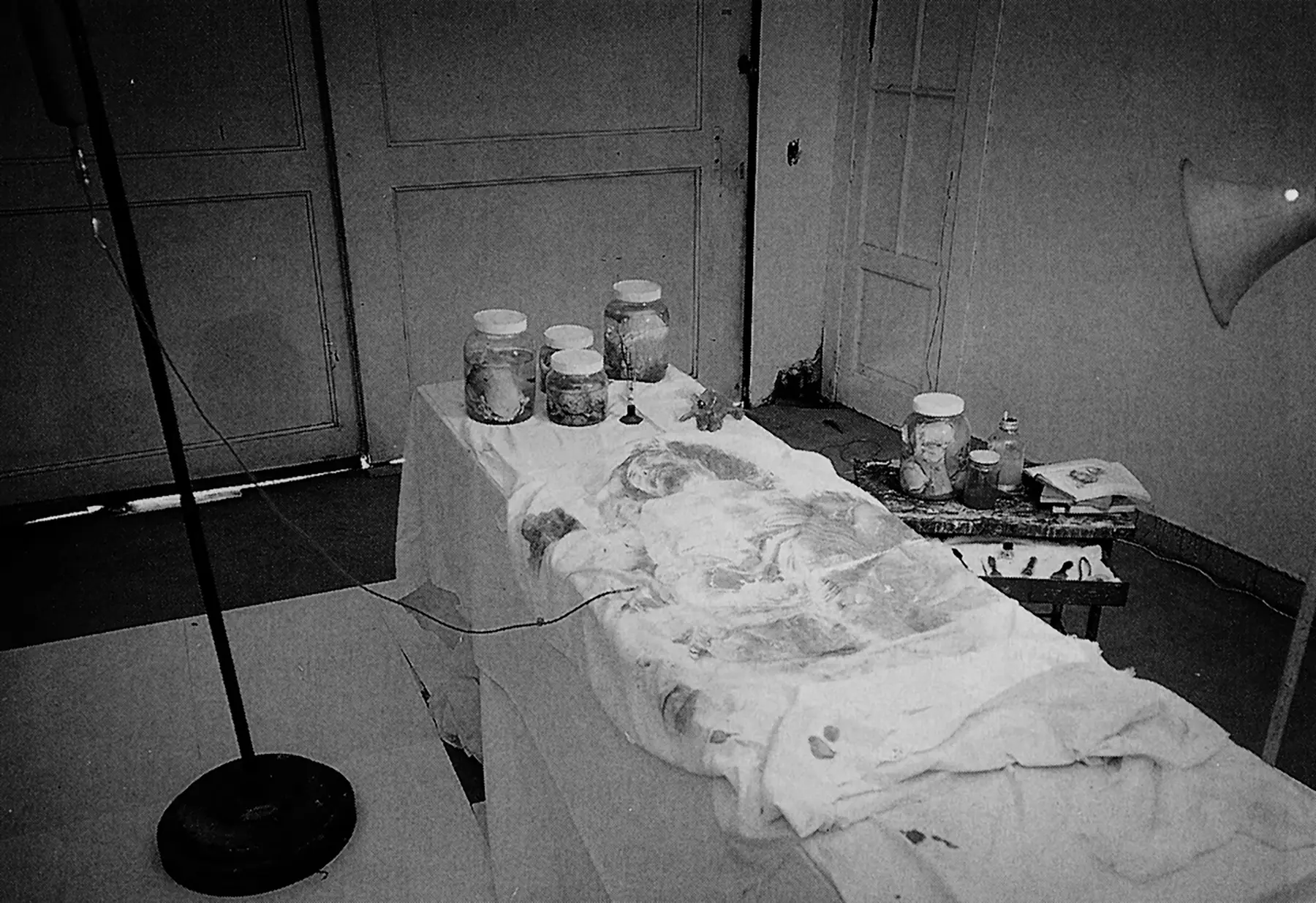
The following year—1993—he presented an installation with similar concerns: The Anatomy Lesson. One entered a room veiled with numerous white canvasses. One was confronted with devices for transfusions, a set of surgical instruments, and a stretcher on which a wrinkled sheet reproduced the Dead Christ of Mantegna. As the artist says: "This work is—or might be—the lesson of a body. It arises from this body and it is this body that begins to inscribe itself in the support-fabric-shroud. Printed, soiled, broken, stigmatized; the body where the world bathes its wounds. The body of pleasure, the body of sacrifice, the body of redemption, the body as the world's stage."4
In this piece appears a phrase by Dostoyevsky: "The most horrific thing is that beauty is not only terrifying but mysterious as well. God and the devil are at battle there and the battlefield is the heart of man. But the heart of man wishes only to speak of its pain. Listen, that I will tell you what it says." Here it becomes evident that Medici is transforming the space of his work into a space of reflection, that furthermore, he needs to break the limits of singular genres and that, for him, words are a medium he includes whenever possible, as being indispensable.
Another example of the use of words is I, Divided in which he returns again to religious iconography. In this piece, heteroclinic elements are presented, laid out as in an ancient codex in which the image of Medici himself appears as a victim, having been split in half, just like the Beatus of Liébana of the Catalonian Romanesque. The text with superpositions, blotches, and displacements, is that of a tango, quite popular in Argentina, that was composed by Armando Discepolo, an equally popular figure in Buenos Aires for his ability to express with grace and wit the character of the typical dweller of that port city. On the decorative border that surrounds the image and text are written Medici and the word "I", repeatedly.
Médici takes up religious iconography again when, in 1991, he composes a work with scenes of death and torture in the horizon a band separated by a text that says: "My flesh is a piece of the hole for crazy people, but history passes through it, language passes through it, the slaughterhouse that is human life passes through it". In the central section, a sinister figure seated on flames devours and excretes human bodies in the fashion of a fresco by Andrea Orcagna in the Pisa Cemetary representing hell. On the other hand, it is common in Christian eschatology to represent hell as a stratified gallery. This sort of illustration—like that of Satan in the mosaic of the cupola of the Baptistry of San Giovanni of Florence or one of the voracious figures of Bosch in The Garden of Earthly Delights—reminds us of Saturn devouring his children. To be human is to be eaten, to be sacrificed.
Related to the previous piece is Sad Tropics in which a beast with three heads appears, devouring and crushing human bodies. The central panel is surrounded by x-rays and superimposed drawings of different sizes laid out with willful carelessness. The sensation of fragility, anguish, and tragic arbitrariness produces a startling effect.
Also related to religious statuary, the figure of the angel stands as a counterpoint to the hellish registers. They are generally solitary figures, embryonic and dormant. They evolved gradually from an encapsulated triangular form into a body on which wings appeared. In fact, the idea of metamorphosis signals its characteristic nature: that of a landscape, a change, a passage between life and death. Like the god Proteus, these angels can take on any form whatsoever. That is why they are so human, why they walk among people. They are neither nostalgic nor religious in an orthodox sense. They are related instead to the numinous. This angel is like the artist's alter ego. It is a fallen angel, an angel that challenges God as does the artist, who, like himself is a messenger: it is he who communicates something, the bearer of the mystery and of a vocation that cannot be renounced.
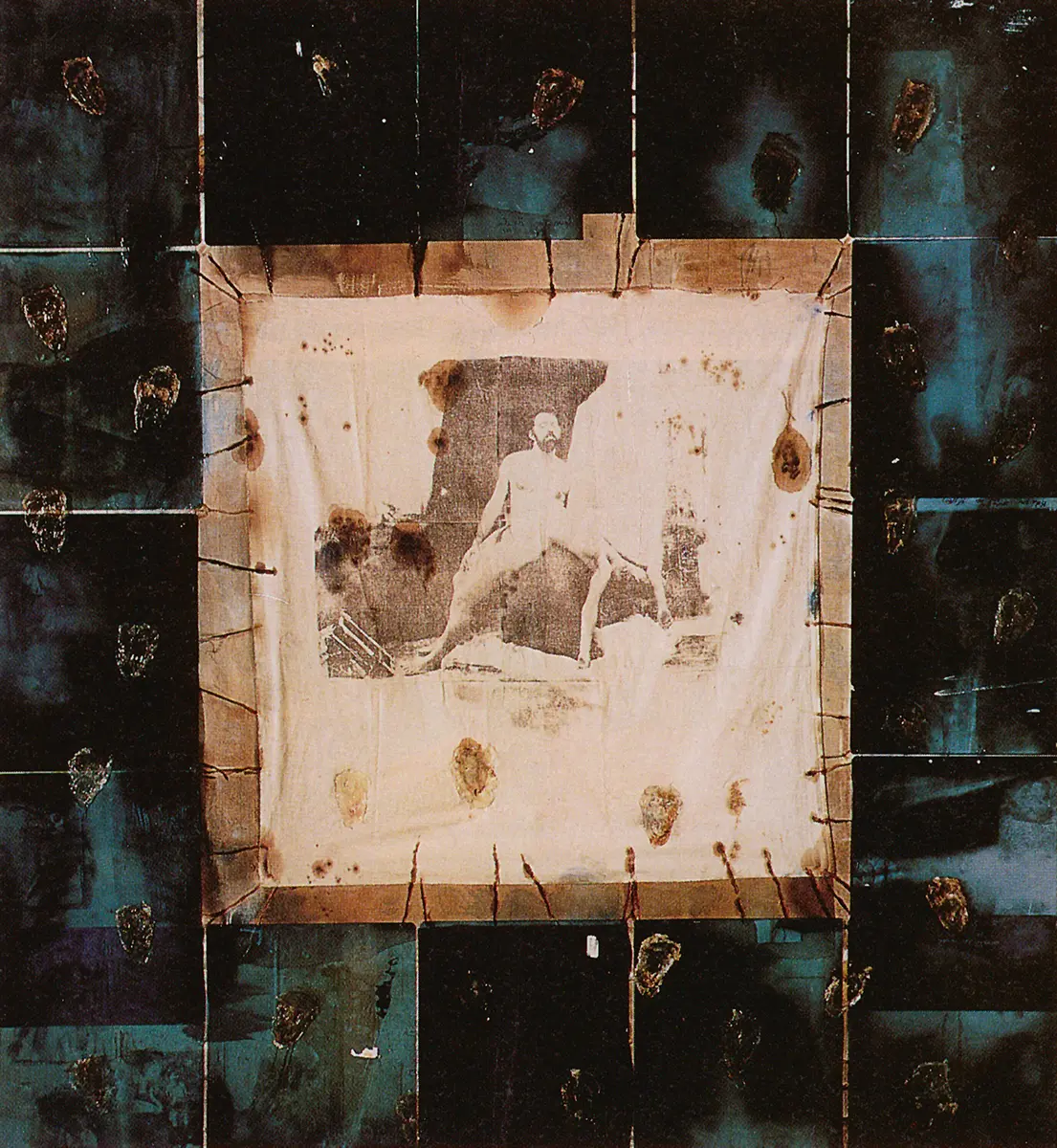
Médici's obsession with the "I" to which we have referred is expressed above all in photographic and pictorial images. In Self-Portraits (1994), his positive photographic image seated with the body of a woman over his knees who has fainted or been sacrificed occupies the central panel of the piece, crudely attached to a frame of x-rays. In this case, the frameworks upon the support discolored it irregularly. With the passage of time, deterioration has taken its toll on the positives and x-rays, but the painter adds on to them his own action. In this case, he induces an interplay between the positive and negative, hierarchizing the central section as he has already done with paint. The manipulation of space might recall ancient Mayan, Chinese, or Western Medieval illustrations.
Médici's faded face is repeated like a trace on pieces of cloth crudely and irregularly sewn together in Untitled (1995) to which he adds the figures of saints bearing his own face, nudes from Western classical art that are barely distinguishable and a border of tiny ID photos of anonymous people. All this light veiled with white paint accentuates even further the sensation of deterioration and homogenization.
Those forms of screening the image, be it with sheets of glass, acrylic, thin layers of paint, or transparent cloth, contribute to the ambiguity that Medici deliberately seeks. An ambiguity that alludes to the immeasurable distance that separates us from knowledge, as much as to the deception of the senses, the fragility of identity, and to death. As the Italian critic, Franco Rella says: "Man is considered part of the vertiginous appearance and disappearance of things in nothingness."5
In August of 1996, Eduardo Medici put on a show in the Der Brücke Gallery in which that order of concerns manifested itself in multiple forms. This exhibition was called Between Me and Me and appeared to respond to the questions posed by the Portuguese poet, Fernando Pessoa, with whom Medici profoundly identifies. "My God, my God! To whom can I turn? how many am I? who is I? what is interval being that lies between me and me?"
In this show, the resources of photography were consolidated. He also realized an installation in which a light was reflected by metal rods severed by mirrors that divided the images while a projector showed a female pubis. The idea of fragility, of reiteration (which helps him to intensify his search,) and the powerful female presence were in evidence as one followed that show to its culmination.
The female nude was already appearing in his pictorial imagery since the eighties as the protagonist of rituals and sacrifices, accompanying the varied and intricate versions of eroticism and death. Woman as emblematic figures—protective uterus or hallucinatory perdition—acquires diverse roles in the work of this artist. It is the woman's body that allows him, through sex, to wage war against death. Death as a limit to time leads him to emphasize his work regarding limits.
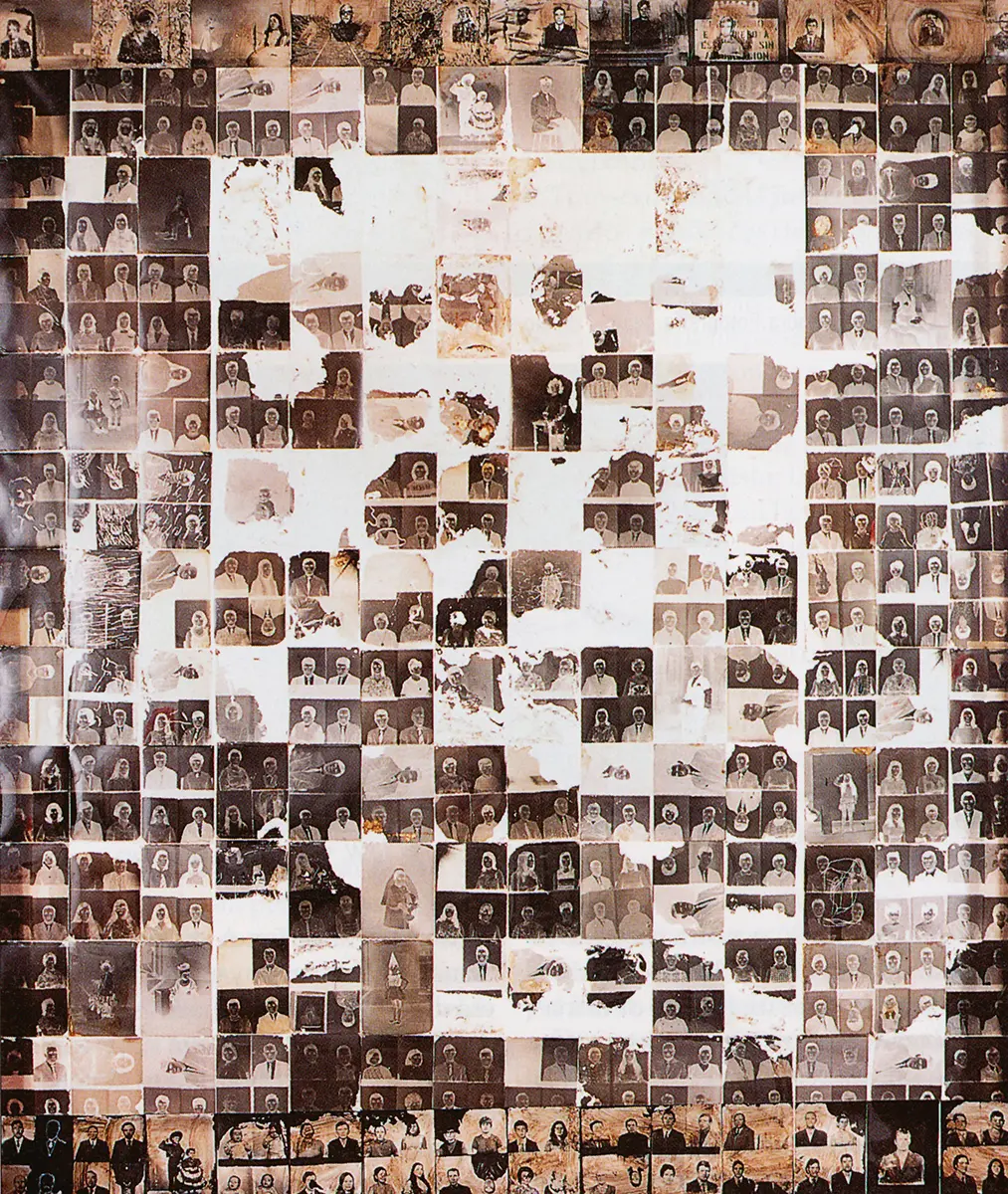
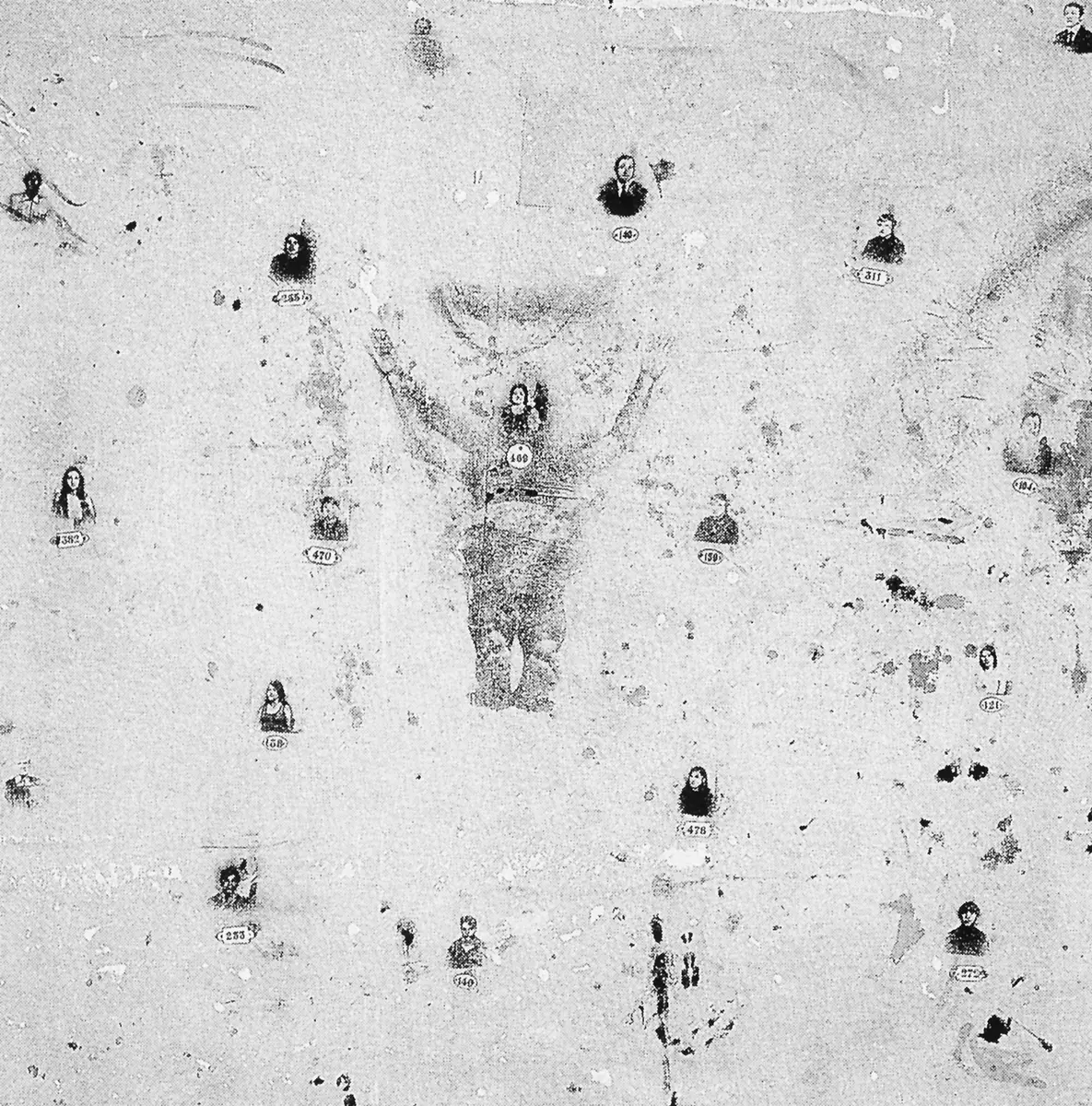
In his piece Who are we, where are we going, Where did we come front? (1996), he makes use of small, wallet-sized photos that entirely cover the space of a piece of fabric, either in the positive on the exterior section or veiled with white paint on the whole of the internal rectangle. They are photos of the sort found in a registry; the models appear without attributes in an impersonal documentalist. If Gaugin responded to these questions poetically, Eduardo Med id seems to vent his anger on the distance, on the actual neutrality, on the conclusiveness of tire state of anonymity. One? many? who are the rest? he seems to be asking himself. But he doesn't stop at denouncing the isolation or lack of communication among his figures: present as well is the idea of the man from a society of masses, of his conversion into a number as in So Much Time, So Much Death (1995) in which each faded portrait is affixed with a dog tag bearing a number which could correspond equally to any kind of administrative identification in a society of masses as it could to the numbering of a concentration camp. The photos come from a highly developed system of classification in modem society.
In other works, the artist would seem to overcome that anonymity by using countless photographs from a specific personal event: a communion or a wedding. In one case, his face is revealed through the back of the central section, surrounded by negatives of social photographs of family events, worked by the artist using dripping and other techniques. In some cases, he uses photos covered by transparencies, as with the Dead Christ of Mantegna and a rectangular piece of cloth crudely sewn with the image, in a distorted perspective, of a body with the head of Che Guevara. The bodies become traces, impressions of cadaverous images that pass through successive transpositions so as to elude literality.
Eduardo Medici constructs his works using photography, but his photographic images are worked as negatives or positives, worn down, splattered, grouped together, and assembled in various ways so that conventional photography disappears in the wake of the artist making use of techniques that have been lost in time (the photos belong to the files of a portrait company that went out of business. The x-rays that made their appearance in a period between painting and photography seem to accentuate that introspective desperation we already perceived in Autopsy.
On tire another hand, the use of photographs—as in his with painting—takes another route to shape his metaphors regarding death, precariousness, the meaning of life and death, always expressed in terms of the body. Eduardo Medici seems to have taken to heart that phrase by Gilles Deleuze which says: "The body is no longer the obstacle that separates thought from itself, what the latter must overcome to be able to think. On the contrary, it is that in which thought submerges itself, or ought to submerge itself to reach the unthinkable, that is: life"6.
Médici represents the body as the stage for life and death, for pleasure and pain, ritual, and sacrifice. This representation is nourished by texts or images from our cultural past and from his knowledge of ancient religions.7 It appropriates new techniques and materials: x-rays, photocopies, photo printing, negatives, photographic emulsion, to constantly fight "the domesticity of the painting"8 and to transcend its limits.
There is also a metamorphosis and a change in the tire body of Iris works which register traces of that change. He raids myth to investigate space, anguish, the rites of contemporary man, and his existential condition in today's world.
NOTES
1. Olivares, Rosa, “El retrato como medio de conocimiento. Cara y cruz," Lapiz Magazine, (Spain), Vol. XV,
127:31
2. Vatlimo, Gianni, “Ollre i confini dell' estetico," Catalog XLV Exposizione Internazionale d'arte, ed. The
Biennial of Venice, 1993, p. 567.
3. Foucault, Michel. Nietzche, la genealogia y la historia.
4. From a conversation with the artist.
5. Perazzo, Nelly, “Encuentros con el angel," EOS; Revista Argentina de Arte y Psicoanálisis, 1994: Num. 3.
6. Rella, Franco, "Metamortosis. Imagenes del pensamiento," Spain: Espaca Calpe, 1989.
7. Cited by Javier Gil in “El cuerpo del arte," Revista Ensayos, 1994,19: 38.
8. An expression that the artist uses in dialogue with Victoria Verlichak, En la palma de la mano; artistas de
lo s ochenta, Buenos Aires: 1996.
NELLY PERAZZO
Critic, teacher, and Contemporary Art Historian. Former member of the National Academy of Fine Arts of Argentina. Curator of the Libero Badii Collection from the Bank of Credit's Foundation.