
For more than fifteen years, Eduardo Zamora has been accustoming us to a kind of spatial human rodeo in which his figures weave a fantastic fiction of everyday life. This artist of Mexican origin was initially trained in Mexico in the 1960s (under the influence of the masters who inherited the figurative and expressionist tradition of the Mexican School), and then in Poland, where he developed his printmaking, for which he has won several prizes. His residence in Eastern Europe had a profound influence on him, with the impression of the darkest moments in the history of the region on his subconscious fusing with his pessimistic and disillusioned vision of life.
French critics erroneously insist on emphasizing the necessary or inevitable Mexican-ness of Zamora’s work, because of the magical and macabre dimension that it seems, at first sight, to create. But I believe that it is rather in the direction of this obsessive internal journey that we must seek the source of, and key to, his images. Of course, there are the themes of death, the skulls, crosses, colonial churches, and the fact that nature here is more tropical than in the hills we might find in Burgundy. It is also clear that the influence of the graphic work of José Guadalupe Posada, which was championed by the artist, serves as a kind of guide to the way in which Zamora achieves a kind of balancing act between satire and black humor. His interest in Bosch and the medieval bestiary, as well as his attraction to the world of the dark Goya, have also helped him give form to his monstrous and grotesque perversion of the real.
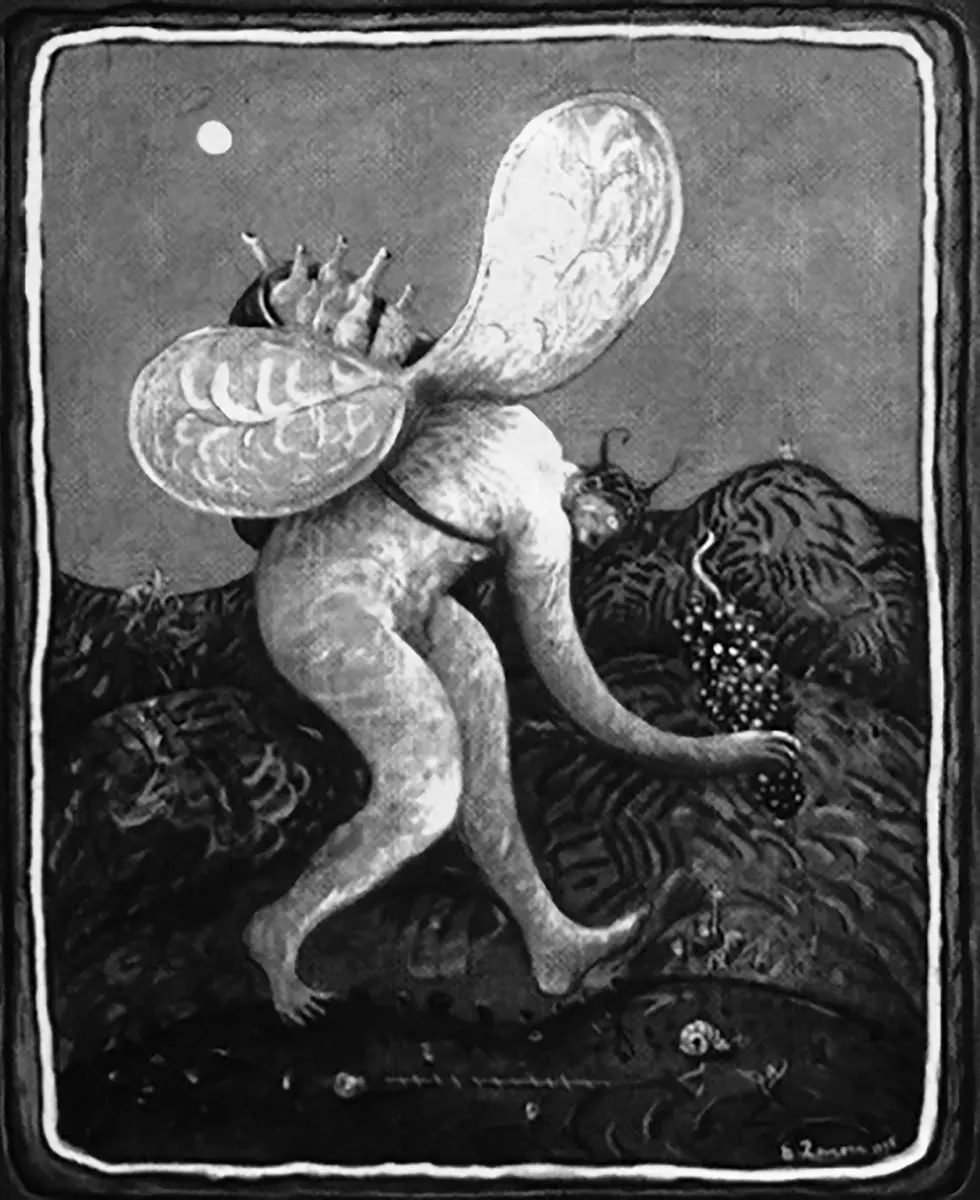
However, it is in Latin American literature, and the novel, during its most magical-realist moments, in the disenchanted world of Fernando Pessoa, with the rhythm of its motionless journey, and in the labyrinths of solitude to which Octavio Paz refers, that we above all find the foundations (or rather the quicksand) on which Zamora's narrative structure is based. It is here that we find the dramatic essence of his work, the poles of his questioning, the things that move him and make him think. Zamora is a creature of solitude, who exercises absolute uncertainty through laughter and sarcasm. The ingenuity of his worlds, coupled with his love of poetry, means that the nightmare often gives way to enchantment.
At his recent exhibition at the Lefor-Openo Gallery in Paris (where Pat Andrea, Antonio Seguí, and Víctor Ulloa also show their work), Zamora’s disarticulated reality, like that of the Uruguayan Iturria, has resulted in a new organization of space and thematic intention. The construction of the canvas, despite its apparent disorder, was always conceived around a central axis which was very often a void— but a void seen as a theatrical space, a place of drama, always delineated, confined, closed. In this new show, emphasis was placed on the effect produced by the figures, with the burlesque elements predominating over the work on space. Thus, there is not so much movement or mobility as calm scenes, distributed over a single plane, creating a kind of static anecdote. The universe is the same, troubled, and disguised. There is still the same grotesque humanoid archetype, a kind of E.T. lost in its everyday cosmogony. Eroticism is desperately absent. Some of the questions raised by these recent works include a scattering of syntax and a rather empty kind of reiteration of iconographic and symbolic vocabulary that weaken the magic of his customary metaphors.
Zamora is excellent when he becomes expansive or when, on the contrary, he deals with what is minuscule. Here it was the medium formats that predominated, giving precedence to detail which might affect our reading of the overall plastic argument. However, the handling of the diluted oil and the acrylic used like gouache on crumpled paper created the texture and rich appearance of parchment, as if the works were manuscripts in the form of images—a clear confirmation of Zamora’s technical skills. The spirit of his "vignettes" continues to be very personal and attests to the richness and vigor of a Latin American narrative tradition that is still very much alive, although it has been abandoned by many artists since the beginning of the 1990s.
CHRISTINE FRÉROT