
This exhibition, which is the third show at Mary-Anne Martin Fine Art (1992,1995,1997) may be seen as the climax in a long investigation by Elena Climent into her past. Specifically, it seems to be the end of a journey through her relationship with her family, their past, Mexico, and the circle of her parents into which she was born and raised. For this, her latest chapter in a thoughtful and highly personalized exploration, the artist has chosen the subject of her childhood home. In the introduction to the catalog that accompanies the exhibition, she states that the show is dedicated ... to [her] parents and their home which was so much a part of their lives. Not stated here, but implicit in the fact that the house, its contents, light, and spaces were and remain very much a part of the fabric of the artist's life.
In this pictorial long good-bye, Climent attempted —successfully she believes— to liberate the spirits of her parents from the house and to .".. rescue the part of [her] soul that was still there, trapped like a genie in a bottle." Her father, the Spanish exile artist Enrique Climent, died in 1980. After the death of her mother in 1994, it became clear that the family household would eventually have to be disbanded and the residence sold. During the last two years, Climent has worked at the examination of the nature of that place. She set about identifying objects and impressions from her past and placing them in the context of the present. This movement of memories, and the power of the objects that generated them, into the current stream of the artist's life, has allowed her to reinterpret or reinvent, the spaces in which these objects have rested, both physically and psychologically. The process has made it possible for the artist to gain some control over the images and their situations and to transfer into them her own power and reality.
Upon entering the galleries, the overriding impression is that the current works represent a different kind of time than that presented in the two previous exhibits. In comparison with these and her past work, these pictures appear to be much more "of a moment", much more urgent. The techniques that are used to impart this sense are a tighter, more highly realistic application of paint and the conscious construction of compositions that are more intrinsically narrative rather than illustrative. There is a palpable understanding in these works that the time represented has just been interrupted, that human presence has just left the scene.
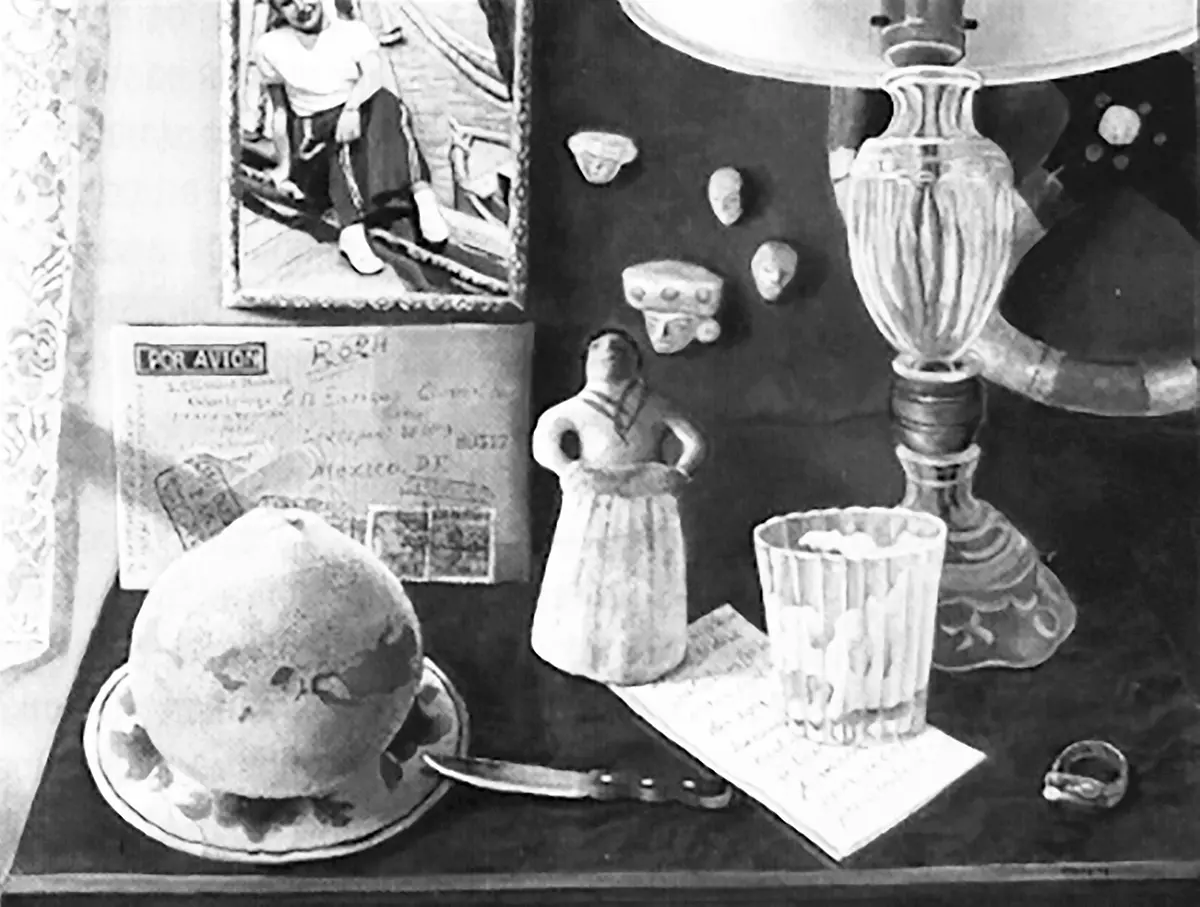
Climent’s still-life paintings are frequently compared to those of Maria Izquierdo. This comparison may be more sound when made between Izquierdo's work and the earlier paintings of Elena Climent. The works in the current show seem to be less than still, resonating with life and action. Among the thirty-five watercolors and oils in the exhibition, one of the most poignant is Armario con muñeca y foto vieja del estudio (Dresser with Doll and Old Studio Photograph). Crumpled banknotes and change have been left on a bureau with a key and a note or, perhaps, a shopping list in a scene that would suggest that someone has just returned home and emptied their pockets. Souvenirs of the past and present are represented by the figure of a doll, a faded photograph, and the reflection of a child in a small mirror. This latter figure may be the only direct representation of a human figure in the show, all others are implied by means of visual devices or references. In Mesa con toronja y carta vieja (Table with Grapefruit and Old Letter), which is of a similar small size and format (barely 22 x 28 centimeters), references to time are implied through the depiction of a grapefruit about to be pared with a small knife, a drink carefully placed in the folded page of a letter and a ring, slipped off and left on the table. All of these devices, which are repeated throughout the exhibit, continue the illusion of a recently inhabited, vital space.
However, in the catalog's essay, which has been insightfully written by Hayden Herrera, it is made clear that what appear to be faithful and loving replications of childhood memories are constructions based on memory, but manipulated in the present by the artist. She has, for example, changed color, add objects that were not part of the original scenario —children’s toys or a fresh piece of fruit. In this manner the artist has attempted to gain some authority over the actual spaces, removing the mystery and granting herself the ability to detach herself from them: the act of recreating and altering these small parts of childhood rooms has given the artist the power to leave them behind.
Heavily laden with symbolism, steeped in personal iconography, and weighted with psychological drama, these works can be squarely placed among the still-life traditions of both the Old and New Worlds. In one of the most complex pieces in the exhibition, Mesa de mosaicos con espejo (Mosaic Table with Mirror) the addition of two papier mâché skeletons effectively imparts the character of a vanitas. With the central reflection of a stairway leading out of the room and the addition of marigolds, flowers that are traditionally used in Day of the Dead celebrations in Mexico, this painting can be viewed as a summation of the show. In this case, the vanitas theme, while demarcating the finality of death and the vanity of earthly possessions, also celebrates individual things. Each object on this table has been remembered, collected, or imagined by the artist. Seemingly, reproducing these objects in paint has given her a firmer grip on them. With that, she has achieved a greater understanding of the essence of "being" and time. The success of this meticulously executed and encyclopedic illustration of an individual's past, beyond the skillfully handled pragmatic issues such as technique and composition, is the simplicity that it communicates that same understanding to the viewer.
CLAYTON KIRKING