
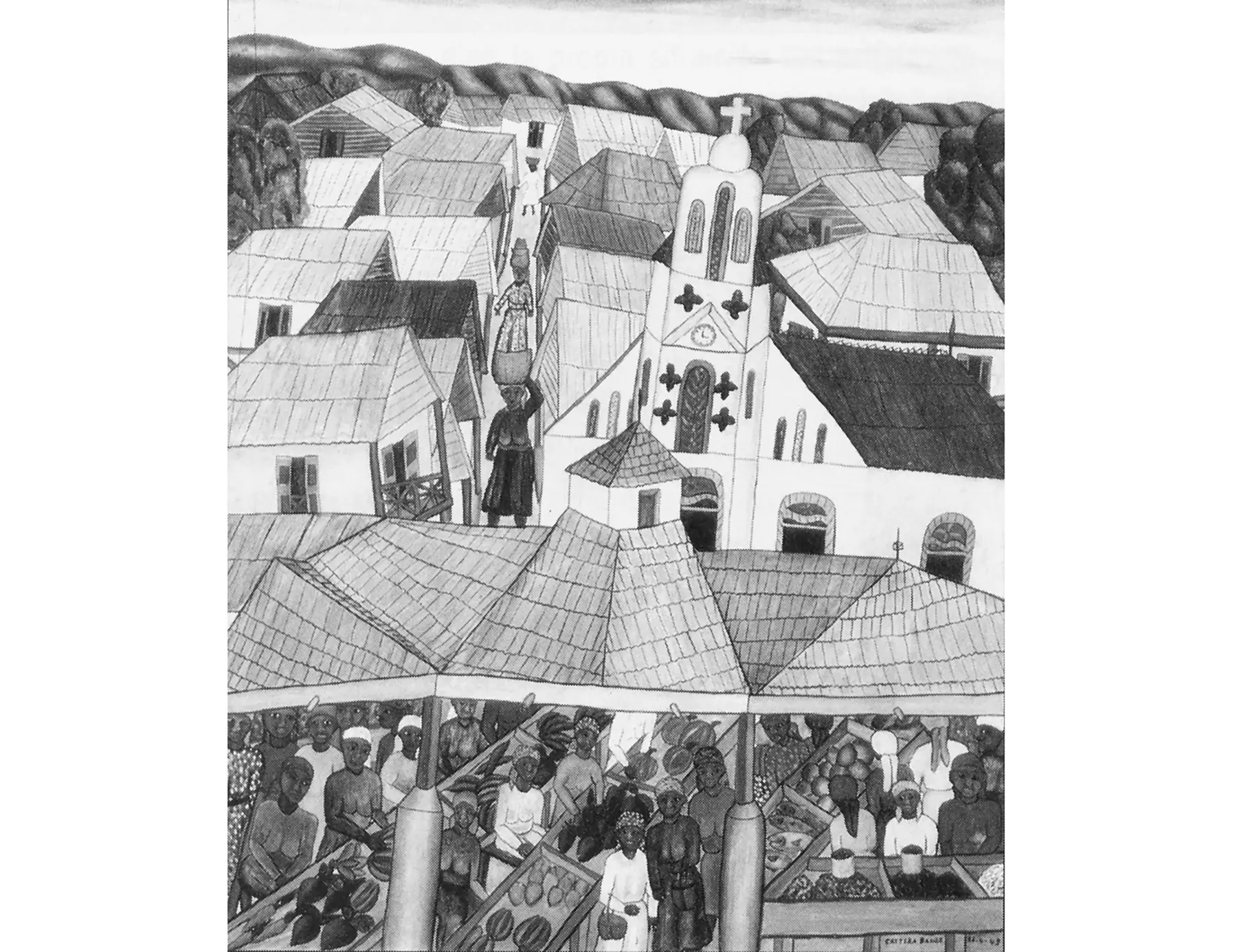
From June 12th to August 16th, over 100 Haitian paintings and sculptures from the collection of Jonathan Demme were on view in New York City. This exhibition was significant on several counts. First, it represented one of the very few recent museum showings of Haitian painting in New York, and second, it featured work of consistently high quality which helped to define the achievements of some of that tradition’s best masters including Hector Hyppolite, Philomé Obin, Wilson Bigaud, and other lesser-known personalities.
Since the late 1940s and the initiation of the so-called Haitian Renaissance in Port-au-Prince under the leadership of DeWithh Perters, the art of Haiti has been characterized by bright colors, subjects related to voodoo practices, and naïve drawing. The New York exhibition served to widen our definition of this genre of art, rich as it is with images whose themes ranged far and wide, from landscape to extraordinary still lives (some of which were strangely reminiscent of both European Symbolist and New World Surrealist depictions of flora and fauna), genre scenes, and an entire room of paintings with trenchant references to the difficult political realities that Haiti has experienced throughout the present century. These ranged from depictions of the various invasions by U.S. armed forces to the plague of the Tonton Macoute strong-armed thugs who carried out the threats issued by the Duvalier family against their enemies and finally, to the problematic relationship that exists between Haiti and its American-backed political leaders.
The exhibition was particularly welcomed by those who had been fortunate enough to see the extraordinary exhibition Sacred Arts of Haitian Voodoo which has been touring the United States since its opening at the Fowler Museum of Cultural History in Los Angeles in the winter of 1995. The Island on Fire show elaborates on many of the themes which could only be hinted at in the voodoo exhibition. It underscores the sophistication of this art which is often dismissed or described in condescending terms for its "primitive" qualities.
The collection has been carefully acquired over the past decade by film director Jonathan Demme who has become a principal patron and promoter of many varieties of Haitian arts. He has also sponsored the well-produced catalog of this show which contains a brief essay by novelist Edwidge Danticat and another by the Voodoo priest Aboudja that offers a concise history of this religion's worship practices and origins.
One important point that must be made when discussing any exhibition of Haitian painting is that the type of art represented in Island on Fire is only one aspect of the complex story of contemporary Haitian visual culture. Artists like Edouard Duval-Carrié, Sacha Tebo, Jean Claude Garrout, and many others, working both inside and outside Haiti, manipulated the international language of visual expression to create images that express a uniquely Haitian vision while at the same time, dealing with the language of signs and symbols that may be readily understood by a public not necessarily versed in the intricacies of contemporary Haitian life.
Island on Fire has served an extremely valuable purpose in presenting to a New York audience a large assemblage of images that should be taken with the utmost seriousness. Haitian artists, while using at times an enigmatic visual vocabulary, have created a language of their own to express the sometimes-jarring realities of life on that island.
EDWARD J. SULLIVAN