
The quality is usually associated with the sculpture of J. J. Moros is the purity of his pieces, the impeccable finish of each of his works. His sculpture has hints of minimalist phraseology and of certain radical postures of constructivism. But now, with his one-person show, titled Vectors, and Tensors, at the Museo de Arte Contemporaneo of Caracas (June-July 1997), in addition to these qualities, there is also the importance of volume as such, specifically a concentration on the fact of volume. There is an intelligent and subtle relationship with the industrial world which nourishes it and at the same time a challenge to the logic of space, the rational act of suspending in the air large iron sculptures (measuring 1.30 cm.) or creating a sculpture-installation of 72 pieces, Percussion Landmarks (1994-1995), in which there is no pre-established order for its spatial distribution. The principal character of this new work lies in the energy of space and volume which it now implies.
We have been following Moros’ exhibition activities since 1986, in collective salons and solo exhibitions. In the beginning, there was a marked dependency on the tradition of modern sculpture, as indicated by Robert Jacobsen and Anthony Caro or, within a national context, Víctor Valera. Then the use of metal and color, the effects of open and drawn planes in space, which now belong to an earlier stage of Moros’ work.
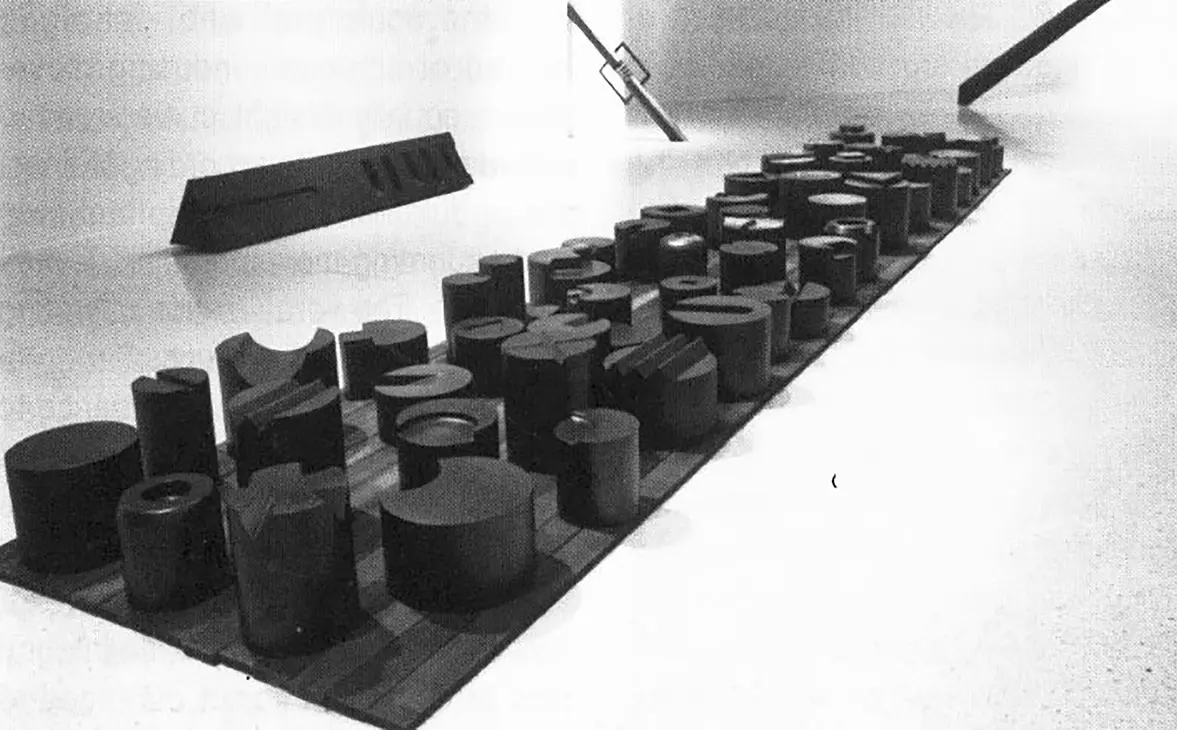
Moros works with soldered and brass-plated iron. From the earlier period, there remains the high-quality finish, which is of such precision as to allow no distraction in the construction of volume and the proposed expression. The execution of the work is very important since, at least in the case of Venezuela, there is, in general, some degree of deficiency in the formulation of sculpture among contemporary artists which is justified in the name of the supposed primacy of the “concept,” which leads to clumsy or elementary projects in works without any sense of charm.
Moros understands that the raison d'etre of sculpture is volume. He subsequently addresses the matter of horizontality. In virtual terms, he uses bodies ad infinitum to alter the logic of their construction or space, with ludic and open elements proposed not only through the understandable openings in Sideros (1994), but even in the fragmented and expanded elements of Percussion Landmarks.
In these works, the base of the sculpture has been eliminated—something which can also be seen in the artist’s research from 1990. His pieces lie on the floor or rest against the wall, or suggest a corner, as in Vectors by parallels (1994), which exists only in the mind of the spectator as the line is straight and the angle in question is nothing more than its shadow.
Vectors and Tensors was an exhibition that placed Moros among the great artists of renovation and continuation in Venezuelan contemporary sculpture, along with such figures from his generation as Carlos Mendoza, Carlos Medina, Miguel Borreli, and Rafael Barrios. They all share a common denominator—constructivism, the purity of volume in space.
JUAN CARLOS PALENZUELA