
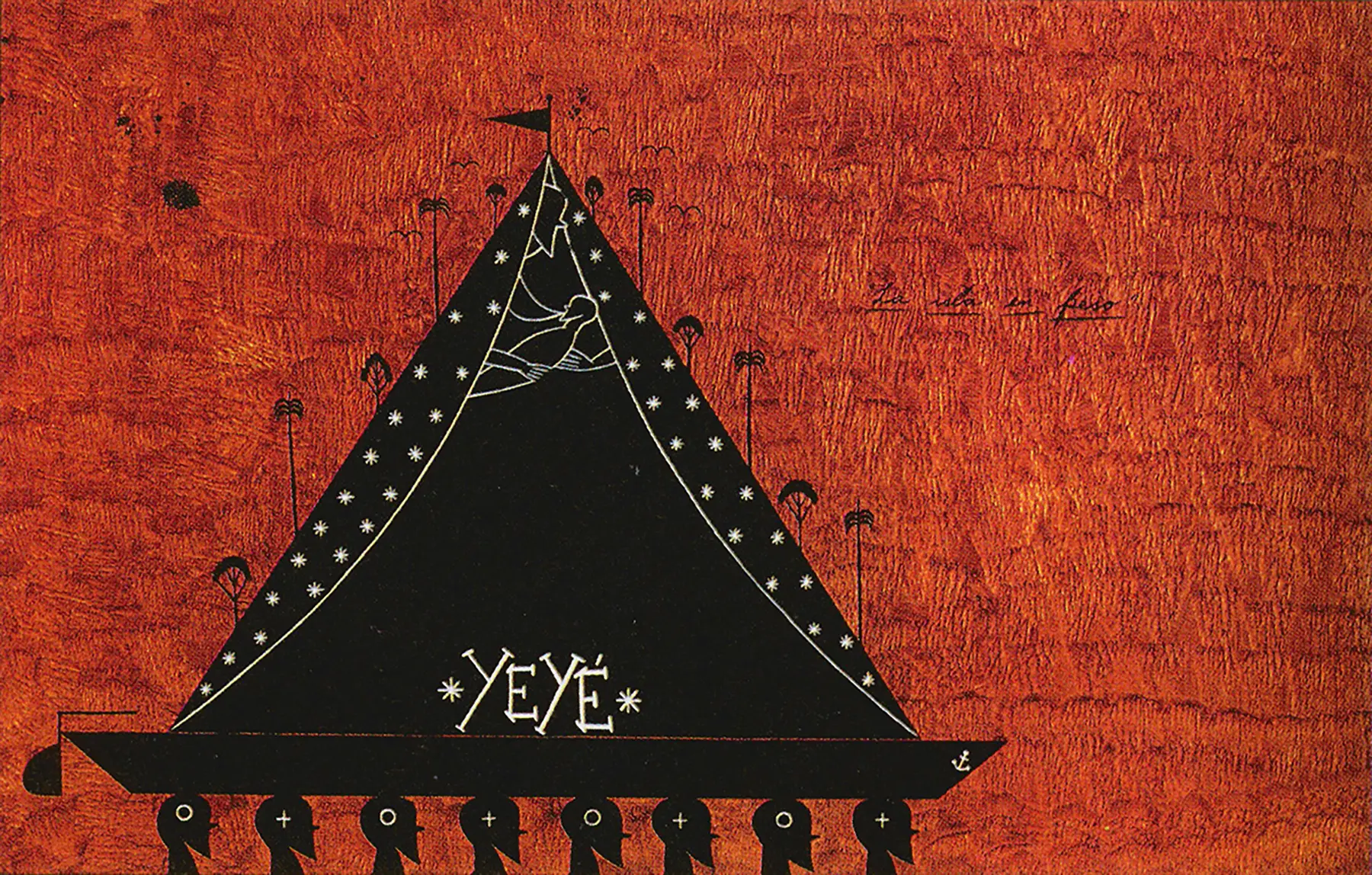
The first retrospective exhibition of the Cuban artist José Bedia is at present on view at the MARCO (Museum of Contemporary Art) in Monterrey (June-October 1997). Curated by Charles Merewether, the show brings together twenty years of the artist’s work, bearing witness to the solidity and consistency of his output from the beginning, and revealing his guidelines from the point of view of both content and themes and of formal resolutions.
The title chosen by Merewether for the show, American Chronicles—which is in fact the name of a series of drawings/collages that Bedia made toward the end of the 70s— represents a node where all the various trends of his work over these twenty years converge. His art has been meant from the beginning as a reinscription and —as Merewether makes clear in his introduction— a revindication of the history of the Americas. It could be said that Bedia has embarked on a messianic mission as a critic of colonialism and imperialism. Within this context, a crucial element has been his constant preoccupation —initially intuitive and becoming in time more and more conscious and articulate— with projecting a concept of continuity of the past in the present by recovering cultural values that nowadays are denied or shattered. The symbol that perhaps most forcefully embodies this concept, and at the same time other conceptual principles behind the art of José Bedia, is the Kongo cosmogram, which represents the sun’s movement, and the continuity of the cosmos. This cosmogram is made up of a cross inside a circle. The world of the living is in the upper part and the world of the dead in the lower; however, they move and interconnect constantly. In the same way, in Bedia's work death, the past, and history are in a dialectical relation with the present, as he combines and projects into our present reality the "original" cultural and religious traditions of Africa and America. Another important factor comes into play here, "the primitive". Bedia has repossessed notions of the "primitive" as a contemporary and concrete condition of the real world; it thus becomes his means of subversion. The "primitive" and the "civilized" coexist organically in the present, and so-called "primitive" cultures —such as some of the African and Native American cultures— are as contemporary and alive as those of the urban "West". Thus, his work also contains a dichotomy between "natural" and "urban", mythological and "real".
Merewether designed the exhibition to make it possible to study quite exhaustively different periods and aspects of the artist’s work; importantly, it includes some of Bedia's early work from the 70s and a series of drawings from the 80s never shown before. José Bedia began his work as an artist in 1976; however, the work of his first two years has been lost. American Chronicles begins with fourteen drawings /collages from 1978 to 1983, photocopies of ethnographic photos of North American and Amazon Indians from the beginning of the 20th century, which have been simply glued to sheets of paper or worked over with texts and sketches which refer to components of the photos or respond to a compositional order, following in some cases the designs of Yanomami body painting. It is remarkable that Bedia, who was born and bred in Cuba, a country where there are no Indians, has chosen to study and portray Amerindians. There is no simple or direct explanation for why Bedia has been fascinated from childhood on by the world of the North American Indians, particularly the Plains Indians. Bedia calls this phase of his output "study work" since it is basically inspired by anthropology books and uses anthropology rather literally as well as romantically.
The second section, which covers 1984 to 1987, is one of the most powerful in the exhibition, consisting of 19 works (drawings) that illustrate almost didactically rituals and deities of the Palo de Monte religion and their importance in human life.
It is important to point out that although Bedia was not initiated into the Palo de Monte religion, of Kongo origin, until the end of 1983, he had been in contact with the Afro-Cuban religions since the 70s. Palo de Monte shows many parallels with Native American cultures and religions such as the Náhuatl, Lakota, Sioux, or Navajo. These parallels were discovered intuitively by Bedia long before anthropology books and direct contact with these cultures allowed him to confirm his intuitions so that from the 80s onwards Bedia produced works where African and Amerindian elements coexist in a symbiotic relationship. It could be said that the formal aspects of Bedia’s work are strongly influenced by the artistic conventions of the Lakota, Sioux, Navajo, Kiowa, and the Mexican codices (names coming out of mouths, profiles of faces, and stylized figures— although these may be related also to African Bushmen paintings— the use of color, compositional elements taken from Kiowa and Kiowa Apache teepees, etc.) while the cultural and religious content is more closely connected with Kongo traditions. It must be said, however, that Bedia also uses as formal resources ritual and cultural elements from Palo de Monte and Santeria (Kongo and Nigeria), such as cauldrons with their tools, branches in the shape of hooks, Kongo "signatures" and cosmograms, texts in Kikongo or Bantu (a Kongo language), and objects like engines which symbolize attributes of gods such as Ogún.
For example, the triptych The Cauldron, the Ingredients, the “Prenda" show how a Palo de Monte ritual vessel is prepared. He's the Master of Iron, 1984, represents Ogún, the god of iron, a warrior by profession who symbolizes the ambivalent “civilizing” power of iron, in a bullet as well as in a train or a knife. After this period, the ritual and symbolic contents related to Palo de Monte become more and more cryptic and unintelligible for the uninitiated. This is the source of one of the most effective aspects of Bedia’s criticism, his work becoming a mirror of our difference and our ignorance.
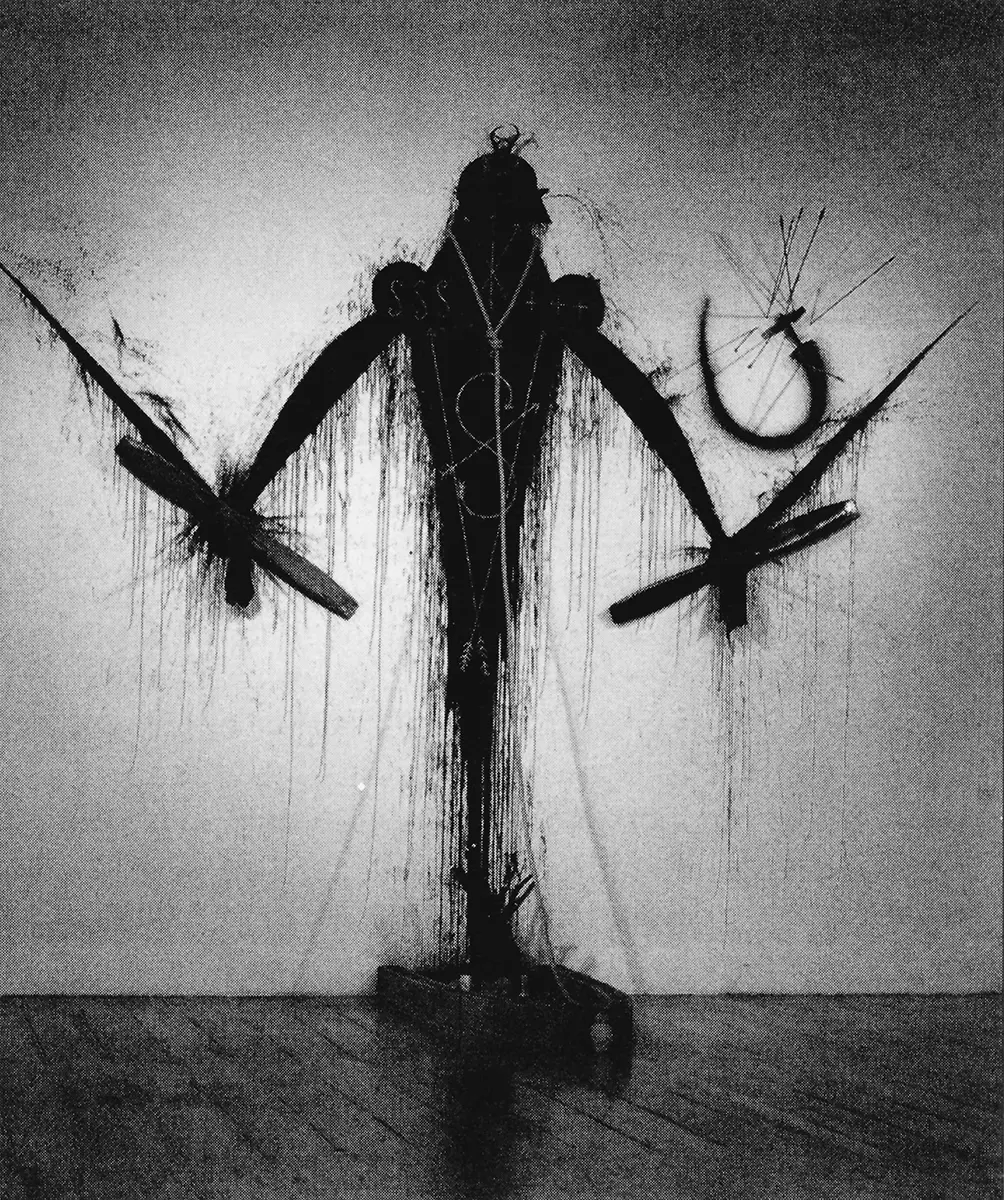
The exhibition is outstanding also for its reconstruction of eight installations, covering a period of ten years, from 1984 to 1994. The most impressive, for its monumental size and the way it plays with space, is Kakuisa el Songe, Iron Flies, 1994. Toy for an Angolan Child, 1985-1989, is particularly effective in the drawing section, and a reduced version of Life on the Line, presented in the Magiciens de la Terre exhibition at the Pompidou in 1989, marks the transition between this stage and a period of forays by Bedia into the field of painting, between 1988 and 1991. One of the most important aspects of Bedia’s work is his formal audacity. Although he had strict academic training, he has tended to be unorthodox in the use of materials, techniques, and formal solutions, and has fostered a constant breakdown of borders between the various genres, including drawings, and incorporating and combining ritual artifacts with industrial objects like engines and propellers, or toys, cloth, kitsch figurines, photographs, drawings, etc. in his installations.
A whole room is dedicated to the 1991 drawings on amate paper, made while the artist was living in Mexico and representing facets of Amerindian culture combined with Afro-Cuban contents. From the aesthetic point of view, these are perhaps Bedia’s most “delicate” works to date. Merewether has also included, in the following room, the important Polyptych of Ogún, a series also on amate paper (1992). Painting is well represented in American Chronicles with the inclusion of important works from the period 1989-1996, starting with more conventional horizontal formats and going on to semi-circles, rhomboids, and even a painting in the shape of a bus, La Cubana, 1994-1995; these last are mounted directly on the wall.
A happy surprise in the exhibition is the presence of some small objects made of wood and bottle tops, in the shape of a machete, a bus, a train, a car, etc.. (for example Unwilling Travelers and The Loose Ox, 1994) which are closer in function to toys although they still have specific symbolic content.
The next to last room in the exhibition is less successful than the rest; it is saturated with different proposals and formats in both painting and drawing, which makes it difficult to appreciate fully the development of the work in series as in the rest of the show.
An important series of collages from 1995 and the installation Ngola Habana, 1994 form the culmination of the exhibition. These collages can be seen as the aesthetic and conceptual resolution of those early efforts at the end of the 70s. Of particular interest is Mundele Wants to Know (White Man Wants of Know), Nfumbi Spirit of the Dead, and Minkisi. In Nfumbi, Bedia shows a palero being possessed by Fumbi, the spirit of the dead. Above the head of the palero he has glued a photocopy of a cut-out ethnographic photograph of the head of an African. Here, the past is symbolized by the head of the man who is dead, while in the figure of the palero they coexist inseparably in the present.
The continuity of past and present as the guideline of Bedia’s work was already outlined in the early work Maloca, 1983 (included in the show and belonging to the series American Chronicles), where the artist used old ethnographic photos of Amazon Indians and moved them while copying them so that the image was blurred. In this way, he detached the image from its immobility and thus symbolically countered the extinction of the people represented and their history. In the installation Ngola Habana, 1994, which closes the exhibition, the notion of the continuity of the past in the present is fully developed. Over a length of almost ten meters, Bedia has placed in a horizontal line a series of photocopies of black and white photos, starting with an engraving representing Ngola, in the Kongo (today Angola), and finishing with Havana. He recounts the history of slavery, the colonial conquest, and the arrival of the Kongo religion in Cuba. The continuity of the Kongos is assured by the survival of their religious beliefs in Cuba. Then comes a mixture of colonial ethnographic images from the end of the 19th and beginning of the 20th century with others of autobiographical nature, such as those of Bedia as a soldier in Angola and those of his godfather in Havana. Bedia makes a connection between a supposed beginning and an end which is the present. He is a participant in this history, is part of its survival, and is thus totally involved in it. The half-circle that Bedia traces over the horizontal line of the photos is related to the Kongo cosmogram, thus reinforcing a historical and cultural continuity.
Bedia seems close to Stanley Diamond’s idea of the "amateur anthropologist",1 who is learning and participating instead of “examining” human beings. He can perhaps be called an "ethnographic artist"; however, his interest in the “primitive” is neither external nor nostalgic, but inseparable from his own condition. The reason why Bedia's work represents a true laboratory for the evaluation of critical and theoretical frameworks in contemporary art, in the context of a pluralist culture for the end of the century, is rooted precisely in this invasion of "otherness" from the inside since the artist is investing one of the most "civilized" systems in western culture-art with a different system of cultural values and not making mere formal or intellectual notations.
NOTE
1. Stanley Diamond. In Search o l the Primitive - A Critique o t Civilization, 1974.
CECILIA FAJARDO
Doctoral Candidate in Art History at the University of Essex, England; Director of Sala Mendoza, Caracas, Venezuela.