
The recent production of Juan Paparella (1965) focuses on the problem of communicability. In 1992 he presented, within the framework of a complex installation, many objects covered with black fabric which formed a protective veil against "knowing" them. Some of the pieces were simple, such as the rectangles graphs mounted on aluminum in which he continued to explore his earlier conceptual concerns. The theme of communicability and recognition, as well as other related ideas concerning names and identity, were once again used by the artist in this spare but meaningful series of images. The photographs on display were not those originally taken by the artist. They were "corrected," with a black pigment covering the human figures. Then the artist made enlargements of these corrected versions and mounted them on aluminum plates. This double register process eliminated both the trace of the artist and the texture of the pigment, highlighting the effect of neutrality and distance vis-à-vis the representation, which predominated in the work.
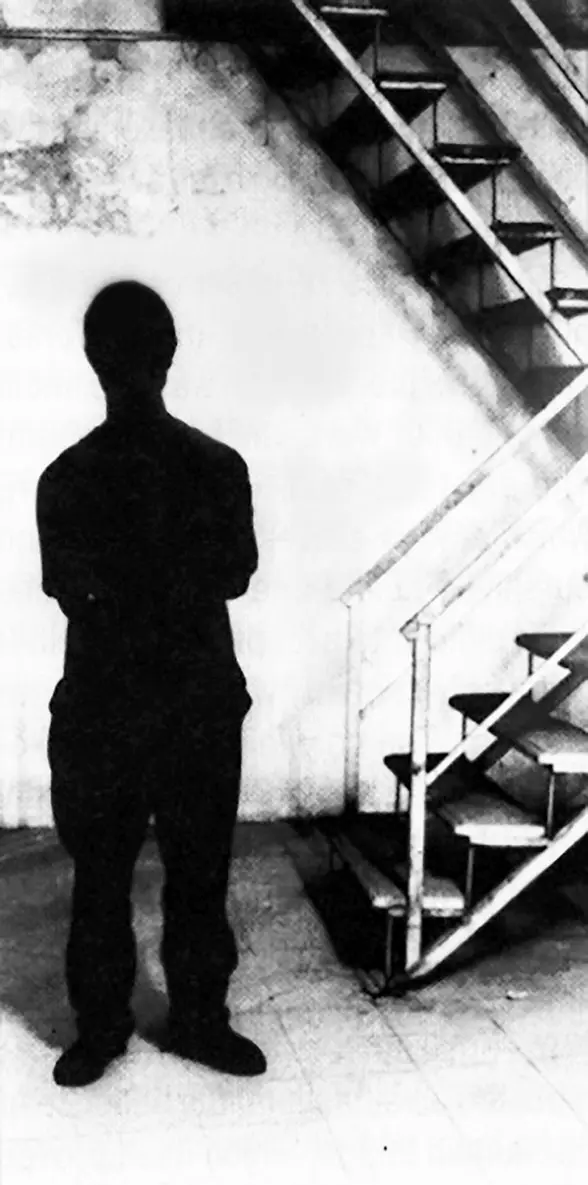
The austere interiors of rooms, captured with all their physical details— cracked walls or wooden floors worn down over time—contrasted with the emptiness of the image of the human being, for whom these settings had in fact been created. The black pigment, thick and "silent," completely filling the space occupied by the human figure, had occlusive functions similar to those of the fabric which covered the objects in previous years. In contrast to the transparent message of photography, with its ability to bear clear witness to "what was there," the pigment repressed the ability to see, blinding it while at the same time questioning the possibility of obtaining a full awareness of the events.
The "poetics of absence," as explored by Paparella in these works, suggests a theme that was a leitmotif in his earlier work: the idea of death. The artist has said, "With any effort, which always proves in vain, we find ourselves facing one of the realities most difficult to accept: death itself. It is the only certainty we have when we are born. The only thing which inexorably applies to us all." The certainty of death replaces, in this case, the certainty of doubt, a constant source of motivation, as the artist himself has admitted, in a large part of his work.
In this series of photographs mounted on aluminum, the absence of the human image, which itself proves disquieting and a source of destabilization, has the potential to become filled with meanings. Dematerialized, without any face, totally void of anybody, the human figure stimulates, from within its disturbing opacity, the interpretative work of the recipient.
As on previous occasions, Paparella once again presented objects—or rather subjects—of “uncertainty, - ambiguous and contrary to expectations. While a certain incommunicability arises initially from a confusion in our consciousness, it is also true that these objects claim, for art, the particularity of being a privileged place not only of memory, imagination, and feeling but of knowledge and, perhaps of action.
Paparella also presented an installation titled As a counterpart of what we do not have at the Maison de I’Art Actuel des Chartreux in Brussels, where he has lived since 1991.
ELENA OLIVERAS