
The keys to this recent exhibition, titled On the Eve of the Sacred, by the sculptor Julio Emilio Neira, are to be found in James G. Frazer’s The Golden Bough. According to the anthropologist, his first objective in his book was "to explain the law governing the succession in the priesthood of Diana in Aricia", but when he set out to resolve the problem, his research began to go in different directions, obliging him in the end to write twelve volumes.
Basically, the book illustrates the characteristics of systematic regicide. Furthermore, in explaining the significance of the King of the Wood in the Diana myth, the author examines the cult of trees in the history of religion, with detailed descriptions of the various kinds of mythologies. Frazer relates how in the sacred grove of Nemi, where the sanctuary of Diana was to be found, there was a tree around which a guardian priest, armed with a sword, remained on the look-out for the attack at any moment since it was the rule that the post could be acquired only by killing its previous occupant.
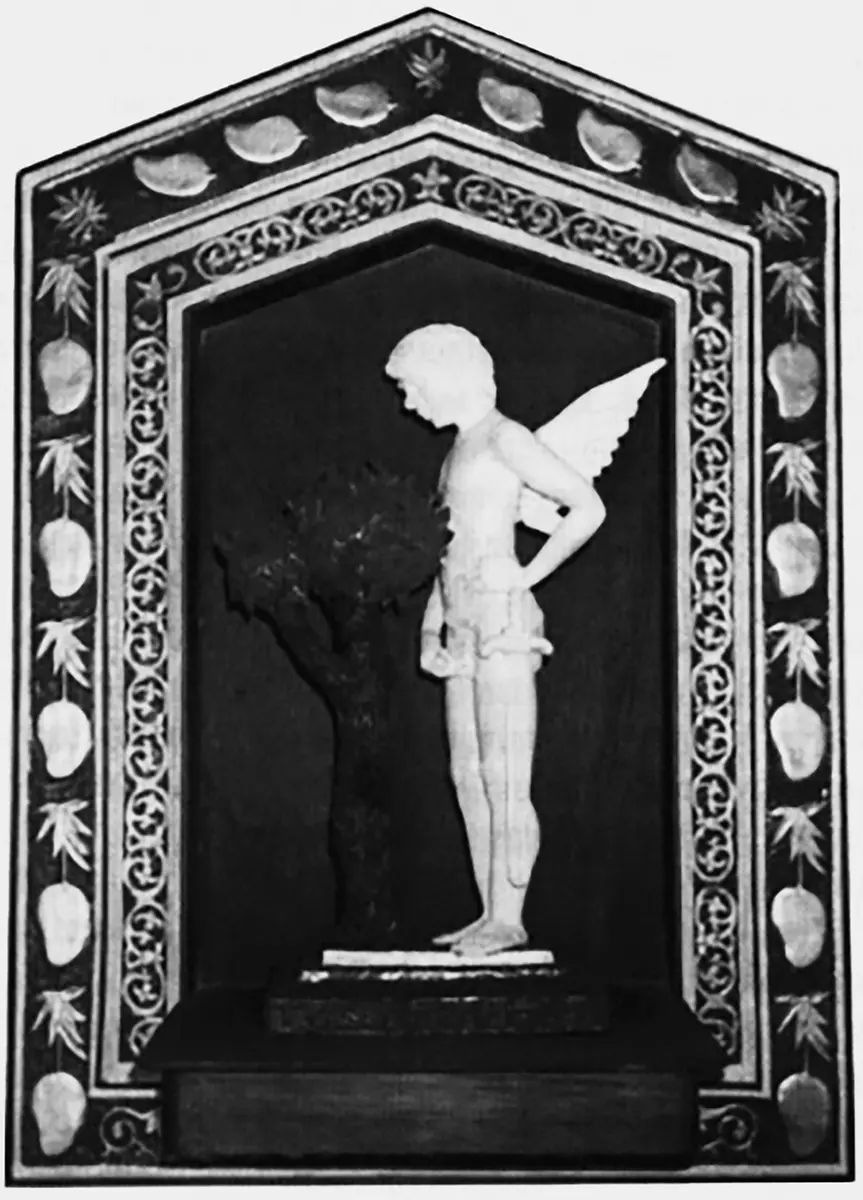
No branch could be broken from the tree; this was permitted only in the case of runaway slaves. "The success of such an attempt entitled the person to engage in unusual combat with the priest and, if the latter was killed, to assume his post as King of the Wood". The priest lived in a state of terror since any weakening on his part would result in danger, "with the first grey hairs sealing his death sentence," the victory of someone stronger and more cunning than he.
Neira does not illustrate the myth, but rather offers a version that serves as a metaphor for power and conflict between generations in Cuba. Like so many other young artists, he exploits the ambiguity of meanings provided by tropologizing to structure his discourse and pass unnoticed.
A frequent device is to make pieces that are visually attractive, with eye-catching color and a realistic representation of the protagonist. From this point on, everything becomes a question of unraveling the whys and wherefores. The problem is then passed on to the critic, who must try and resolve the confusion and translate the language and images into concrete words which have to be printed in a Cuban publication. First, they are not published, then they are said to be problematic, and the show remains in the gallery for a month. All this brings about its consequences in terms of rhetoric, which consists of writing obscurely and ambiguously about something to avoid problems: if everything must be perfect, there is thus nothing to criticize.
The nine pieces by Neira, handsomely resolved, were worked in plaster, wood, clay, enamel paint, and patina. They were all small format works, a scale which the artist prefers and for which he has obtained several prizes.
The figure of the guardian links the narrative and is presented as self-portraits which reinforce the impression of sleight of hand at work in the meaning. They were placed in urns, like the ones popularly used for figures of saints. This was perhaps due to the influence of the artist's grandfather, who used to accept commissions to make figures saints in urns, although he did so in secret since religion was not very well looked upon in Cuba at that time.
The urns are colored red and green, suggesting moments of violence, and white and light blue, evoking serenity, and tranquility. The mango is a tropical fruit that becomes an emblematic element in the work: a symbol of the country.
In the sequence, the guardian protects the tree, waters it with his own urine, copulates with it, eats its fruits...little by little, Neira constructs his own myth about contemporary Cuban society, advantages which art allows in the case of history: or rather, the capacity of artists to invent for themselves a metalanguage with which to speak about post history.
ERENA HERNÁNDEZ