
Karen Michelsen (Lima 1969) graduated with distinction from Concordia University, Montreal in 1994 and already has collected four prizes in her short artistic career. The exhibition called De Lacrimae Rerum (The Necessity of Tears), deals with the topic of a woman as a martyr and her fragmented identity. These fragments are drawn from religious and cultural postcolonial South America. Michelsen's work is feminist, avant-garde, and conceptual. The main element of her work is a cloth which can be traced to her childhood when her mother sewed every piece of clothing she wore. Her unconventional way of working can be felt, as you enter the gallery. The materials of her work are textiles, stitched cloth, and embroidery.
The centerpiece of the exhibition is an installation called La Espera (The Wait), in which a wooden chair is completely covered and sown with white organza. Over a squared tapestry of the same material, sticking out of the organza fitted seat are several tubes of the homogeneous material that are connected to the tapestry. This work is a metaphor of "The ethnic roots that are never lost and at the same time, they are very personal. The chair is a sculptural object and signifies a state of waiting and of no movement, alluding to the idea of an immigrant person without a home, to create a very intimate and personal world."1 The other chair in this installation symbolizes the opposition to the first chair having rootlike tubes. Because the organza cloth is only draped over the chair and can be rapidly removed, it refers to the vulnerability of the woman immigrant in foreign lands. Illegible Spanish handwriting on the wall completes this installation. The meaning of the text is unimportant, but rather what is significant is the language that was imported from the Spaniards during colonization. On the day of the vernissage, a performance took place on the chair without root-like tubes. A dancer surrounded with the organza cloth moved like a caterpillar would, just before the cocoon opens and emerges a butterfly, but this one never reached that point. The performance refers to the present state of mind of the artist and the limitations of her life away from her family and goals.
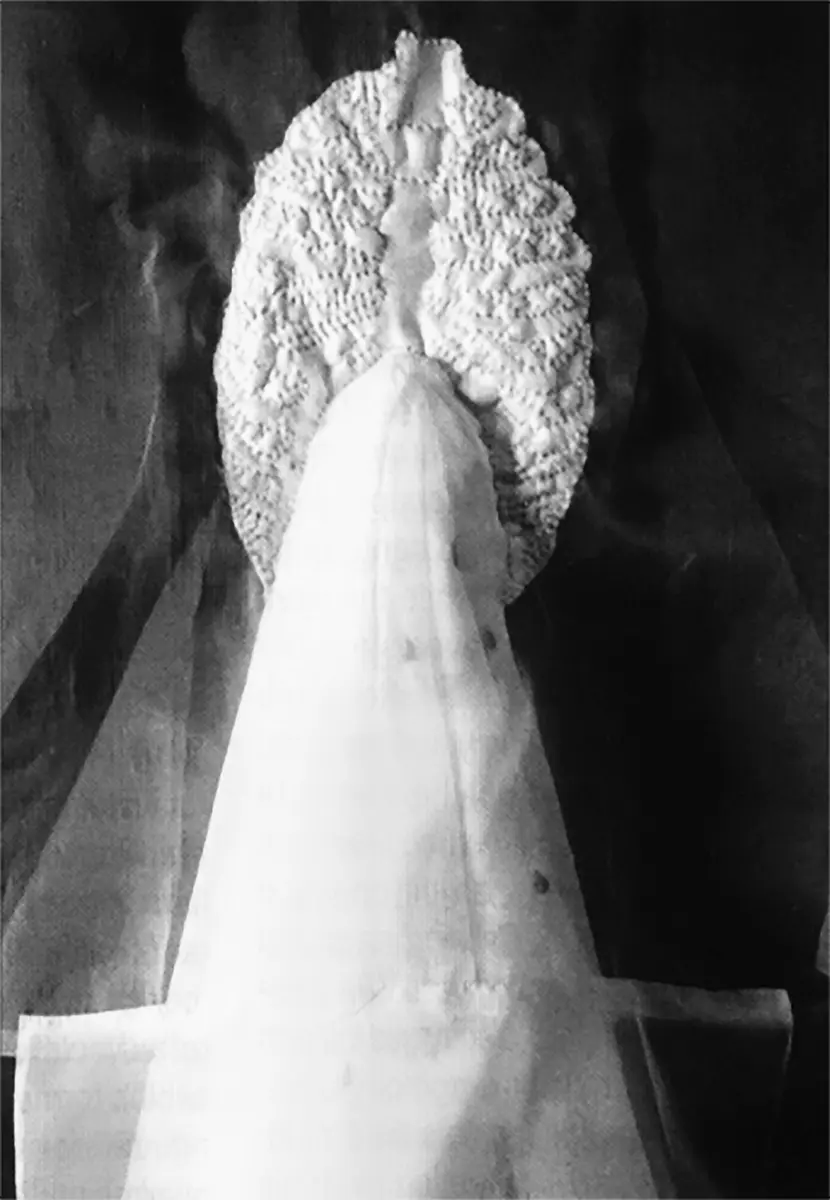
The work De Lacrimae Rerum shows a detailed ribcage sewed in a silver thread over a white satin cloth. The ribcage was chosen because it is an important center of the body. It is placed like a halo over a white veil that emanates from the organza cloth, which is embroidered with gray tears, "These are not from suffering, but tears without sentiment."3 This work alludes to the wedding dress and symbolizes the union of cultures during colonialism. Moreover, she borrows the symbols of tears, halo, and veil from religious iconography.
Three sculptural works mounted on the wall titled Hostia, refer to the Christian sacrament. Their form is round and made from broken plates glued together, "that are the reconstruction of religious symbols that have been lost."2 The plates are rounded with white organza cloth. In one of these works, the pleated cloth that surrounds the plate alludes to the antique Spanish neckwear during colonization. This fusion of religious symbols and colonialism imagery is the most important part of her work. In other works, Michelsen uses small books protruding from the main piece of textile. These books are made of white cloth pages with blue lines but no text, another symbol she uses to represent colonialism. To make a good reading of her work, the viewer must know her symbols or ideas, because her visual language is very personal.
NOTES
1. Interview with the artist, April, 1997.
2. Ibid.
3. Ibid.
AUGUSTO CHIMPEN