
This exhibition by the painter Pablo Siquier (1961) was the first retrospective by a young artist at the Museo Nacional de Bellas Artes in Buenos Aires. After elimination, of the regulations that limited the museum’s program of exhibitions to only works by deceased artists, this new show marked a new stage in the history of the institution. It also placed Siquier’s work at a level of recognition different from that associated with the normal mechanisms used in Argentina according to the status to artists—mechanisms that are determined more by the presence of international success than by achievements within an artist's own environment.
From the mid-1980s, when Siquier first began to exhibit, he has produced a systematic body of work in which each picture is set within a larger series. This development, with a few incursions into installation art, but fundamentally of a pictorial kind, focuses on two ever-present problems: the question of style and the representation of light in the two dimensions of the canvas.
The works from the last decade with which the artist is more often identified, are closer to the technical drawing of a designer than what is traditionally seen as painting. This results from Siquier’s sense of meticulous perfection which cancels out any "expression" of the immediate nature of the pictorial act. Through the artifice of light and shadow used to create a sense of volume, these works can be compared to the trompe l'oeil: Siquier’s universe is created with the optical laws of nature, though abstracted from its forms. This is one of the reasons why it tends to escape any dominant parameters used to measure it, appearing instead as one of the most complex works amongst the efforts of young Argentinean artists to explore the history of abstraction.
Siquier’s work can be divided into three major consecutive series, each of which contains small variations and the repetition of fundamental themes.
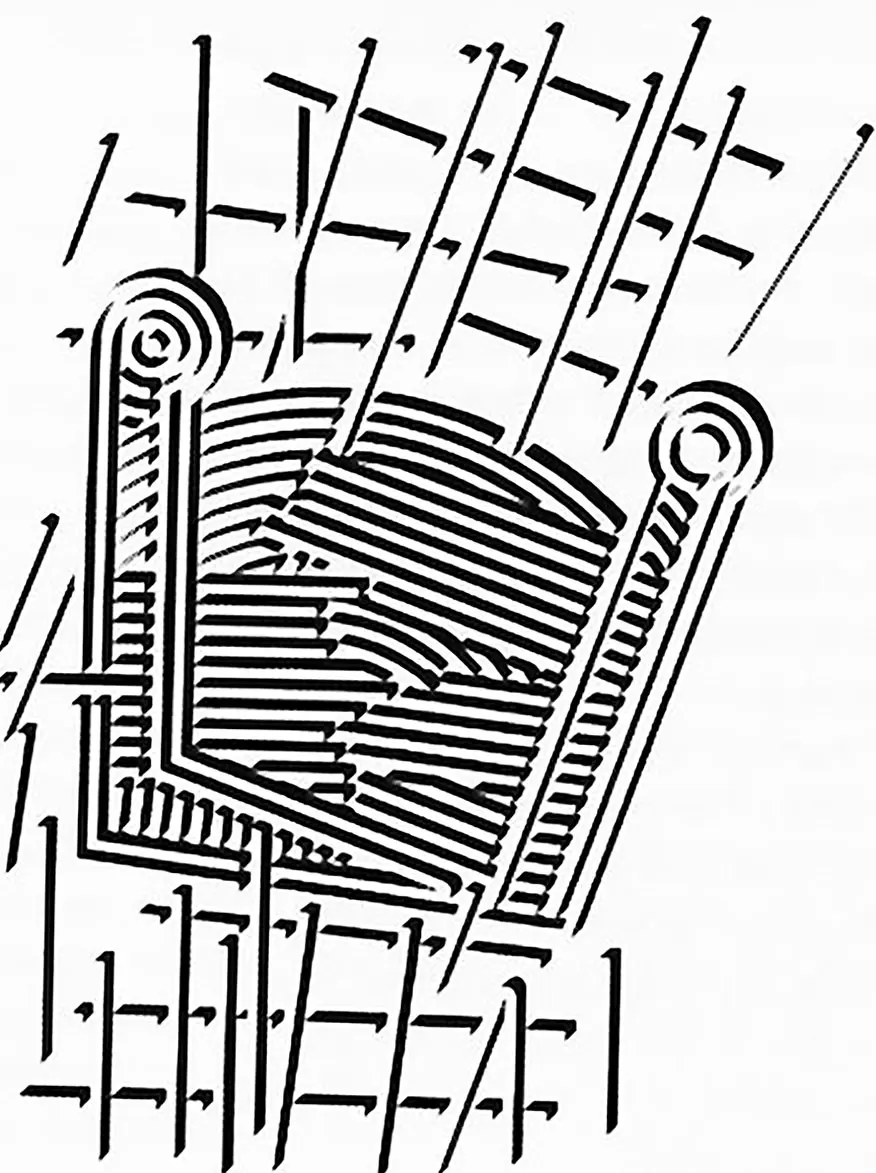
In his first period, the influence of drawing can be seen in specific comic-strip characteristics. These are pictures with vibrant colors that evoke textile designs upon which a central protagonist figure, generally concentric, is juxtaposed. In 1989, the first shift in his work occurred when it became more cryptic, more geometrical, and rich in historical references. During this period, which lasted until 1993, Siquier drastically reduced the motifs in his backgrounds and restricted his palette to blue, grey, and greyish brown tones. He began to obsessively design figures contaminated by different styles from the decorative arts and architectural ornamentation.
His most recent pictures differ from the earlier work in their total lack of color. They form a series of black and white pieces in which the design of the figure invades the entire surface of the canvas, creating a sort of burst circuit or a map of some absurd city. In this series, the references to historical styles become increasingly diffuse, the designs increasingly amorphous.
For his exhibition at the Museo Nacional de Bellas Artes, the artist's idea was to present a journey through his work that would highlight specific aspects. While from a critical standpoint his painting was more and more viewed as a point of confluence between various abstract and geometrical currents—with Siquier being seen in particular as an inheritor of concrete art—this exhibition reflected a clear desire to relativize such a reading. This was precisely the most interesting feature. For this show, Siquier highlighted works that had been marginalized because they differed from his more canonical images. Exceptional works, "the beginnings of series never developed," as the artist describes them, possess an exuberance and almost delirious kind of radicalism in their exploration of forms. This places his work at a contradictory and critical level in which the distortion of historical forms and the excessive deformity of the design are evident to an extreme degree. This reading, emphasized in the show by the montage that combined works from his different periods, thus destroying the idea of linear and systematic development implicit in Siquier, brought the works close to the destabilizing effects wrought by the baroque on classical forms through the perversion of pre-existing rules. It recalled the schizophrenic monstrosity reminiscent of Gaudí, distancing him from the healthy harmony for which the avant-garde movements longed.
In each of his pictures, there is a multiplicity of historical references: pop art, minimalism, art deco, concrete art, the staggering of Asian or Mexican architecture. This broad base of reference comes together to form a new style that, in relation to its referents, constitutes a wild form of aberration, a hyperbolic dialect that has lost its original language.
INES KATZENSTEIN