
The Canadian Cultural Center in Paris, established in 1970, has taken a new direction in the last two years. Since remodeling in 1995, it now showcases contemporary art based on new technologies. Located in the Esplanade des Invalides, its exhibition rooms have been adapted to house the most audacious artistic expressions.
Between May 16 - August 29, 1997, curators Christophe Domino and Catherine Bedard presented a major exhibition of work by the Argentine-Canadian artist Pat Badani, entitled Tower, Torre, Tour. Pat Badani has been working in Canada, Mexico, and France since 1978 Badani’s work is and includes drawing, oils, sculpture, and photography. This variety of media is closely related to the artist's spatial investigations. The work was arranged in groups with a series of horizontally organized sheets containing notes, drawings, watercolors, and photographs predominating. There were also sculptures constructed of superimposed assemblages and finally, video.
The mystical and omnipresent form in Badani’s work is the circle, materialized here in a bowl made of bread. Exploring the French tradition of bread baking, Pad Badani discovered one of the oldest bakeries in Paris dating from medieval times which still makes the so-called "Poilane" bread. The ovens are wood-fired and operate day and night. Pat Badani entered this world of artisan bakers who participated with her in the artistic adventure of making thousands and thousands of bowls which form the basis of her installations.
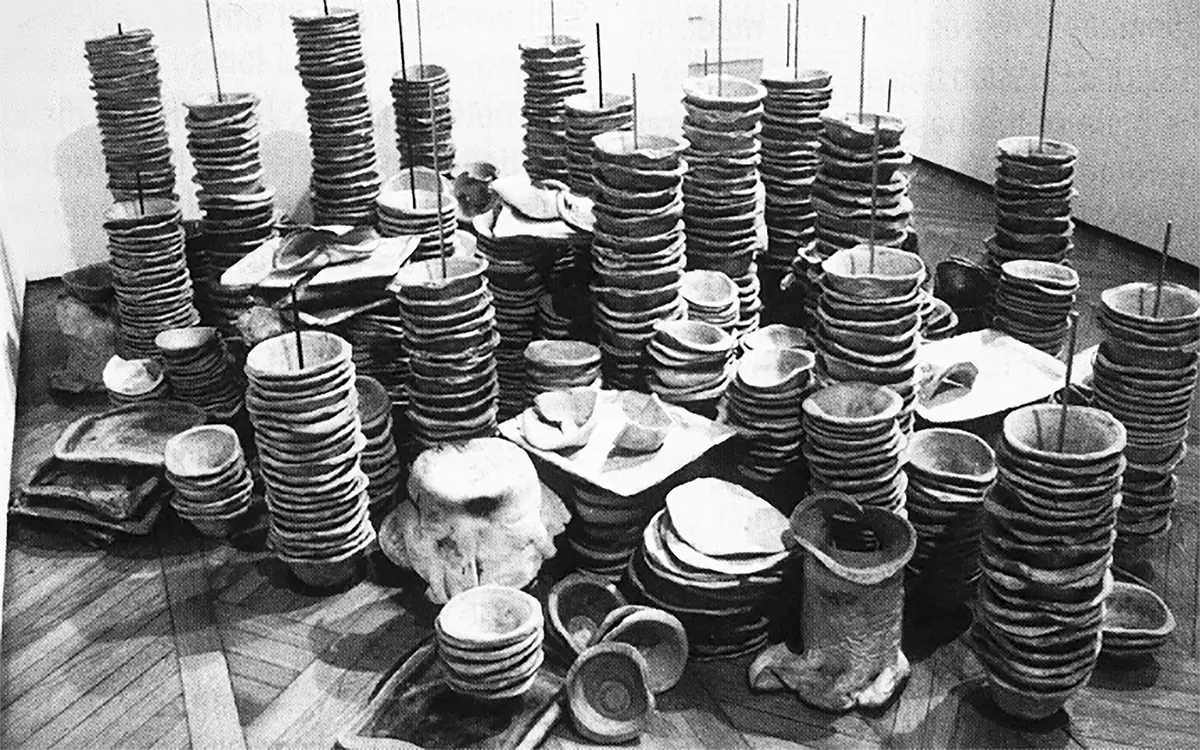
The work is a scientific investigation, the exploration of knowledge. The simple form of the bowl creates a series of visual experiences through the association of ideas. The reversible form of the object allows various spatial analyses to be developed—full vs. empty, concave vs. convex, container vs. content.
The two-dimensional part of the show was made up of sheets of notes, drawings, and photographs organized as engineering, architectural, geographical, or biological projects, with the bowl becoming a kind of dam, private room, island within an archipelago, fragment of archeological remains, or microscopic cell. This dynamic and simultaneous interplay of scales gave the work a playful and poetic dimension. The spectator was obliged to actively participate by reducing or adapting his or her sense of perception to the state of the bowl.
The sheets were organized within a specific program that studied four elements: soil, subsoil, air, and water. Badani described methods of prospecting and provided topographical drawings and field photographs that recorded all the past and present forms of the bowls that the artist makes appear and disappear. These sheets reflected the artist’s concerns about the condition of man and his relationship with the material and natural environment, the passing of time, and the need for ecological awareness, with a broadening of the focus of the man-space/man-nature relationship.
With regard to the sculpture, the bowl is the basic element for assemblages that take on the contours of urban landscapes. The main installation, titled Metropolis, was a futuristic city on a reduced scale, with a perfect architectonic harmony, made up of superimposed bread bowls on rigid metal bases that acquired the imposing forms of skyscrapers.
In another installation, the superimposition of bowls, this time of varied dimensions and accompanied by trays of breads suggesting the remains of constructions, gave the spectator the impression of being in the presence of an archaeological find—a funerary tomb that took him back to ancient civilizations whose utensils and adornments are the only means we have of deciphering their complex existence. The spectator not only changes scale but travels through time from a remote past to the science fiction of an ecological city.
The same bowls assembled with a flexible cord appeared to be necklaces, snakes, tubes, and hoses, distributed in different areas of the cultural center. On the facade overlooking the garden, a bread rope hung from the top floor of the building, taking on the appearance of an escape rope from some prison window. The birds who came to the garden were intrigued by this strange but delicious object and ended up pecking away at its ephemeral presence. A hidden camera filmed the event which Badani will use in her video installations to perpetuate the feast.
The Serpent, another flexible sculpture based on a series of bread bowls, has become her faithful friend. It accompanies the artist on all her travels and has been photographed in the most unusual places and positions. The photographic series in the form of a family album appeared on one of the panels. Here Badani's work takes on an intimate character, the personification of her most cherished object which has a constant place in her existence. Its versatility allows it to be used to separate spaces and frontiers. Its life expectancy is infinite if crops are grown to make flour and there is water on the earth. The piece functions as an ecological, historical, and social manifesto.
The regenerative aspect of Badani’s work contrasts with the video installations where the towers of bread came tumbling down one after the other, simulating an urban catastrophe—a terrible earthquake that shows the impotence of man before the forces of nature.
Badani’s work is in essence, very human in its exploration of the condition of mankind, its past, present, and future, its relationship with the environment, and the parallels in human customs over the course of time. All this is presented through structures made with bread, which in turn is made with flour and water—universal and elementary ingredients. Badani constructs and deconstructs, playing with myths of excess and the rupture of the established order, the serpent responsible for original sin or the fall of the Tower of Babel.
TATIANA VILLEGAS