
In collaboration with the Enrique Guerrero Gallery of Mexico, the Biblioteca Luis Ángel Arango presented last summer (June-September) an exhibition of fifteen works by Remedios Varo, selected from her late production in Mexico at the end of the 1950s and early 1960s, shortly before her death in 1963. When we look back over the characteristics of her work during the period from the mid-1980s to the 1940s, which appeared to be one of constant experimentation, we can see the various tendencies which inspired her work.
These ranged from the use of Dadaist collage, as in The Message (1935), to an almost medieval glance at the world of Bosch, as well as a series of decidedly modern and avant-garde paintings whose language reflects the presence of surrealism and her interest in psychoanalysis—for example in the Cat Man (1946), where Varo makes use of the random, free association procedures of the Rorschach test. Sometimes, there is a geometric tendency characteristic of modernity, as in The Scorpions (1942) or Manicure (1935); in other works, graphic elements recall the iconography of the surrealist gesturalists, as in the Festival of Mosquitoes (1942).
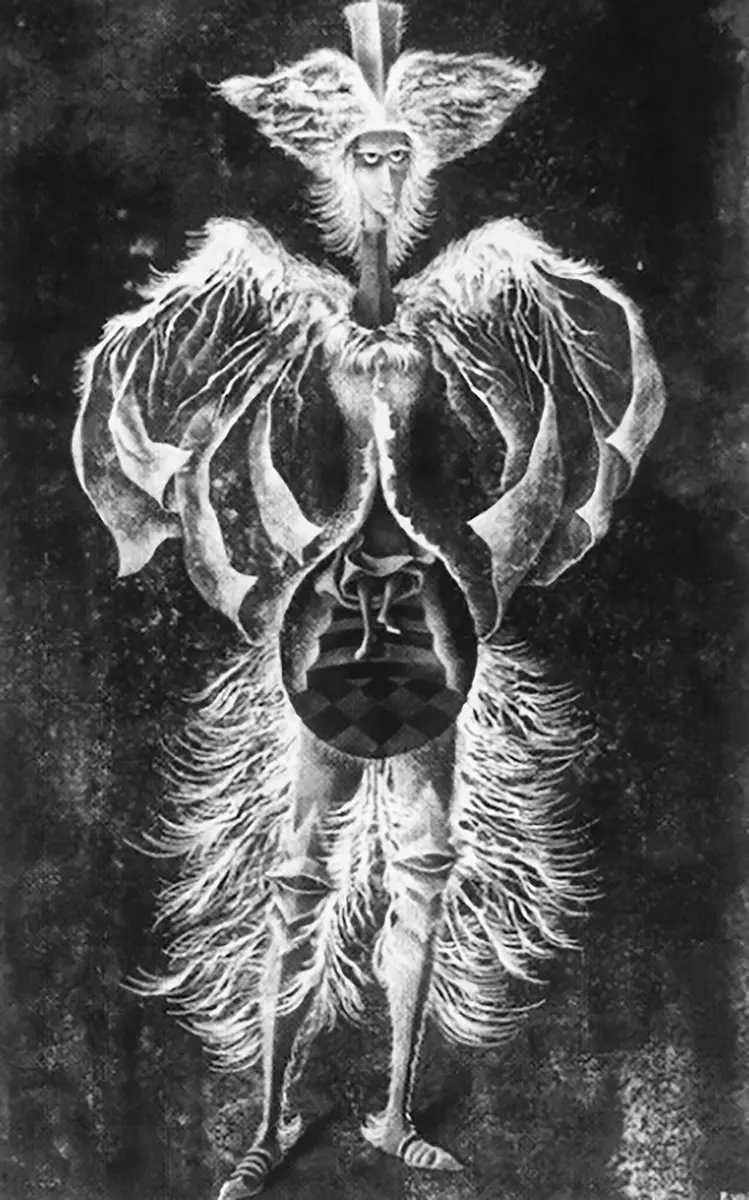
Throughout this incessant search, the driving force was the stimulated imagination championed by the surrealists who were to accompany her to the end of her days, as could be seen from the works on show in the Biblioteca Luis Ángel Arango. These pieces speak through the image, through an oneiric poetics based on psychoanalysis, literary elements, and constant references to Bosch.
The montage of the show endeavored to create an atmosphere in keeping with Varo’s world. The walls were painted in warm, dark tones and the paintings and drawings themselves were set against black suspended nets, which together with the light created a floating and unreal effect perfectly in keeping with the works. This very successful installation highlighted one of the most interesting paintings in the show, the self-portrait titled Personage (1958). There was a tendency in the montage, however, towards the illustration of aspects that were undoubtedly at the time important to the painter's work process.
In addition to the above-mentioned self-portrait, mention can be made of other very important works in terms of the artist’s love of and passion for painting and the invention of fantastic worlds. This passion was there until the end, as can be seen in Ascension of Mount Analogo (1960), Discovery of a Mutant Geologist (1961), Aquatic Taxi (1962), Strange Rites, Unexpected Visit or the Visitor, and Disturbing Presence (all three from 1959). Disturbing Presence was accompanied by a pencil on the paper sketch which shows, in the absence of color, how excellent the artist’s drawing skills were.
The show included a catalog of the works along with two presentation texts included in the exhibition, written by the Colombian historian Álvaro Medina and Gonzalo Celorio from Mexico. Celorio establishes a parallel between Remedios la Bella (a figure from One Hundred Years of Solitude) and Remedios Varo to link the "magical realism" of Latin American literature to the painting of Remedios Varo. Medina emphasizes the literary character of Varo’s work, which is indeed an integral aspect, and concludes: "When Remedios Varo referred to the creative characteristics of the world or the microcosmos, she spoke of creatures enveloped in a garment like a kind of heavenly placenta. This idea of a heavenly placenta makes me think that Varo's world is the record of a forked memory, with one part linked to the archetype and the other to her personal obsessions." This observation clearly illustrates the sources of these disturbing images which take us back to surrealism as a distant but constant reference which, over the years, served to emphasize the existence of an oneiric world with its own indecipherable and sometimes very suggestive keys.
MARTA RODRÍGUEZ