
Between May and July of this year, the Quinta Gallery in Bogota presented an exhibition titled Friezes by the Colombian artist Santiago Uribe-Holguín. The show consisted of his most recent work, the various aspects of which are both rich and interesting.
The artist spends part of his life in Spain. He comes from a strictly academic background, which he provisionally abandoned in the 1980s to explore abstraction as a means of expression. It was during that time that some of the things he saw remained with him, as he came to know closely the work of the Spanish artist Antoni Tápies. This was to definitively mark his abstract period and contribute to the initiation of a serious and close relationship with matter and texture. Also important at the time, however, were the archaic references, as he developed his interest in forms to be found in pre-Columbian and oriental art. Circles and hoops appeared submerged in diffuse atmospheres, with sifted stone being the main element. From that abstract period which the artist subsequently abandoned on his return to figuration, there remain a number of formal elements such as his interest in texture, in the color which materials suggest to him, and in giving his work an especially evocative and nostalgic atmosphere. It is precisely through the development of the use of these concepts, materials, and images that Santiago Uribe-Holguín not only manages to communicate with the spectator but to pursue his aesthetic searches for the meaning of beauty, like the ancient Greeks and Romans.
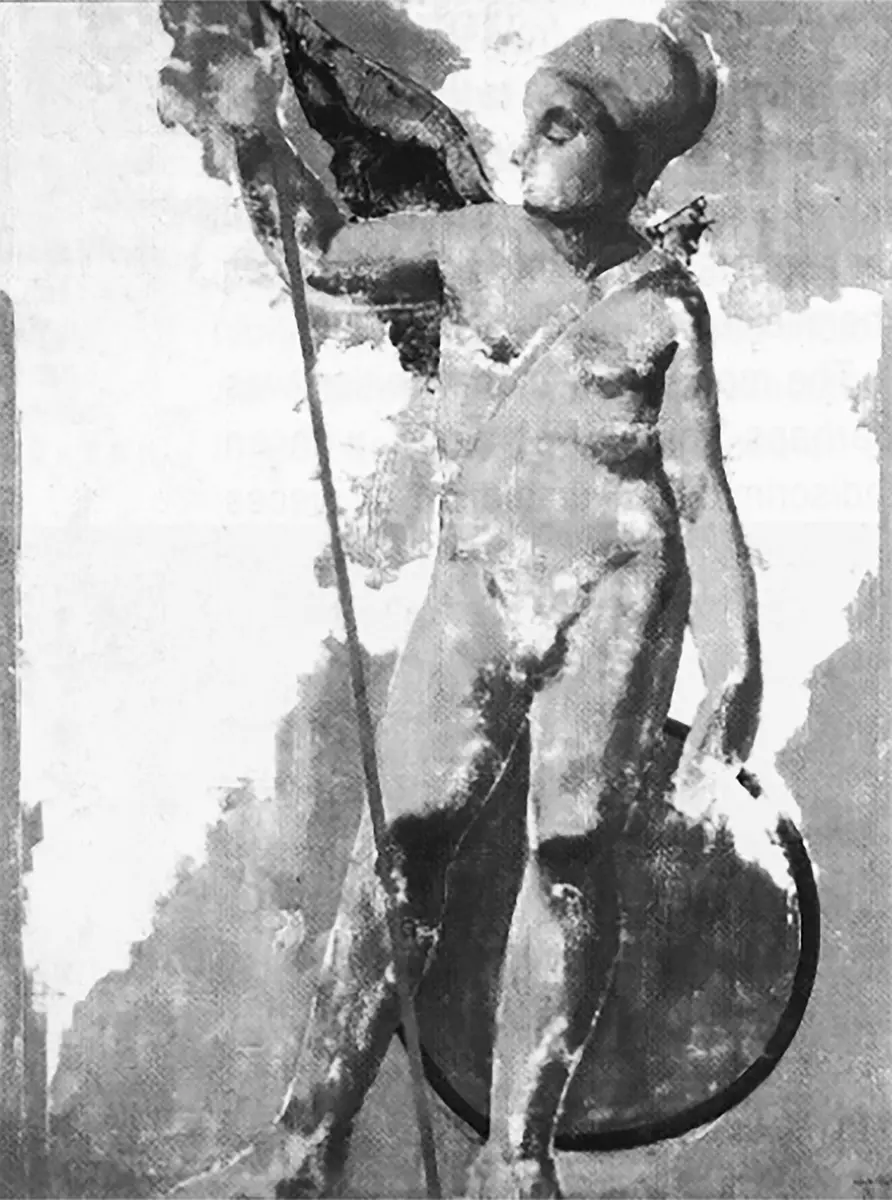
In his most recent work (1996-1997), the protagonists are angels, archangels, cherubs, warriors, and minotaurs, filling the exhibition room with an atmosphere that transports the spectator to mythological and remote times. For Uribe-Holguín, what matters is not what is painted, but how it is painted, and so he takes up subjects that have already been used by different artists throughout the history of art, as well as the theme of maternity.
The figures appearing within the stretchers worked on sheets of large format wood, clearly recalling mural paintings and classical statues. The texture in his pictures is provided by pumice stone, sifted sand, and acrylic pigments of earth colors, coming close to both stone and ancient wall paintings. This is a kind of two-dimensionality that the artist has developed with great sensibility and respect for his materials. The reading is cold since the color used is read as marble which has been exposed to the ravages of time, which in the three-dimensional works in stone appears as changes in color and the chipping and cracking of various parts. But sometimes it is also the human hand that eliminates part of a face, replacing and adding to it in a process of "restoration". Uribe-Holguín seeks out an intermediate point between the image which can still be recognized and the image which must be deciphered.
The faces and bodies which can be found in works from the classical period are the same which Santiago Uribe-Holguín is studying at present. He believes that the way of approaching and understanding the human body continues to be characterized by the same positions and physical characteristics. They share the same principle but have become contemporary since they have been working in the present. The use of light and shadow in the figures creates volumes for these bodies which seem to be infinitely caught in an instant of movement or to be posing for the sculptor before an amorphous piece of stone. In both cases, the process results in color stains in which the characters and the space in which they are set to tend to fuse together since pieces of each seem to break off and to combine background and form in a formal prolongation of the artist’s abstract period.
The works do not belong to any school and do not seem to reflect any specific time. Rather they seem to represent the point of contact between the classical approach to art and a modern intervention of classical works. At all events, each barely sketched face, devoid of any detail, seems to be a nostalgic and evocative element which in the final analysis speaks of a way of constantly reworking art itself. It is gratifying to find a series of pictures that so clearly reflect the artist’s pleasure in the act of painting. An act that generates pleasure since it takes time since it is a creative process in which the things and elements involved have their own raison d'etre, their own reason for being there. Nothing is left to chance since this might create a disorder that has no place here. Rather there is a clear intention to create works of art that will last, remain intact, and impermeable to the passage of time. Marguerite Yourcenar in her book About time as the great sculptor said that when a work of art is finished, it begins to have a separate life from that of its creator, and that this is precisely the moment in which it begins to live. She speaks of a first stage through which the stone passes and takes on a human form, and then a second stage in which time intervenes, wearing away at what man has achieved and even returning the material to its original mineral state. The work of Santiago Uribe-Holguín is a clear example of what Marguerite Yourcenar explains in detail, and indeed if there is a link between the artist's work and literature, it would seem that this text provides a definitive point of identification.
MARCELA MEDINA