
Drawing, the presence of the face, and interest in pictorial elements are constant characteristics of the work of Adonay Duque. On his exhibition Untitled at the Centro de Arte Euroamericano last June and July, the artist offered two premises which shed light on his artistic activity, "My painting is autobiographical", he says in the catalog text; and in a press statement he declared, "l am following a solitary path". His work is autobiographical not only because it includes self-portraits (he also used his children or friends as models), but because the figures he paints repeatedly are taken from the great tradition of the museum, the history of art, his preference for El Greco, the expressionists, Van Gogh, Soutine, and Reverón—all that can be expressed by great art. All these figures bear witness to the tormented individual, the innocent sacrificial victim.
About Duque’s solitary path, the phrase should be read in the present context of art in Venezuela, where the act of painting and working with an easel is looked down on by the proponents and practitioners of installation art. To be a painter of his generation is almost a rarity, and Duque, along with Lizardo, Pujol, Arria, and Bugullo, is an avis raris: a path pursued, perhaps by a hermit, but also in a spirit of faith.
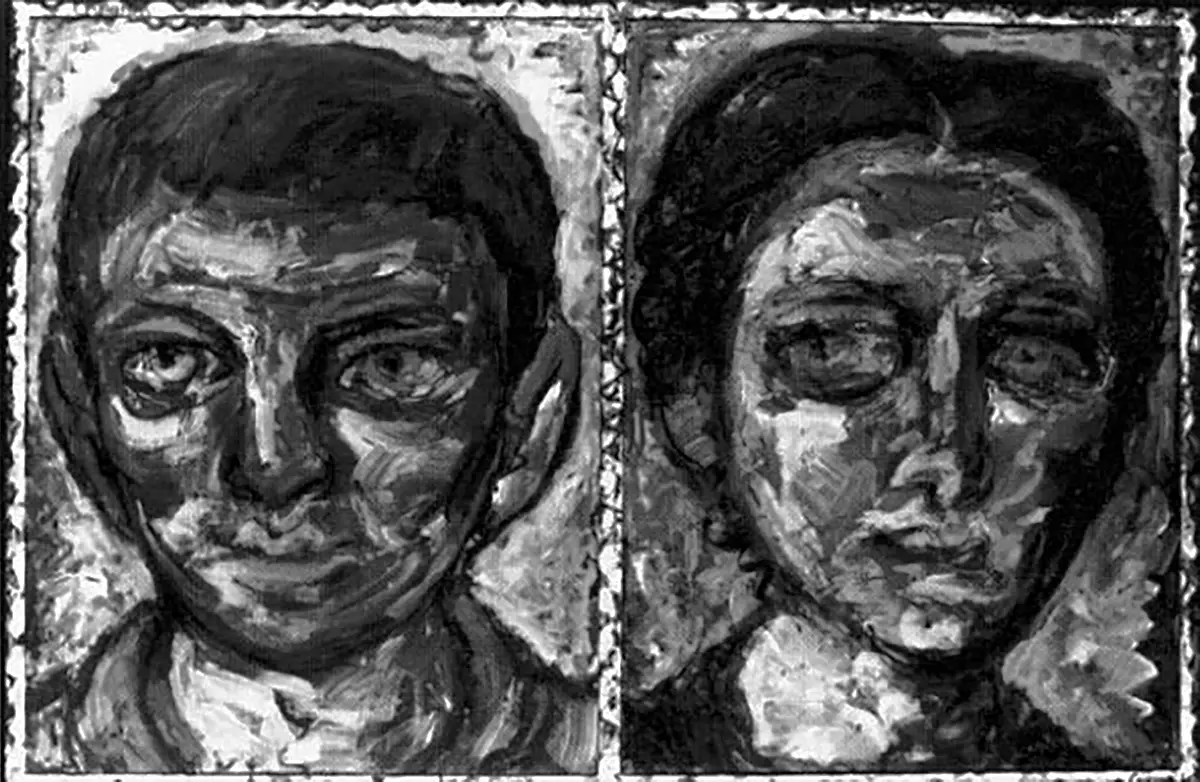
Duque appears unequivocally as a painter—a painter who enjoys painting, a painter of large formats, a painter has undertaken to represent use certain themes on canvas. The drawing is apparent beneath the texture and in the structural sense of each composition. His subjects are bodies and several portrait heads. There is a frenetic kind of line work, violent and rich in texture that reveals the fine mastery of the painter. Duque draws with his brush and constructs space through the rhythms and torments of color. This is a painting, but it is also a figurative painting.
The models painted by Adonay Duque are not ancient or fixed in the past, but on the contrary, belong to the present and radiate a sense of vitality: paintings, bodies, faces reflected in the presence of man and his glance. Their circumstance is their texture and their colors on the canvas. These are anxious faces that disturb the spectator. This accounts for their uncomfortable kind of relevance.
Contemporaneity offers multiple possibilities, although the new breed of sectarians argues to the contrary. There are projects concerning objects or ideas in space that, when resolved with sensibility, originality, plasticity, and philosophical thought, undoubtedly become an art. But here, as in any other kind of manifestation, the tumultuous repetition of models, copies which may be entertaining, and gestures made without any basis or root in experience are synonymous with a continuing lack of quality, a blunted kind of avant-garde. Alongside such expressions, in solitude and silence, there are painters who work, who develop their creative processes in interesting ways, and whose objects provide the basis for their imminent recognition.
JUAN CARLOS PALENZUELA