
During the month of May and early June, the Centro Colombo Americano in downtown Bogota presented an exhibition by Alicia Viteri, titled Pictorial Spaces. The work was executed in 1984 and has since 1986 been on a long journey which has taken it to the Intar Gallery, the Hispanic Art Center in New York, the Galeria of Quito, the Museo de Arte Contemporaneo in Panama City, the Museo de la Tertulia in Cali and the Banco de la República in Pasto.
The show presented in Bogota included Mural, a piece made of six panels in oil on canvas, in black, white, silver, and gold, with an overall size of 7x3 meters. In Mural Viteri explores the theme of carnivals and funerals, which are fused into a single act, with a host of figures invading the canvas to weep for their dead and to participate in dancing. The show included six preliminary sketches, seven oil paintings which, in a kind of chromatic close, highlighted some of the figures from the mural, and a video that documents some of the key moments in the preparation of the work, as well as its montage and exhibition.
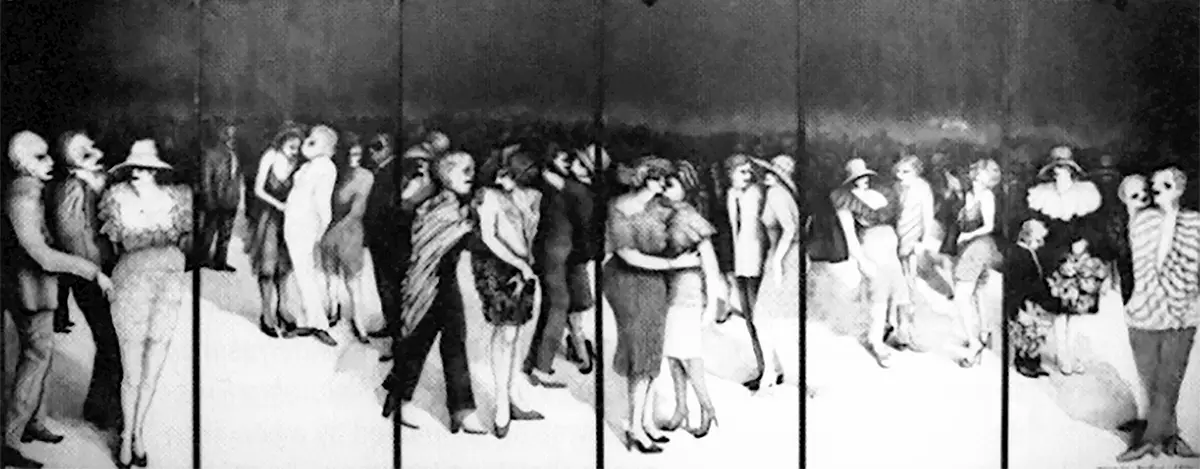
The main interest of the work lies mainly in three aspects. First, it is a work which at the time of its execution seemed intensely innovative: if we look at it from the standpoint of the Colombian art to which Alicia Viteri by training and nationality belongs, installation work then was then only just emerging. One of the few existing examples was that of Miguel Ángel Rojas, who began to enter this field at the end of the 1970s in the Atenas Salon and in the project room at the Museum of Modern Art in Bogota. Viteri’s work is not so much an installation as an environment that also makes use of sound—a recording mixing urban noise with music—which can be read in two ways. At times it suggests the buzzing of insects or it can be interpreted as the murmuring of the crowd.
Another important aspect of this environment is the handling of lights that color the figures who retain a natural scale. These elements help create an atmosphere and mood which go beyond the two-dimensional nature of drawing and painting to involve the spectator emotionally in the funeral and carnival presented on the large canvas. It should also be remembered that this work was conceived and constructed based on an artistic career characterized by serious research in the field of printmaking and painting.
The video included in the project is not so much a record of events as an essential part of the work, since it shows that the active participation of the spectator is what cancels out the frontiers between art and life, through the image of the television screen, making it impossible to distinguish between the crowd appearing in the mural and the crowd making up the public. The work also represents one of the most decisive moments in the artistic process of Viteri, in which she abandoned the world of the insects which characterized an entire period of her production in the 1970s, both in Bogota as well as in Quito and Panama. In using a very disturbing iconography she presented insects oscillating between a sense of tenderness and terror, which gradually became humanized and resulted in the prolonged metamorphosis culminating in the Mural.
Finally, this exhibition includes the preliminary drafts for the Mural which undoubtedly constitute, along with the series of drawings and prints of insects and the series titled The Mummy, some of the most interesting work of her entire career. These works can be seen as some of the most outstanding representatives of the drawing which emerged in Colombia in the 1970s. The oil sketches on the paper shows how the handling of the brush can lead to a sense of liberation in the medium of drawing, so that the emphasis falls on the act of drawing, with the linework revealing the moment of its creation. These drawings are done with such spontaneity pay homage to a pure sense of craft that has been nurtured by an inward-looking gaze, a gaze towards the human condition itself, as well as an outward-looking view towards the history of art. They reflect the shadows of Goya, the chiaroscuro of Rembrandt, and, with devastating power, the determination of expressionist art—features that, like a backdrop or atmospheric setting, have guided Alicia Viteri’s steps towards the creation of the Mural.
MARTA RODRÍGUEZ