
One of the most outstanding exhibitions in Caracas this June and July were Horizons. Limits of an Idea, by the Venezuelan artist Antonio Lazo. The show presented essentially spatial works whose dimensions exceeded the limits of their "corporeality" because of their conceptual, reflective, and contemplative intentions. With an almost "titanic" attitude, the artist transferred existing spaces—his studio in Paris—to the specific space of the Sala Mendoza. This transfer process involved a desire to overcome spatial obstacles—not just the geographical distance between Paris and Caracas—and to confront the spectator with an interesting experiment in perception. Though the spectator knows of the real existence of the urban landscape of Paris, its streets, and houses, as well as the artist's studio, the distance involved inevitably means that he or she only has an "idea" of these places. On the other hand, the artist transcends these limits or horizons by reconstructing the spaces in Caracas. It is his workshop and the place where that workshop is to be found, but it is also his idea.
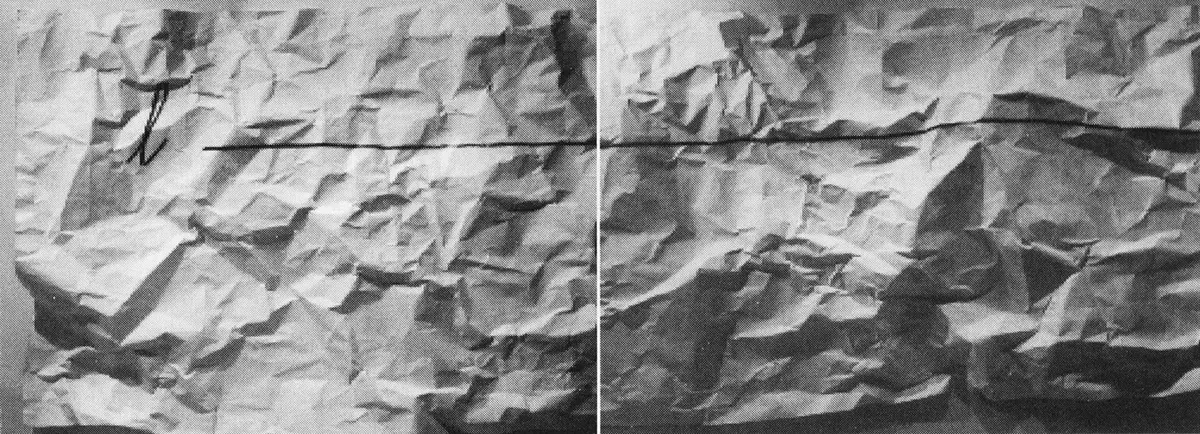
The exhibition moved from the general to the particular. The urban landscape was presented through models and other elements which illustrated the area in which the artist’s studio is to be found. As the spectator moved through the installation, he encountered increasingly specific spaces until reaching the artist's workplace. Here we find his objects. These settings were reconstructed with throw-away materials, such as paper, cardboard, fabric, and wood. A dichotomy was undoubtedly established between what is hard and permanent (the real studio) and what is ephemeral and disposable (the Idea of the studio). Lazo takes his models and then, using graphite or charcoal “traces- onto the paper some of the architectonic elements (doors, windows, walls, etc.), as well as objects from his studio (bookcase, ben6fi). The natural space, as Cecilia Fajardo-Hill rightly points out in the catalog, is depicted through its linguistic translation: "bird", "nest", "tree", etc. Thus, the concept transcribes the experience itself.
Inevitably the work occurs within a period—the movement of the spectator through these "places"—but the artist also transfers the real-time he experiences in everyday life into videos installed as part of the montage. These show scenes and sequences in the artist’s movements.
All these features confirm a move from the pictorial (the work from the I980s) to the conceptual. Drawing is essentially the appropriate medium for the objectives of this installation, but it is used here with the intention of transcending it. This desire to transcend is not new for the artist. In the I980s Lazo dazzled us with the voluptuousness of his pictorial work, which was prolific in its resources and materials. This time, he surprises us with the opposite characteristics: the austerity of the media, the fragility of the materials used, and even the sensation of “lightness- which can be felt. The installation is monochrome, neutral, and depersonalized by the systematized depiction of experience, but at the same time, conceived with a vast and voluptuous kind of conceptualization. This need for abundance is now focused on reflection and on the conceptual nature of the work.
And so, the spectator reaches the None Hour: a "room" with a lightbox that invites contemplation. It is the hour of inner thoughts and meditation. Here, as we face a “Closed- square, it is possible that we are taking the universe by the hand.
SUSANA BENKO