
Beatriz Milhazes’ painting establishes a sensual relationship with the ornamental, which to some extent is apparent in her preferences for forms and color, the same pleasing and lustful impression characteristic of Matisse. The spectator's gaze is forced to enjoy but also to specify the sense and significance that concepts such as ornament and decoration assume from such a perspective.
The exhibition presented by the Elba Benítez Gallery in Madrid gathered works from 1997, which clearly and forcefully emphasized the projects the artist has been developing in recent years. Her work can be set within the abstract trends which in this decade, have been based on the use of fiery and artificial colors, along with freedom in the use of forms introduced by the decorative element both as a referential and iconographic universe and as aesthetic temptation. Undoubtedly, it is the way in which ornament and decoration appear measured and apportioned in her work that determines their specificity, compared with the more formalist and specifically North American currents.
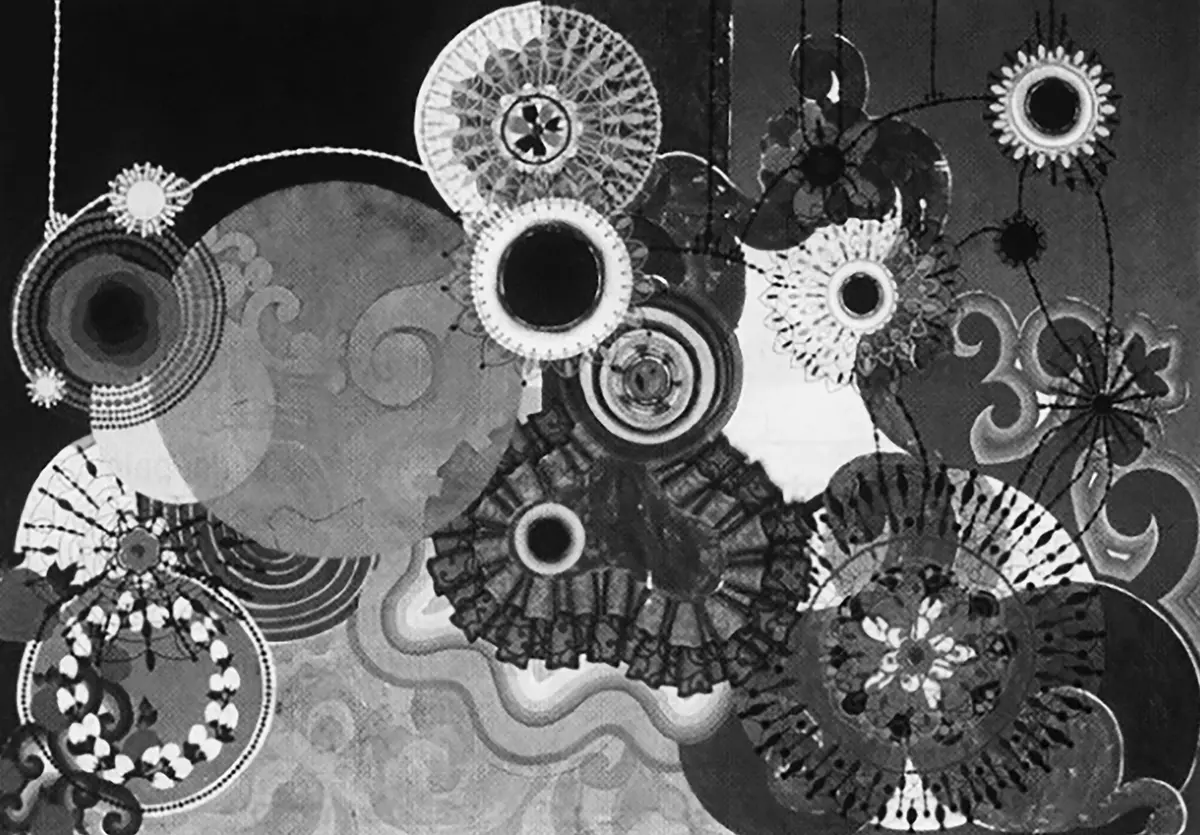
The Inverleith House in Edinburgh, Scotland was the site of a group show titled Theories of the Decorative, which included some of the most representative names of contemporary abstract production, such as Philip Taafe, Juan Uslé, David Read, Fabian Marcaccio, Leslie Wayne, Ingo Meller, and Beatriz Milhazes, in an exploration of the questions implied by the decorative in painting. The bringing together of these works provides some links and points of difference.
Abstraction in the 1990s has been dominated by the problem of decorative and ornamental. Sometimes, painting itself has become decorative and the frame an element of decoration, when the void in argumentation allows formalism, efficiency, and impeccable finish to prevail. In such cases, the pictorial acquires more the aspect of a piece of haute (or bas) couture which is acquired or used to decorate rooms—art as a symbol of economic or social status. At other times, painting uses these ornamental elements as pictorial tools or vehicles providing access to levels of perception or aesthetics ranging from the critical to the vindication of claims, the recuperation of the pleasure of the gaze, or the expression of the symbolic. The ornamental is indeed a vehicle of symbolic universes often hidden behind the avalanche of images imposed by the commercial and advertising markets.
The question of the decorative has often been dealt with, particularly in the United States, in discussions on painting and abstraction, but in general, the problem has been examined from a superficial and complacent standpoint regarding the commercial aspect, without taking into account the complexity of the implications of the decorative or the diversity of approaches adopted by each artist. The case of Milhazes is paradigmatic given its distancing from the decorative and its systematic use of the ornamental: her painting is articulated around color which generates the recognizable or imaginary forms of the ornamental. The picture appears as a meeting place of forms that have been imagined or conceived based on the idea (and symbols) of what ornamentation may mean at the popular level. Like a kind of patchwork sewn with the painting itself, the color planes immediately suggest tablecloths or tapestries in which the imagination
may soar freely. The use of monotypes and transparencies to create superimposed forms and colors has been gradually replaced by painting, with the baroque effect being maintained more as a kind of sensibility or perceptive arrangement than as a technique.
Simply put, Milhazes’ work forcefully and vigorously addresses the problem of the decorative, distancing itself from what would be a facile exercise, namely an anthropological or social essay on the reality of the popular aesthetics of the domestic work which it adorns: it is not easy to imagine the possibilities of a transfer to the painting of these aesthetics which have never been standardized or stereotyped, but which have always remained in constant movement. The popular roots which we can sense in Milhazes’ work fuse with the iconographic legacy of modern ornamentation; both consume one another and give rise to the chaos of the imagination.
The abstraction borders on the figurative and reveals the mysteries of ingenuous sensibility, tackling the poetry of affectation without concessions to a repetition of claims and discourses about feminine sensibility. The way in which Milhazes deals with these problems allows her to make use of irony. It also facilitates the recovery of the ornamental elements in their original purity, with culturalizing prejudices, to reclaim memories nurtured by a process of permanent crossbreeding and evolution between the ancient and the modern, the oral history, and soap opera aesthetics. In this way the ornamental highlights the decorative as a place of reflection which goes beyond mere pleasure.
SANTIAGO B. OLMO