
In his recent exhibition, Carlos Salazar showed a group of paintings that seemed to explore the theme and phenomenon of visual pleasure. These paintings, some diminutive and some wall-sized, typically featured a female figure or a group of female figures arranged in shallow space or against a patterned background. These women, rendered with a somewhat dry Realism of contours and nearly flat color, seemed to represent objectification of fantasy types of beauty, ranging from the Ingres-like nude to the sex kitten, in an interesting mix of the classical and the contemporary, with a nod to the allegorical.
Yet the effect ultimately resides in the Apollonian rather than the Dionysian side of the scale. In two paintings, Fishing at the Mainstream (1996) and The Sprint Affair (1995), Salazar's taut compositions are flattened into a picture plane fractured into a mosaic of irregular panels and interlocking shapes. His simplified treatment of these figures results in abstractions that blur the lines of the individuality of the models. But while Klimt or even Alex Katz possessed graphic strategies for dealing with the figure not dissimilar to Salazar’s, his reduction of form is accompanied by a reduction in type, taking the heat and personality out of his models. This serves his purpose, however.
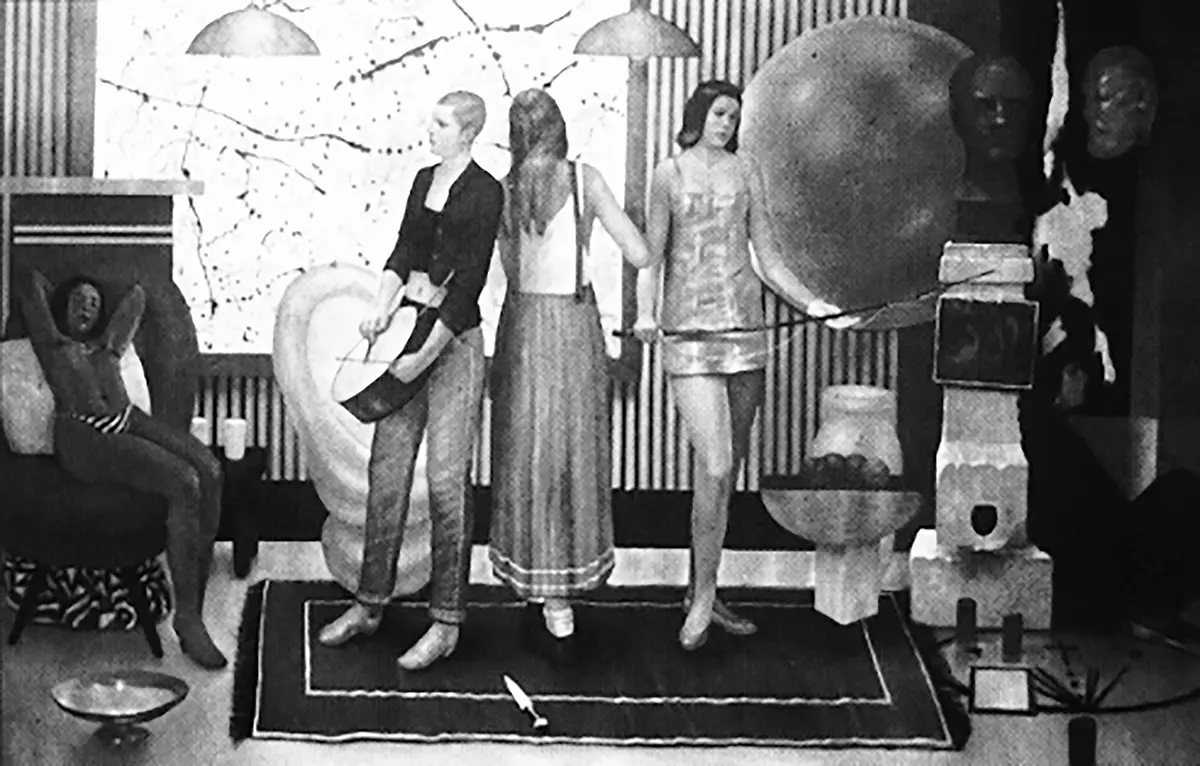
Salazar’s prolonged and gratified looking is compensated for by restraint and an eye disciplined to the task at hand—to transmute the visual pleasure enjoyed by the artist into an object of visual pleasure for the audience. The textureless surface of Salazar's paint, the order of these structured compositions, the isolation, and detachment of his figures all complement the detached scrutiny which seems to be Salazar's strategy.
The Judgment of Paris (1996), for example, features a group of women in one composition, though each is dressed (or undressed) differently from the other, and each is sheltered and framed in some kind of visual niche to quattrocento effect. The simplified setting, with its lack of reflected colored light and, for the most part, cast shadow, does not partake of the reality-enhancing function of atmosphere. It is not at all a space that “makes sense» but Salazar’s interests are in the service of the completed painting, not the logic and transparency of Realism.
Like the gesture he represents several times over among these paintings, Salazar is engaged with his paintings as objects in the Modernist sense, as objects of beauty, and lastly as objects of desire. The combination of eye-catching colors and shapes and libido-attracting figures is a surefire one. Dripping Venus (1995) is probably the stand-out in the show by virtue of the pure lusciousness of Venus' curves, though Salazar’s other particular strength, his ability to reach for rich and off-beat color combinations and relationships, is on display in every piece.
K.K. KOZIK