
David Alfaro Siqueiros was a visionary, but above all, he was a man who knew how to say no. Repudiation was at the core of his work as he translated his passionate and explosive mix of communism, confrontation, protest, and contacts into an array of irrefutable visual formats. Artist, manifesto writer, and labor organizer, he rejected social, political, and economic injustice with tactics that won him both supporters and enemies alike.
Siqueiros defined himself as a revolutionary, one who lived long enough to be perceived by a younger generation of Mexican artists as having taken a stance that solidified into its own conservatism. For another generation north of the border, Siqueiros became an inspirational figure whose acts of resistance enabled the possibility of social change in the wake of the struggle for civil rights in the United States. Now that a century has passed since his birth, the project of critically reexamining the contexts and constructs of Siqueiros' life and work has spurred the production of exhibitions, symposia, and catalogs that focus on his formative years through Mexico City, Santa Barbara, Houston and London venues of Portrait of a Decade, 1930-1940.
The paintings, lithographs, and woodcuts included in Portrait of a Decade, 1930-1940 were produced in Taxco, Los Angeles, New York, Uruguay, and Spain. As Siqueiros fused a life of exile, political activism, and art-making practices, he produced work of staggering variety and technical virtuosity. A smaller exhibition than in Mexico City, the show at the Santa Barbara Museum of Art provided an opportunity to see works widely dispersed in private and public collections by an artist rarely shown in the United States. Organized into six thematic groups, the 77 works gave a glimpse of a man consumed by his passions and intense political beliefs.
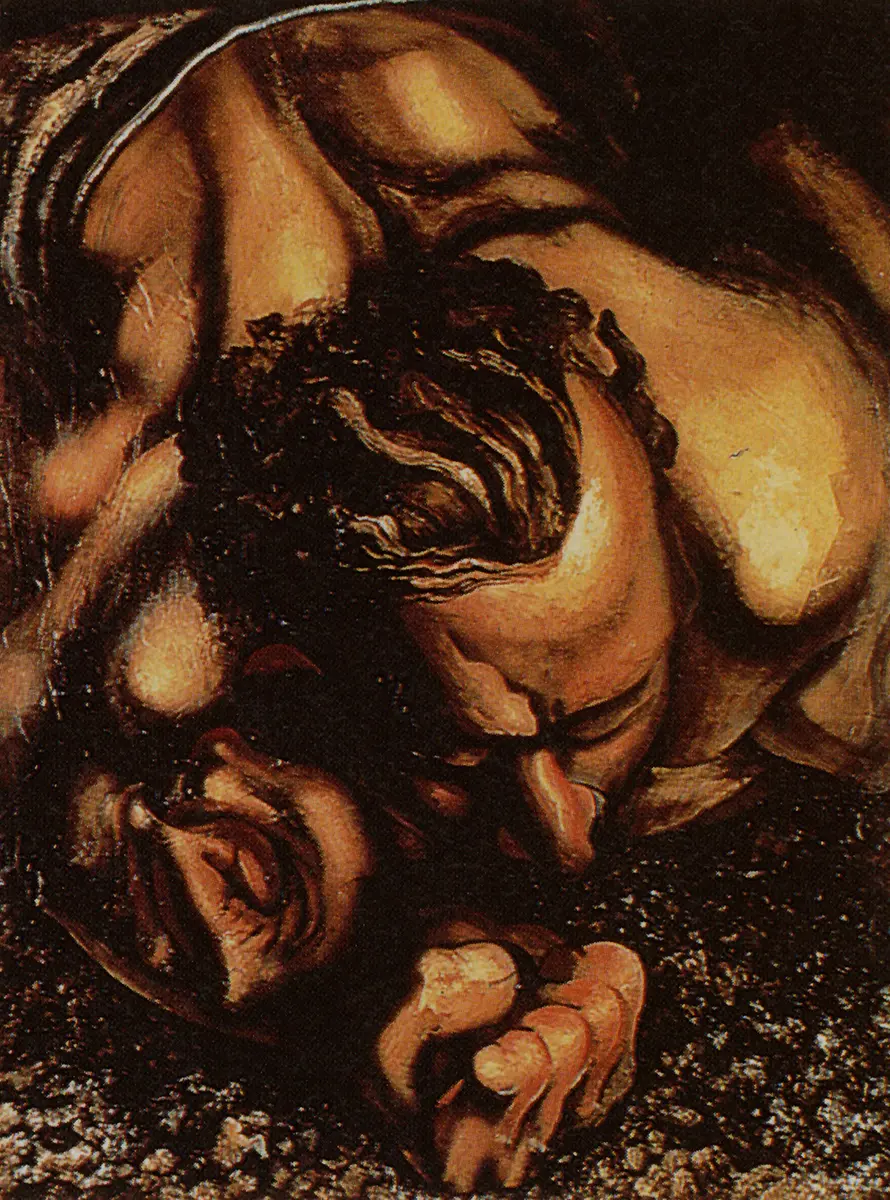
Siqueiros returned to art in 1930, after a hiatus of several years. His sentencing to Mexico City's Lecumberri prison followed by a year-long house arrest in Taxco by the Mexican government only intensified his resolve to create works that presented the reality of social inequities. He experimented with techniques and materials that would convey his vision of social change as an artist; it was a vision informed by photography and cinema. Tight space, per- spectival shifts, an earth-toned palette of deep browns, rusts, and orange hues—these elements soon shifted over the first half of the decade as Siqueiros continued to experiment with the painted surface, pushing and stretching the bounds of an expressionistic realism that first transferred the textured surface of traditional fresco onto canvas, then onto the raised clotted surfaces of burlap, and later, moved into the luminosities captured in pyroxylin, an industrial auto paint, airbrushed onto panels.
Organized chronologically, Portrait of a Decade opened with a series of paintings and woodcuts done in prison, and closed with paintings filled with references to an escalating Second World War. The six sections of the show were "Penitentiary, 1930"; "Mexico Today, 1930-32"; "Portrait Gallery, 1931-36"; "Revolutionary Struggle, 1930-35"; "Towards War, 1936"; and "Down But Not Defeated, 1939", which included works containing allegorical references to his participation in the Spanish Civil War.
The work Siqueiros produced about Mexico City's Lecumberri prison conveys the sense of endless waiting and danger that came with incarceration. Despite the heavy atmosphere of the prison, the artist continued to experiment with the abstraction of the human form and the manipulation of space, its compression analogous to the pressures exerted by the institution. In Penitentiary, 1930, a group of women wait to enter the prison at dawn; the faceless body of one woman merges with her dress into a columnar form that conveys resolute anonymity, from a view tilted by the painting's orthogonal perspective. Even Siqueiros' conjugal visits were food for experimentation: three works featured his companion (and later, his wife) the Uruguayan poet Blanca Luz Brum within the setting of the cell she visited.
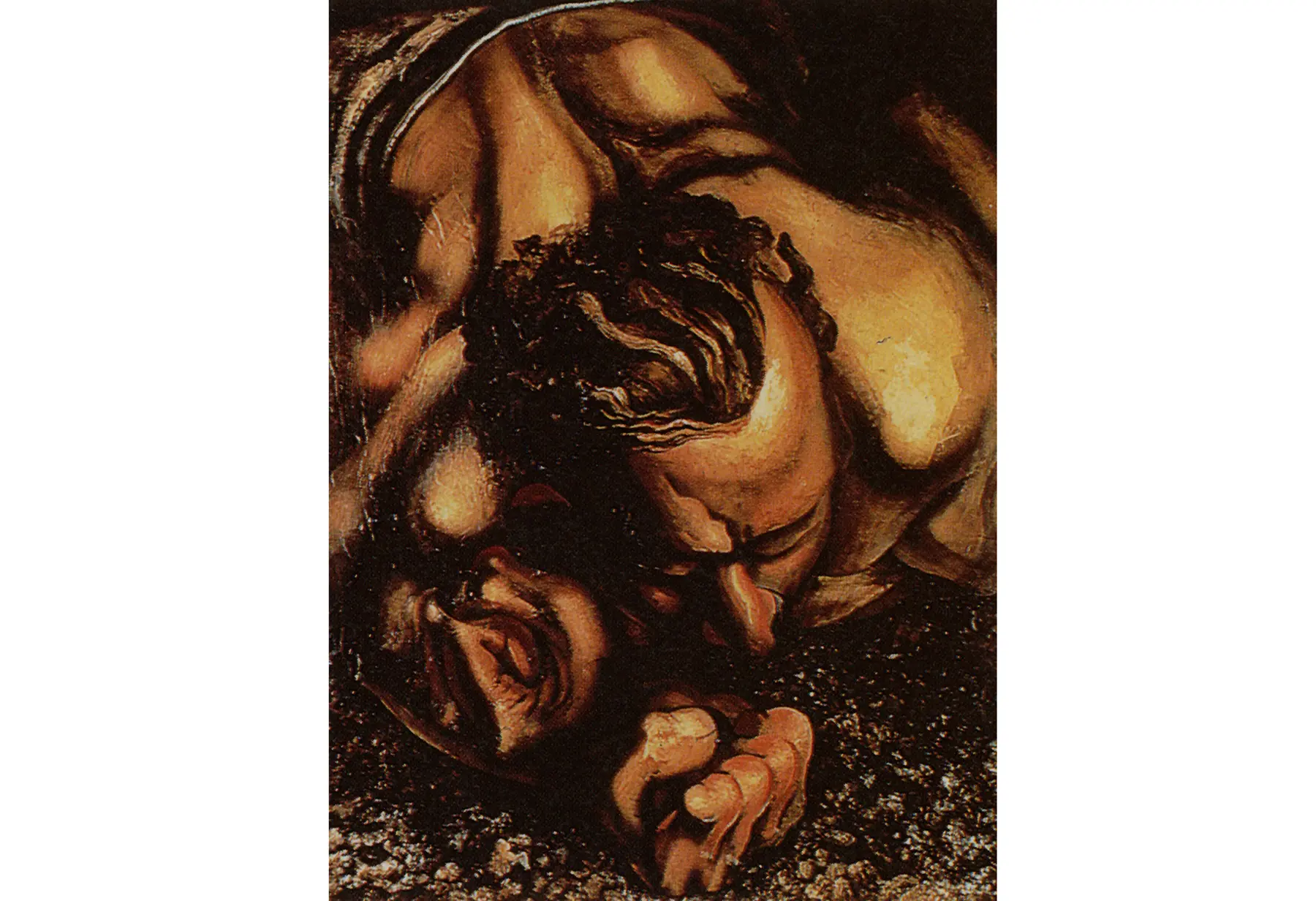
"The Portrait Gallery, 1931-1936" contained works that ranged widely in format, texture, size, and materials, including portraits created in Taxco, endowed with a monumental sensibility by having the subject thrust into the frontal plane in an extreme close-up, as in his Uruguayan portrait of Violeta Brum, (1933). Thick strokes of paint sculpt the planes of the head and combine (and sometimes clot) with the surface of the gessoed burlap and woven coconut fiber mats used for doormats and floor coverings that Siqueiros occasionally used as supports. Among these portraits were friends, lovers, acquaintances, and patrons, a rich combination that suggests the complex emotional and economic support system that sustained Siqueiros during the 1930s: William Spratling, Moises Saenz, Lone Robinson, and Josef von Sternberg.
"Mexico Today, 1930-32" included the enormous easel-sized mural, Accident in the Mine, as well as Peasant Mother, Maternity, and Proletariat Mother. The combination of genres, concepts, and challenges in these works were important precursors to Siqueiros' three Los Angeles murals of 1932. Two of these survive (Portrait of Mexico Today and America Tropical, the latter now in the process of being consolidated and preserved by the Getty Conservation Institute). After 1933, beginning with Victima Proletaria, surfaces of metal, board, or panel were painted with pyroxylin.
Ethnography (1939), one of Siqueiros' best-known paintings, offers an allegorical critique of the anthropological gaze. Through the monumental image of a peasant wearing an Olmec mask, the painting illuminates the temporal juncture between perceptions of Mexico's pre-Columbian past and its present peoples. Two other works from that tragic year, The Sob and Down But Not Defeated articulate responses to the rise of fascism that was deeply emotional, yet, like many of the portraits, maintain traditional gender roles. Despite the crushing blows from the collapse of the Spanish Republican government and the Nazi invasion of Eastern Europe, these two paintings function as an invocation of agency and resistance rather than surrender in this darkening hour of the war.
The exhibit's momentum dissipated somewhat in its last sections, beginning with "Revolutionary Struggle, 1930-35". Exhibited in this section were two lithographs of nudes, a portrait of Zapata from 1931, as well as a powerful 1936 work that featured the attempted abduction of his lover's child (The Abduction). These were incongruously grouped together with Troop Train, Rally, and the chilling Allegory of Maria Harraz Mireda de Terra (1933). This section could have been strengthened by a greater focus on Siqueiros' activities during his 1932 exile in Los Angeles, so critical for understanding the production of works created immediately after that year.
The symposium Siqueiros in Exile held at the Santa Barbara Museum of Art on April 27, 1997, featured three presentations, two of which were by members of the curatorial team for the show, James D. Oles and Mari Carmen Ramírez, and a third by Shifra M. Goldman, a well known Siqueiros scholar. Oles' presentation gave some insight into the formation of an audience and market for Siqueiros' art during the 1930s, and then recounted the trials and tribulations of locating works for the exhibition, many of them shown in the United States for the first time since they were painted.
Ramírez's “Siqueiros: The Mural in the Age of Mechanical Reproduction" located his work in terms of the artist's theory and practice of poly-angular perspective—a cinematic technique that evolved from his meeting with Eisenstein in 1931, and was introduced in 1933 with the painting of the mural Plastic Exercise in Buenos Aires. The complexity and contradiction of modernist influences Siqueiros absorbed (Cezanne, Futurism, and Cubismamong them) while studying in Europe contributed to the development of his artistic theory and political practice. Highly informative are Ramirez's catalog and symposium essays which offer an analysis that begins with Benjamin's Art in the Age of Mechanical Reproduction and examines Siqueiros' application of Eisenstein's theory of montage to the creation of a new paradigm of revolutionary painting on walls for the masses.
In contrast, Goldman's “Siqueiros Among the Angels" investigated the rediscovery and vernacularization of Siqueiros' work among the new muralists in the United States from the late 1960s to the mid-1980s. She emphasized how the dissemination of his work was accomplished by appropriation, revision, and adaptation of themes and styles rather than by the technical systems he developed.
Portrait of a Decade, 1930-1940, curated by CURARE and sponsored by the Institute National de Bellas Artes, marked the centennial of Siqueiros' birth in 1896, and the first extended examination of this crucial formative decade. Events and publications produced in conjunction with the exhibition have brought new and welcomed critical analysis and debates in its wake, and covertly serve as a reminder of the power of visual images in inciting outrage and sparking social change.
ELLEN FERNÁNDEZ SACCO
She is currently completing her dissertation at UCLA. This summer, she held an Andrew W. Mellon Fellowship at the Library Company of Philadelphia and is the curatorial consultant for the America Tropical/David Alfaro Siqueiros Interpretive Site in Olvera Street.