
Polish/Venezuelan artist Gabriela Morawetz’s recent exhibit at Gómez Gallery showed the formal and thematic links that unite her creations in these varied media and the ways in which aspects of one medium nourish her expression in another.
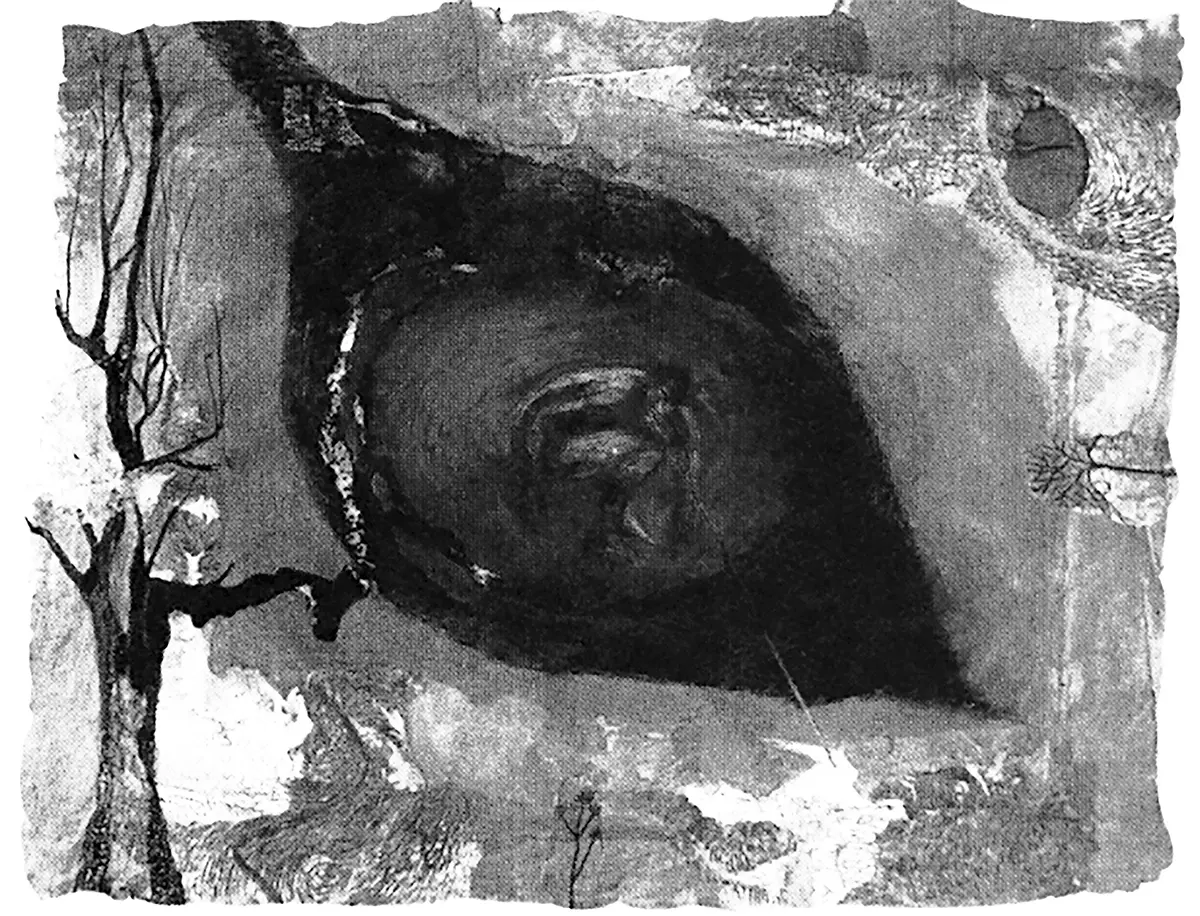
Beings in fetal positions inhabit her mixed media paintings on paper. Although semi-abstracted landscapes occupy most of the pictorial space. Morawetz employs several compositional devices to ensure that her androgynous humans dominate the work. Despite their relatively small size, these individuals are clearly not infants. Pierced by sticks like some ancient human sacrifice or covered with mysterious thorns, their ritualistic presentations uncover the internal psychological difficulties associated with growth, change, and maturity.
Morawetz explores similar ideas in many of her photographs, where the specifics of reality define her beings as adults. The intimations of motion, sometimes through pose, sometimes through the blurring of the figure itself unite internal conditions and external action. Morawetz models dance, run, or swing in ways that are idiosyncratic yet recognizable, remnants of some long-forgotten moment of humanity’s shared past.
The solitary beings in her photographs inhabit far more complex landscapes than those of her paintings. In a pair of works related to her painted figures, people crouch before elaborating offerings set in ambiguous spaces that seem part artist studio, part primeval forest. The figure's place in nature is still suggested, but the relationships between man and nature in these works are more troubling.
The thematic links between her paintings on paper and her images on the photosensitized, painted slate are further emphasized by the formal elements that unite them. The inherently uneven surface of the slate, highlighted with touches of gold powder, denies the uniformity of the photographic print. The wrinkles, folds, and tears Morawetz inflicts on her paper violate the expected form of the image’s container, imparting a visceral quality to the acts of creation each work demands. In both cases, she emphasizes the rough beauty of her material, unifying the expressionistic trends in her mixed media works with the specifics of her photographs. Her intent is not to replicate or evoke the glass negatives or ancient scrolls in any of these works. Nonetheless, the irregular slate surface effectively recalls the character of early 19th century photographs and provides intriguing points of contrast with the contemporary sensibilities of her images.
The bare branches of frozen orchards and gardens in a trip of photographs provide the most telling connection between Morawetz's formal concerns and the philosophical concerns of her figures. While the fractured lines of these winter landscapes echo the irregular surfaces she employs, their subtle ordering also shows a human hand at work. The face of death and deterioration holds its own haunting beauty as it simultaneously expresses the hope for a fruitful renewal.
Morawetz’s vision arises from a territory where nature, in all its power and terror, still dominates the human consciousness. Her figures engage in rituals evoking the eternal cycle of birth, growth, death, and renewal. Their aim is not so much to control these forces as to create alliances with them, an imperative no less critical to early agricultural peoples than to today’s urbanized society.
K. MITCHELL SNOW