
Joaquin Torres-García remains one of the less well-known artists in the U.S.A. and a strong representative exhibition of his works come along rarely. The recent exhibition at Jan Krugier was both timely and informative. This exhibition had the added benefit of being taken from the collection of Torres-García’s children, works that have never been seen before in the United States. Looking at this representative survey of Torres-García’s life and work, it is easy to see how those who chose to embrace a more dogmatic purism in the art could be offended. In the paintings and wood constructions on display, Torres-García presents us with the geometric abstraction that is not purely geometric and shows some suggestions of modeling, cubist-derived paintings that nonetheless look organic, and many works that walk the fine line between abstraction and figuration. This is an exhibition of works by a man who assimilated everything but imitated nothing.
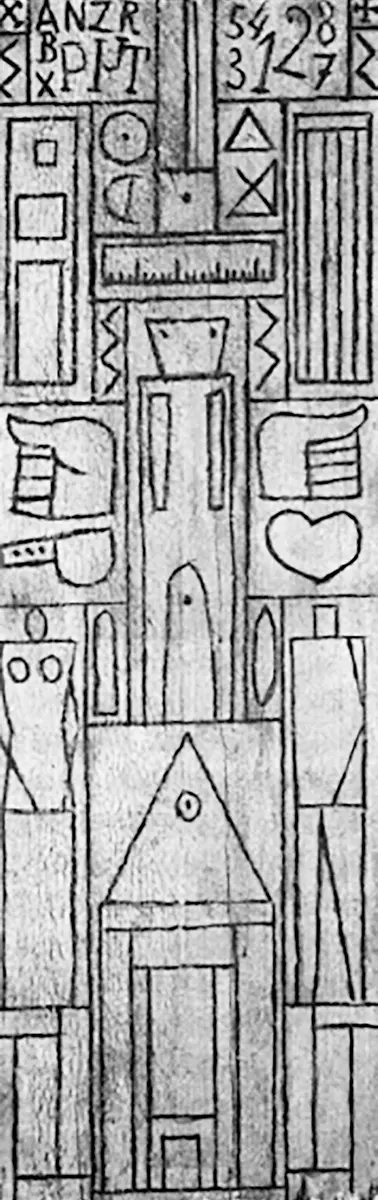
Torres-García’s assimilation of more indigenous tendencies is equally impressive. In this exhibition, one sees a few paintings in which pure geometric planes of color come together to form figures and symbols taken from Incan art, and wooden reliefs give way to hand-carved children’s toys. Among the more impressive types of painting, however, were the works that were subdivided into imprecise grids and filled in with arcane linear drawing, such as Constructive Grafisme. Looking at these paintings, we find a clear precedent for Gottlieb’s Pictograms of a decade later and an example of Torres-García’s dual function in the course of 20th-century art: as an assimilator who demonstrated the possibilities in what was developing around him, and as an innovator who inspired those who came after.
He sought a personal artistic idiom for the Uruguayan artist (and the South American artist in general). He believed that his countrymen could no more renounce their European ancestries than they could deny the influence of their indigenous (or as he often wrote, Indo-American) culture and that a fusion of all these tendencies would lead to an authentic and viable South American art.
JOHN ANGELINE