
The end of a century and of a millennium is a propitious occasion to look back at the past, to take up again newly elaborate memory fragments that have been lost or overly simplified by official stories with excessively globalizing claims. In Colombian art, there is a variety of artists who think about memory, not as a simple referent, a reminder of the collective unconsciousness, but to sensitize the observer to his past.
History, memory, and the ideology of power constitute an ever-present trilogy in the work of Juan Fernando Herrán (Bogota, 1963.) He is interested in history not for the knowledge of the past per se but rather, for the extent to which it allows for the evocation of situations that continue to maintain a foothold in the present. To paraphrase Antonio Machado, we could say that Herrán is concerned with: "The epic song that sings and tells of a yesterday that continues to be," reflecting on those experiences that seem unchanging in human beings, as they are cultural patterns closely tied to the ideology of those who exercise power.
And out of that, the intention is to recover fragments of our collective memory, using methods resembling those of an archeologist. That way of working supposes for the artist a certain kind of inquiry and documentation that seek to show continuities but also contradictions, that recover memory to prevent amnesia while at the same time proposing other gazes toward the past.
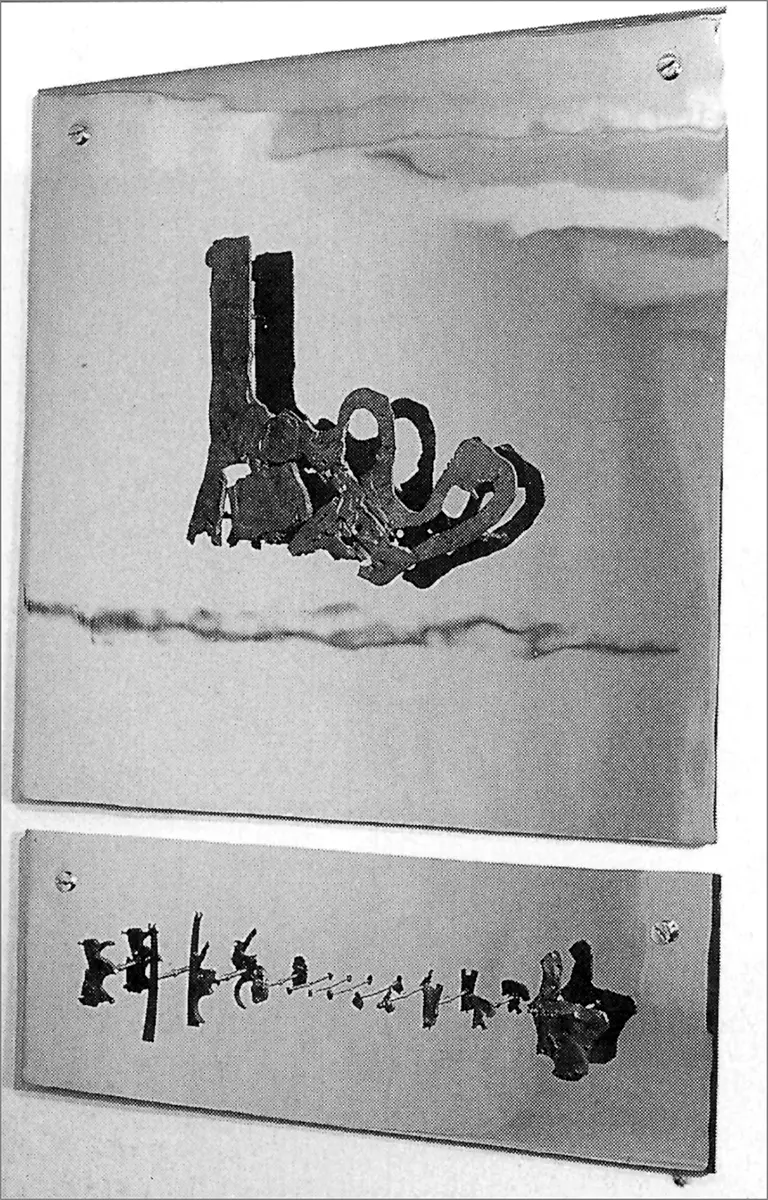
Starting with his objects at the end of the eighties, Herrán explored the possibilities of clay, a material laden with history. He modeled it with his eyes closed, giving priority to the tactile, letting the prints of his fingers remain in the irregular implements that resulted. The objects have a certain pre-Columbian resonance though alluding to uses far from the original. It is possible to be an active or passive subject when looking at these disturbing implements which awaken latent feelings in the observer. They refer to pre-Columbian forms but also resemble instruments of torture and it is perhaps the memory of the spectator that con-, fronts an open reading.
Already in those objects, Herrán left no doubt that his intention was not to denounce them but to show them as part of the violent space that produced them. The duality of the reading implied the chosen material as well: the unfired clay evokes past cultures but at the same time is such a fragile material that as an object it is ephemeral.
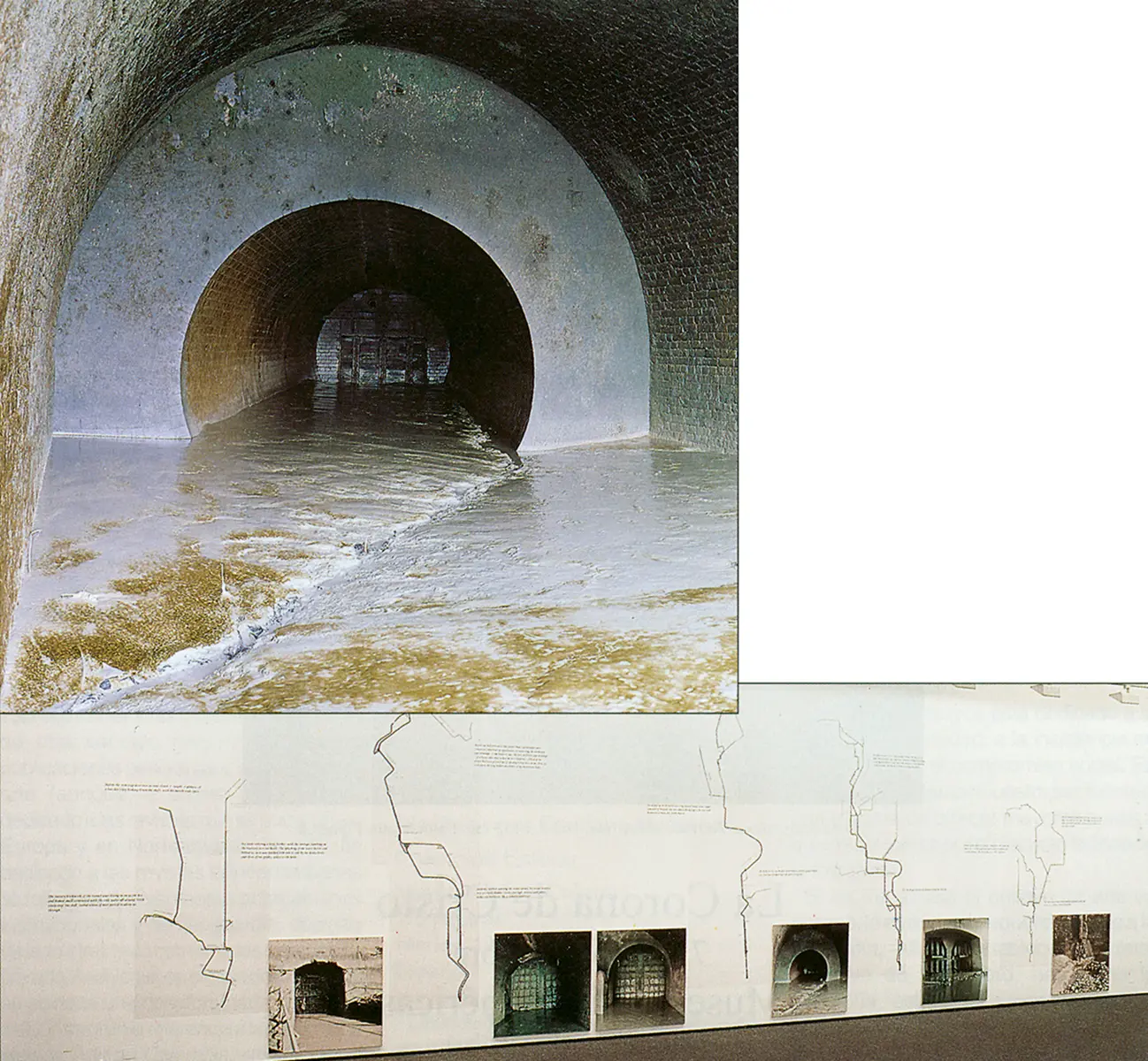
His trip to London in the nineties led him more directly into an investigation of historical memory, through the recording of objects he offers as fossils of contemporary civilization. This is an era in which we are so familiar with refuse that it forms part of the daily urban landscape. Interested in probing the relationship between man and nature more deeply, he took as a focus for reflection several London rivers, such as the Thames and other tributaries. Lost, confined, channeled rivers, turned into drainage systems, far removed from their original function. Herrin gradually discovered that de-naturalization when he began looking into various texts from the 19th century.1 The central line of his research was not based on the study of nature as a landscape or as an aesthetically beautiful object. His search took the direction of personally experiencing the danger that hovers over it as man expands his urban growth. In his piece Geographic Transformations (1995- 1996) the landscape became an archaeological reconstruction. Making use of photographs, drawings, and texts, he attempts to reconstruct the history that lies behind that domesticated nature. He reveals how places that once were critical points of communication were converted into trails, sealed under heavy metal lids that blur and cause to vanish from sight that which was their original purpose. That investigation that sinks to the bottom of lost memory, it is attempting to recover, also reveals the power of man to repress, even the free flow of nature.
Traveling through these walled-up spaces not only furnished him with elements with which to think about the consequences of the repression but also with working materials. His position as a Colombian immersed in a context that provoked dual feelings such as attraction and alienation led him to enhance the highly manual aspect of his work. Manual work and recycling were two elements incorporated into his later work. Traveling through those marginal sites of the British capital provided him with osseous remains with which he assembled a large ball of bones that alluded to a kind of summary of different cultural referents. An object made of those materials was the central piece in the project Inter farces et urinam Nascimur, with which he participated in the Biennial of Havana in 1994.
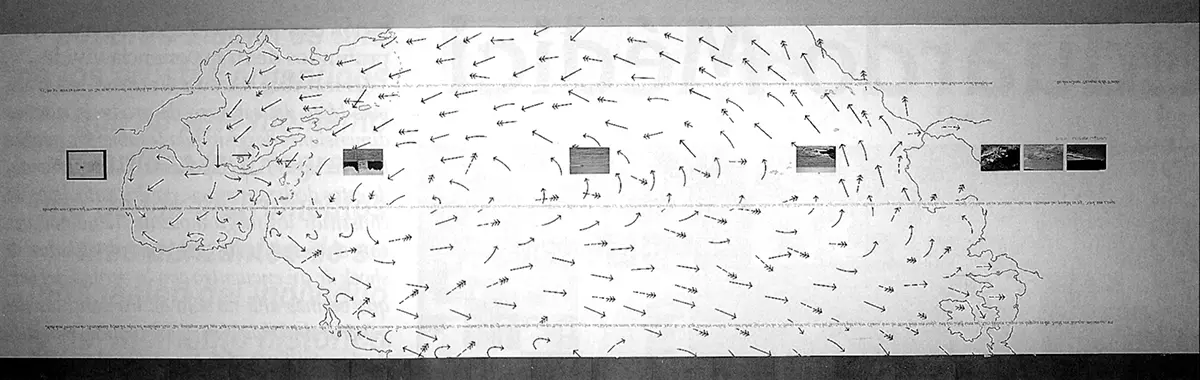
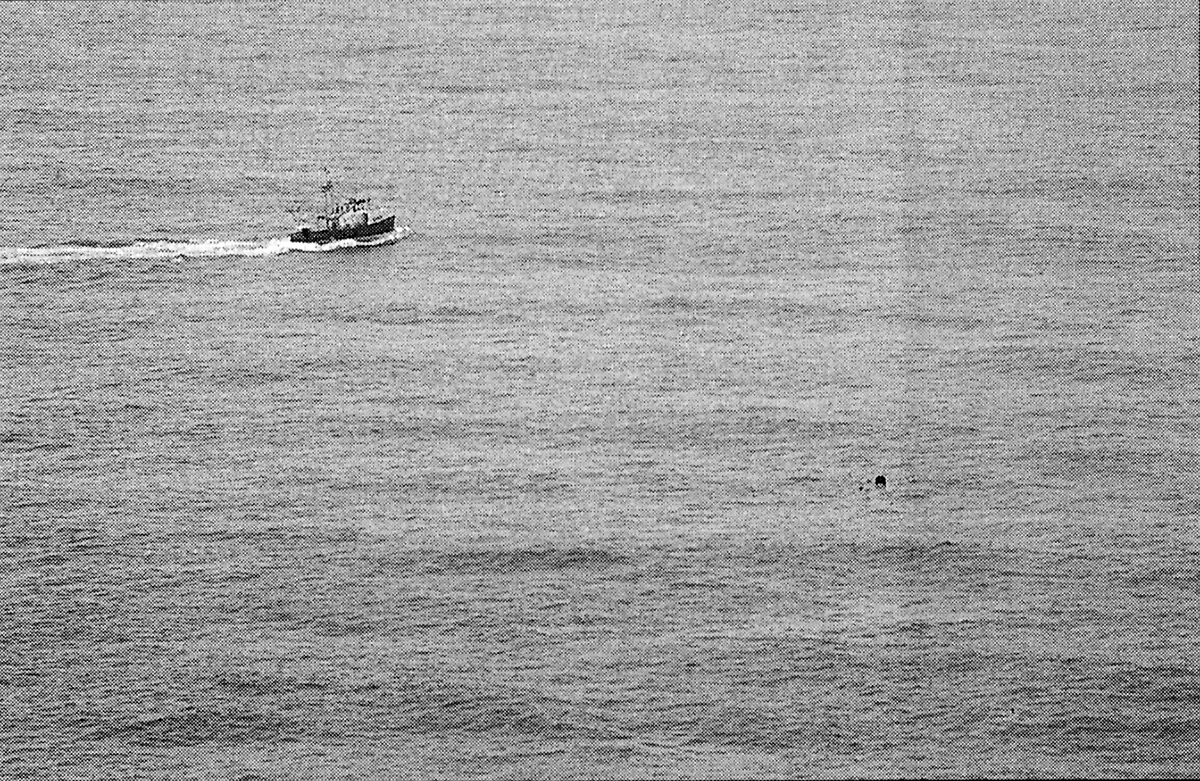
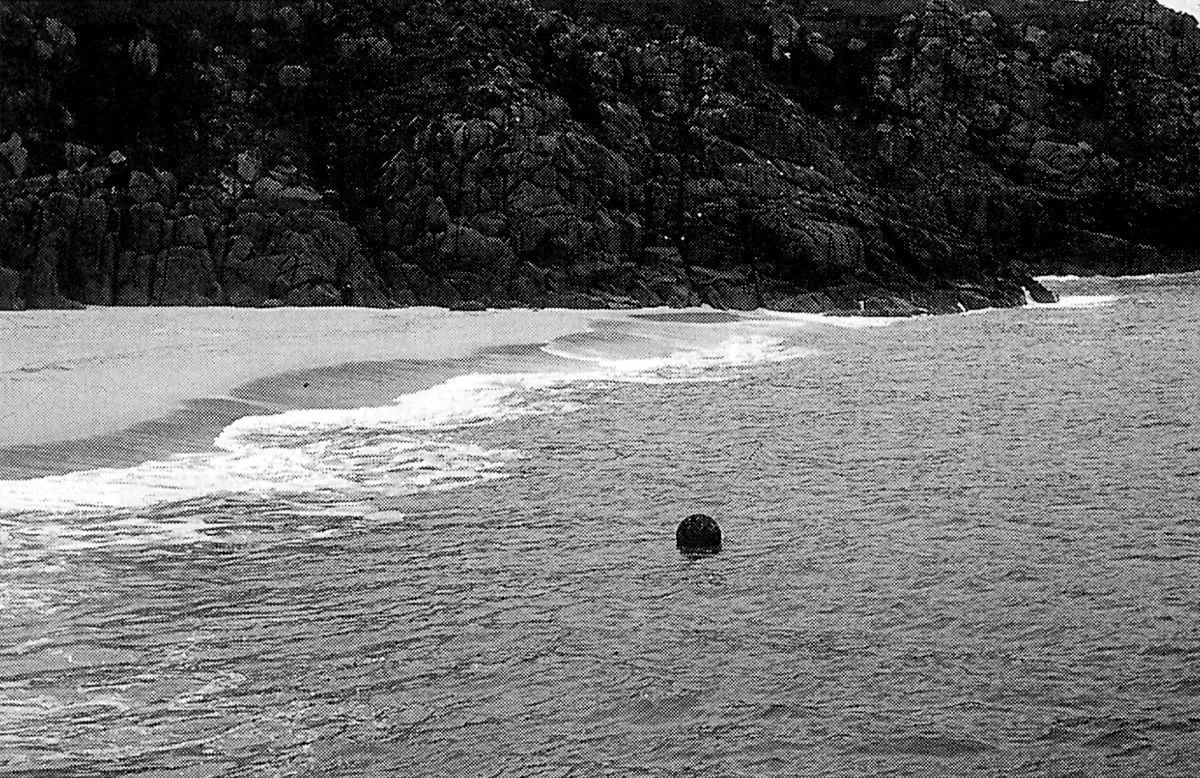
Following a careful study of ocean currents, a ball of bones, suitably prepared, was launched in March of 1994 from Land's End in England, headed toward Cuba. It would have to travel 4,271 nautical miles to reach its destination. Harrán had projected an ideal path after studying navigation charts, returning to texts from the past: a book on navigation from the 19th century in which the most suitable route was described connecting Land's End with Havana.
Lat 50'02'N. Long5'40' W was the name given to the project that brought together maritime charts of the ideal route, photographs of the action of launching the box of bones into the sea until it vanished over the horizon, and drawings. From the European coasts, an object began its journey to America, constructed with elements of the cultural memory of London and launched by a Latin American who was symbolically seeking to arrive at a place from which others wished to leave.2
Upon his return to Bogota in 1996, he worked on a theme of strong local content: the investigation is made of a series of well-known public figures accused of authorizing the entry of drug money into the last presidential campaign.
His work Anexo 273 made a direct reference to a legal proceeding. After reviewing the published information, and attempting to reconstruct the unfolding of events, he opted for the construction of the image of a concrete event: the handing over of the money.
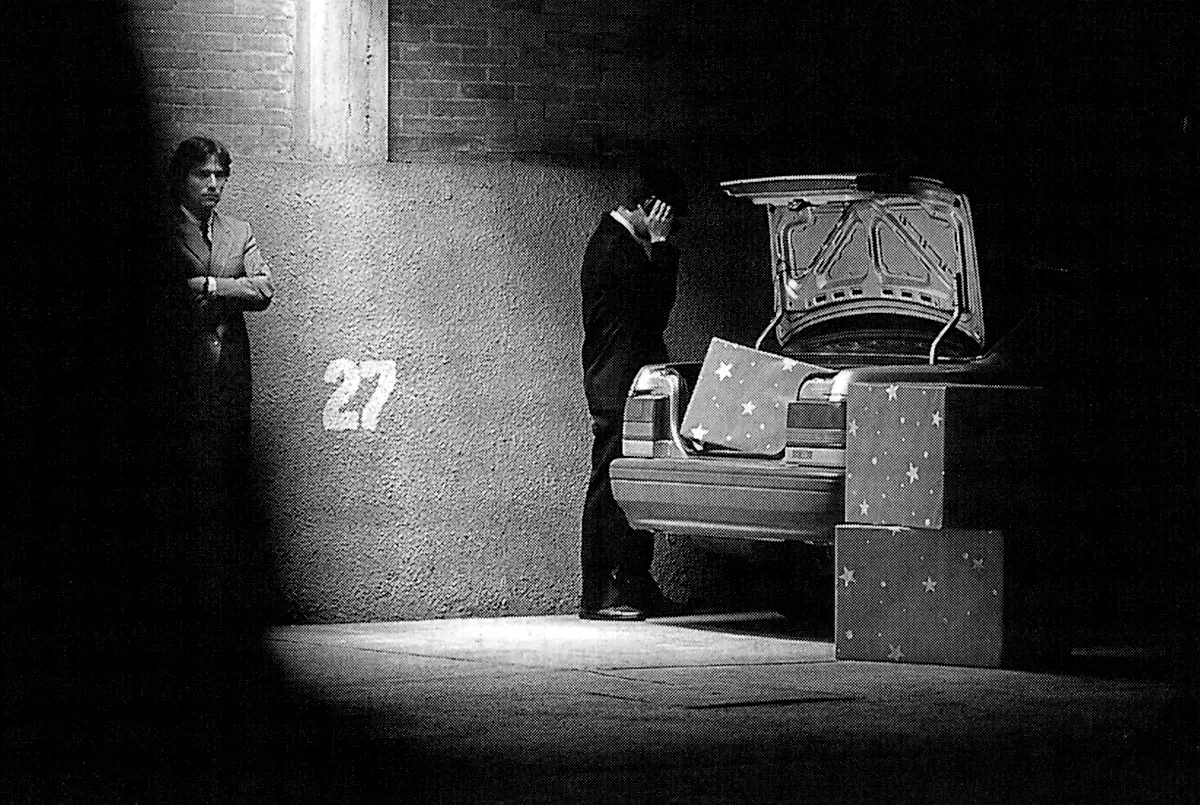
Transcribing the information of witnesses, the newspapers described the occurrence saying: "...it consisted of five and ten-thousand-peso bills in cardboard boxes wrapped in fuchsia wrapping paper with shiny stars." Thus, there existed no other account of the event that only the protagonists themselves witnessed. An image is required for memory to persist; the lack of image in this judicial case led to references to events such as "the alleged handing over of the money."
Herrán reconstructs the images of a historic event of which there exists no documentation. He investigates reality and invents it as fiction, mounting an installation in which there is a photograph that shows the boxes wrapped in gift wrapping being removed from the car by two stealthy male figures who resemble bodyguards, and everything is in shadows. The photograph was accompanied by a tower of boxes wrapped in the famous fuscia paper covered with stars.
Once again, archaeology becomes, for the artist, a tool that allows him to go back to objects without any apparent connection between them, leaving its interpretation to the spectator, recovering for them the meaning these individual pieces have for the society that lived through the account of the event. His representation has the double condition of reality, based on events that took place, and fiction, in so far as they represent a visual memory that doesn't exist.
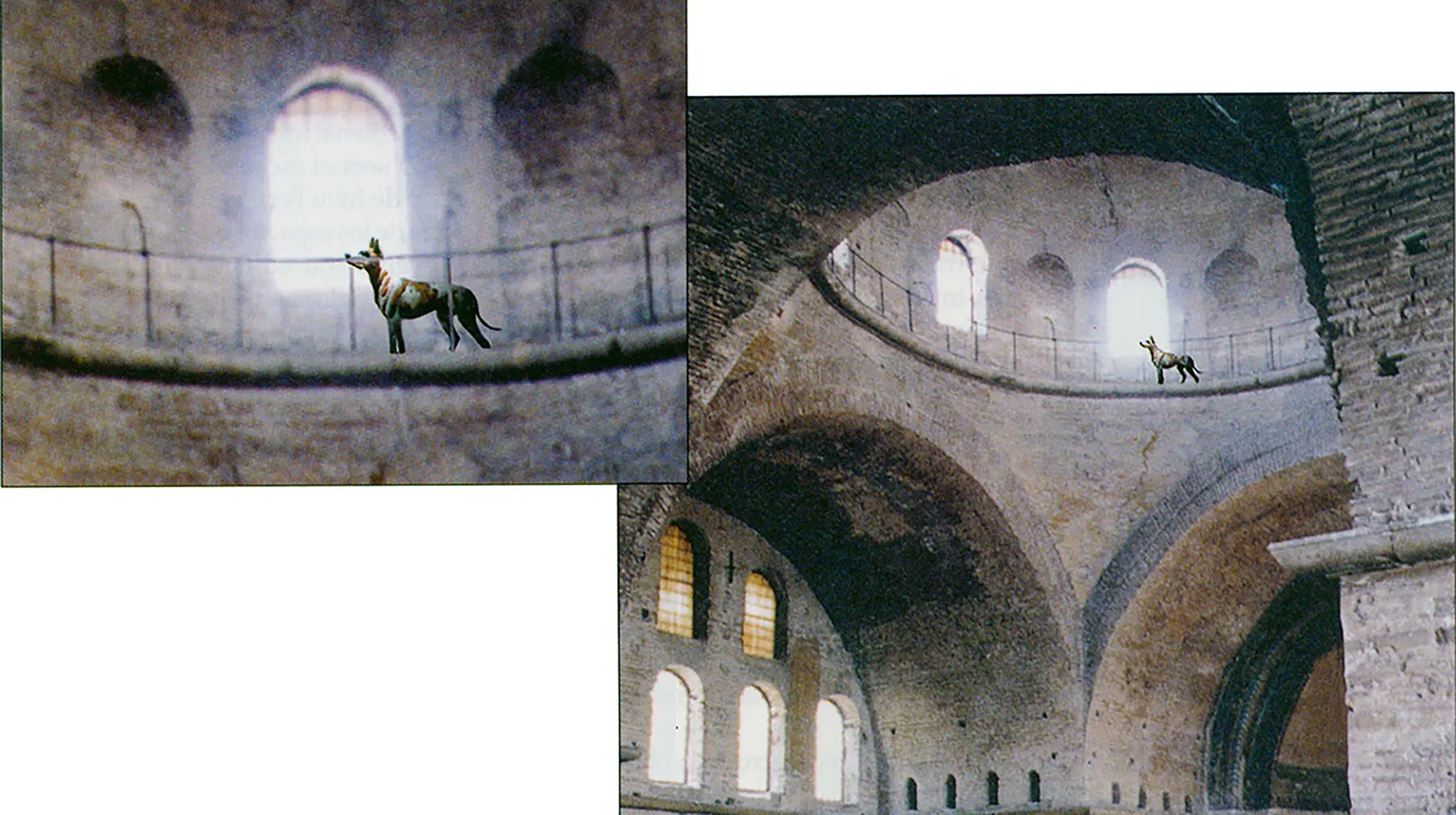
The 5th International Biennial of Istanbul (1997) will be the setting for Juan Fernando Herrán's newest project. Most of the spaces being used for this event are historic buildings. For example, churches and Byzantine cisterns date back to the era of Justinian. The possibility offered to the artists to work in such sights, in the case of Herrán, accentuates his interest in the relationship between history and the contemporary world.
After wandering through the diverse spaces, he chose to work in the Church of Saint Eirine (Eirine meaning peace,) which was built in the 4th century and is the second-largest in the world after Saint Sofia. Two elements were significant to him for his work in that space: the history of the place and the survival of certain symbols.
With respect to the first, he found that, in contrast to what had happened with the majority of Byzantine churches, Santa Eirine was not converted into a mosque when the Ottoman Turks invaded in 1453. It was first used as an arsenal and then as a military museum.3 With regard to the symbols, the most significant intervention was a coat of arms painted on the cupola of the church, replacing the customary holy image.
At present, the place, converted into a museum to allow for the observation of its architectural particularities, maintains an unquestionable duality: it is a spiritual, religious place but it is also a space in which for centuries weapons were exalted.
Herrán's investigation centered therefore around that cultural collision that allows one to consider the place from a double perspective: seen from the religious point of view, it is a site for spiritual reflection; with a secular gaze, the space assumes the changes generated by history with all its contradictions and the possibility of redefining the place as well as its meaning.4
His proposal consists of using the cupola as the site of an installation whose main purpose is to explore that historical duality and its ideological and cultural conflicts. In the cupola, various elements come together: the idea of a vault of heaven, that of it being one of the architectural structures of greatest presence, and the customary depository of religious statues. But in this case, the center of the cupola is occupied by the Ottoman coat of arms—this and a star on one side are the last vestiges that remain from the application of Turkish decoration. Both constitute unquestionable evidence of the secular use of that space over two centuries. The work will seek to activate the cupola5 through the incorporation of an element that very slowly moves around the circular walkway that rings it. "The image of choice will be the sculpture of a 'guard dog' who will inhabit the cupola in a metaphoric fashion."6
Wiry this choice and what sort of dog will be used? To avoid naturalistic representations and to make it a symbolic image, morphological elements of dogs of various races were chosen.7 This hybrid and hieratic canine will move in such a nearly imperceptible fashion around the walkway that it will permit ambivalent readings such as those contained in the building itself. The image of the dog seeks to emphasize the contradictions of the place: it could be seen as a guard but also as someone who is trapped. On the other hand, it is not customary for an animal to inhabit that place, as it is not customary either for a coat of arms to replace the religious image in a space initially conceived of as spiritual. The intervention seeks again to delve into that guiding idea in Herrán's work: the use of power can modify the use of space and the memory of what has happened persists in the few images that serve as a form of testimony.
Herrán's stance as a perpetual investigator demands that he uses diverse tools and solutions, conditioned by place and time. But that diversity of alternatives does not invalidate tire central problem that remains the same: How does one relate the past to memory—a memory that remembers and informs and through which images can be created whose final purpose is not, for the artist, denunciation, or narration? It is a matter of stimulating reflection in the observer regarding certain existential questions that exist in the most diverse cultural realities.
NOTES
1. A key text was that of John Hollingshead who, in 1862, described traveling the paths of the rivers channeled and
converted into drainage systems.
2. The artist has requested whoever sees the object to let him know. In 1994, a fisherman from the port of Moniz in Madeira
reported that he had seen the sculpture, to which he attached a buoy, near the northern coast of Madeira.
3. The use of the church as a military museum lasted from the middle of the 16th century until 1940.
4. Taken from the text of the project presented by Juan Fernando Herrán at the 5th International Biennial of Istanbul.
5. The cupola stands 24 meters above the floor and measures 16 meters in diameter. It is 35 meters high and contains
at its base a circular walkway 90 cm. wide, bordered by a metal railing.
6. Taken from the project text presented by J. F. Herrán.
7 . From the 9th to the 14th century these are descriptions in multiple chronicles and histories of the city of Istambul regarding the problems caused by loose dogs confined to certain zones of the city.
IVONNE PINI
Art teacher at the National University of Colombia, and Executive Editor for Art Nexus / Arte en Colombia.