
On a pristine white carpet stands a 260 by 150 cm large planning table, two production drawings are etched into the table. One must walk around the table in order to read the text which has been set as an edging: "I decided to build a crematorium with a high capacity. In November 1942 I concluded my draft on a crematorium for mass cremation and submitted it to the German Patent Office in Berlin. The crematorium was to function on the principle of a conveyor belt so that the corps would be continuously transported and kept going constantly. This patent could not be registered officially because it was classified as top secret by the German Reich."
It takes a moment to become aware of the narrow-mindedness of the factual, yet somewhat frustrated comments of the engineer Fritz Sander, ahead employee of the Erfurt Furnace Company J.A. Topf & Sons, made in front of a Russian military tribunal. Also, the style of the base of the table first becomes apparent at a second glance. The base is made of gas pipes standardized by German industry. On the wall hang 19 photographs of patches of grass seen from below— the root side.
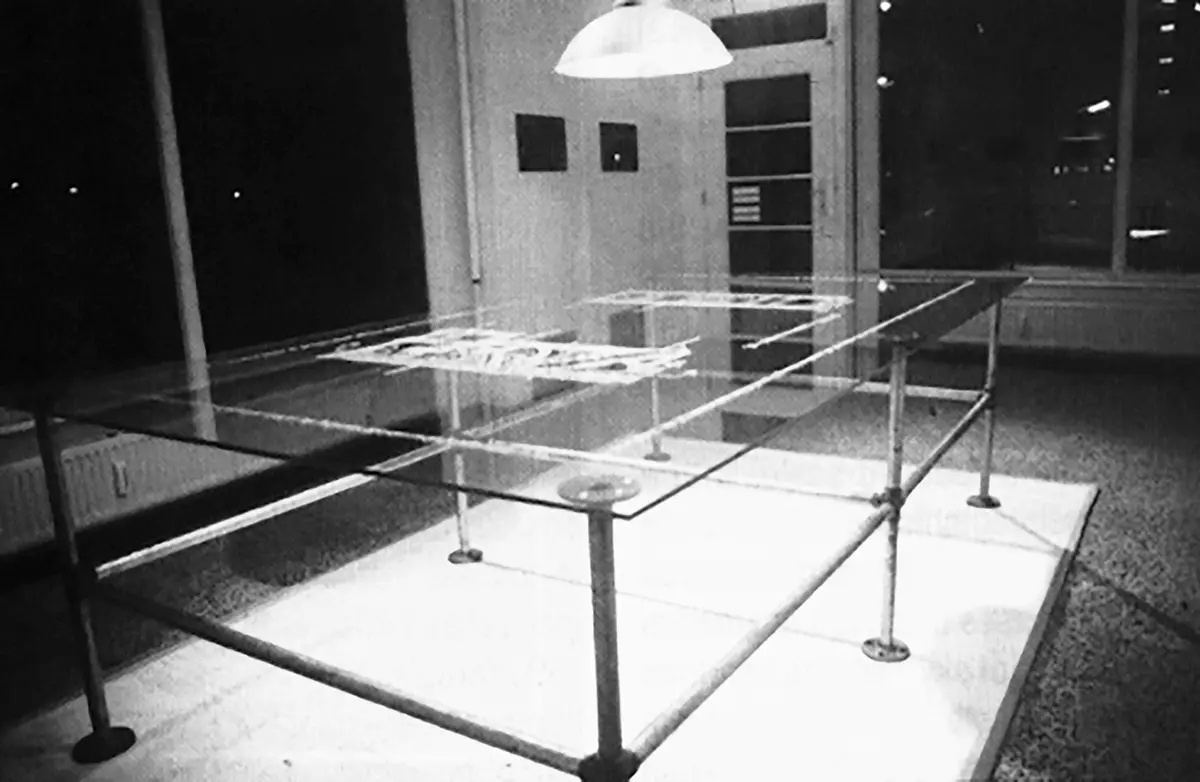
Patent Application is the title of the installation by Uruguayan artist Luis Camnitzer. It is exhibited in the section "Power" in the Kwangju Biennial in Korea. Set in a specially constructed closed room with low ceilings, the effect is more oppressive than during its first presentation (January-April, 1997) the brightly lit Galerie Basta, in Hamburg, Germany. A public reception in Hamburg took place in two completely different stages. The first impression was simply as a piece of furniture, then the shock came once the text was read and the connotations of Geheime Relchssache (“secret government affair”) were clarified by the mention of the year 1942. The thought of the Holocaust and mass murder became inescapable. The reference to genocide is not entirely rejected by the artist (his family was forced to emigrate from Germany and his father’s parents died in a gas chamber). However, Camnitzer claims that his intention is not to work on—or to resolve—this unimaginable crime. What led him to make his work was a more general issue: Sander’s desire to have a project of this kind patented. Nevertheless, the specific German context becomes an amplifier and points out a general and still present lack of ethical responsibility.
Whether plague, bombing, or mass murder, the victims are the starting point of the solution to the problem quoted in the patent application and have not been mentioned by either the inventor or the artist. It is the indifference of a technical device towards cause and effect which is important to the artist here.
The table with its innovative etchings —ready to serve some criminal use— at the same time reveals what has been lying for centuries on the planning tables of engineers and board directors, soon to be forgotten and without leaving any traces. It is a work about the unscrupulousness of technical feasibility. Even after 1945, during the postwar Adenauer period, the civilians responsible for the NS—death machinery were not just a privilege of the past. And today, plots to cause disaster are hatched in the kitchens of technology (e.g. chemical laboratories) under the guise of progress, all over the world.
"I try to layer various depths in one artwork, politics always have a role, but not necessarily the first one. I lay down the conditions as in a theater, and hope that the play begins for the spectator. The opus takes place in the space between the title and the picture. It has to do with evocation, not with information."
Luis Camnitzer explains his way of working, and thus brings himself closer to the different cultures that determine the character of his biography.
A cosmopolitan, who thinks both in Latin American Spanish and, by now, also in US American English, speaks German with part of his family. He lives both in New York and Italy. He participated in the last Bienal do São Paulo and was one of the few artists represented with two pieces in the mega exhibition Face a l'Historie at the Centre George Pompidou in Paris. His installations can be interpreted on a political level but not solely. They always reflect upon the artist’s own situation. Whether a patent application or an artist’s signature, Luis Camnitzer examines his work, both as the personal setting and the individual proclamation of a project, through which an idea or an object can become part of the economic cycle. Subsequently, it is not only the out-of-control art market, which is well known to the artist and satirized by him in Signature by the inch (1971). In it, he mocked himself by creating a formula to determine the value of the individual letters of his own signature. Key statements such as “looking Without paying is Stealing," or "Aesthetics are to be sold, Ethics Are to Be Wasted" were distributed by Luis Camnitzer in the Art Cologne Fair of 1996 handbills, costing 1 Dm a piece.
Transgressing the boundaries of the art business beyond this historically isolated case, there is a general danger that the never-ending creation and production of goods and services will run itself to death and the individual or the society will, slowly and without noticing, become insane. Countless manufacturers both in art and commerce alike are intoxicated by their own success and power. Still, they are trapped in a prison, hallucinating freedom. Three years ago, in his installation Zanoobia, the artist dealt with hypertrophic production as a misguided form of creativity. The artwork is about a senseless piece of handcraft made by desperate sailors on a ship carrying toxic waste. Prevented from docking at any port, the ship sailed the ocean for years... Tamagochi had not even been invented yet.
Against postmodern quotations and absolute staid material aesthetics, Luis Camnitzer insists on art that is sensual and committed, without overestimating the artist as an individual. Camnitzer is interested in aesthetic borderline cases, in which formal fascination turns into an existential problem. He finds the idea strange that the artist should above all be artistic and not primarily an ethical and political character. Described by the great Argentine writer Jorge Luis Borges in his story "The Aleph", one of Luis Camnitzer’s dreams is to find the point in which all portraits of the universe are visible at the same time. The artist will then obtain his greatest power and, share it democratically like a teacher.
HAJO SCHIF