
Three decades have passed since the well-known kinetic artist from Argentina Luis Tomasello (b. 1915), last presented an exhibition in his home country. The artist, who has lived in Paris since 1957, was the subject of a retrospective exhibition presented at the Borges Cultural Center. In addition to offering an overview of the artist's work, a central focus of this retrospective was an homage to the writer Julio Cortazar. The works exhibited covered a period of around fifty years of artistic production and included the ten black pictures which inspired Cortazar’s poem Negro el 10. In addition to Tomasello's well-known kinetic work, the show also presented examples from his early figurative period, from the 1940s and part of the 1950s.
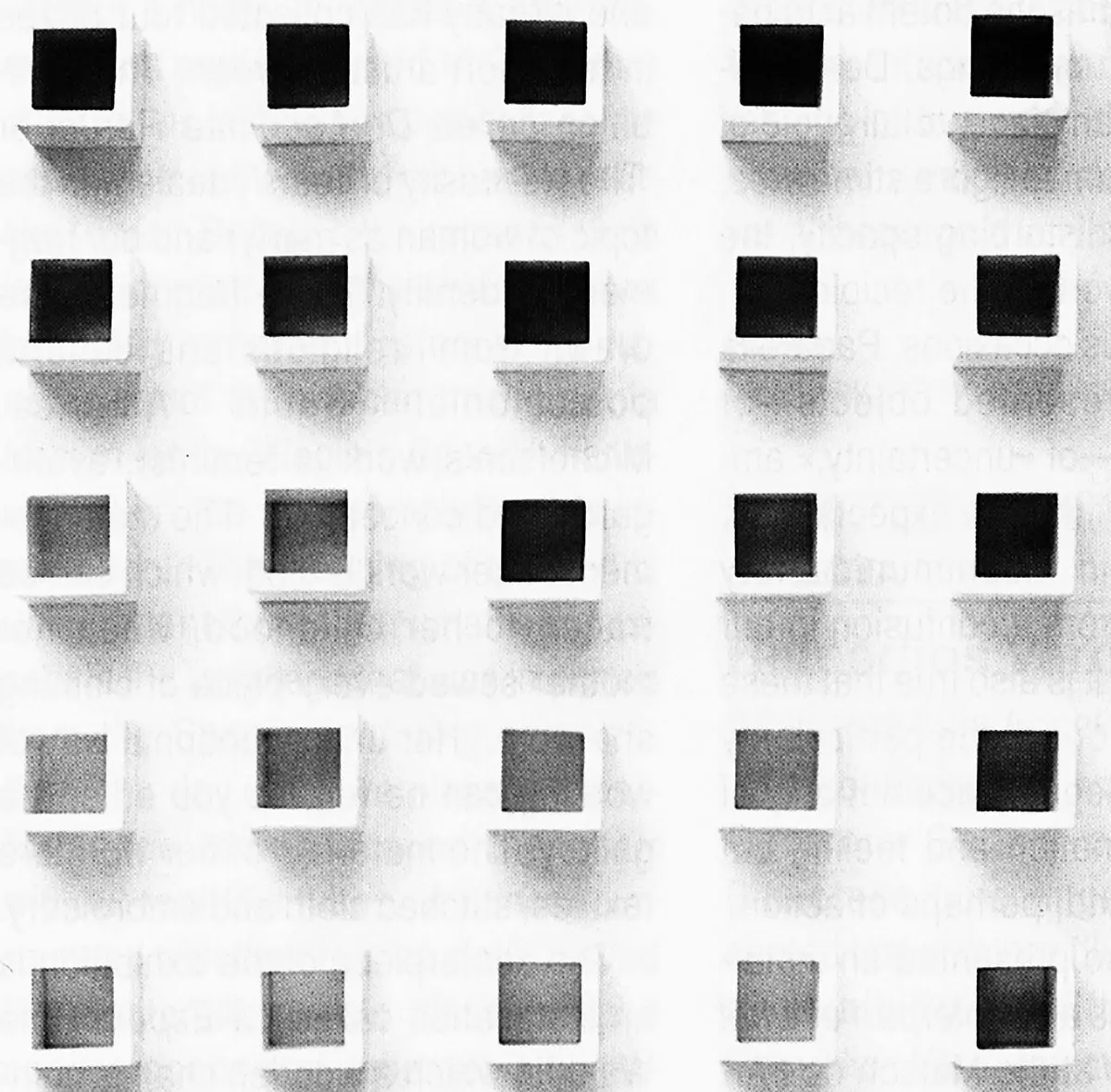
Tomasello studied in Buenos Aires, graduating from the Higher School of Fine Art at the age of 29. In 1957, he settled permanently in Paris and established contacts with the kinetic artists Vasarely, Soto, Agam, Schoffer, and Tinguely. Of the almost I00 pictures in the exhibition, around thirty came from his formative years—the figurative period, characterized by experimentation and the search for images. The nudes and landscapes from the 1940s show Tomasello conforming to the academic rules, while the work from the next decade reveals a wider artistic horizon, especially after a trip to Europe in 1951. These years included his approximations to the concrete movement, reflected in such works as Geometrical Figures, an oil on wood from 1956 and Kinetic Painting, an enamel on wood from the following year. With these works Luis Tomasello discovered the path which he was interested in exploring.
His investigations in this field of kinetic art are very interesting, with his central concern, both in the works done on flat surfaces and in relief, focused on the theme of light. The apparent monotony of the works is offset by a subtle richness devoid neither of warmth or sensibility. This is perhaps the most interesting aspect as the extreme rigor of the works on display in no way compromised their sense of poetry.
Another interesting aspect of the exhibition was the section which illustrated, through photographic panels, what the artist called “architectonic integrations,” with examples from 1971 down to the more recent, done in Mexico, France, Norway, and Morocco. Mention can be made here of the polyester ceiling of the entrance hall of the Department of Pharmacy at the University of Marseilles (1972), with its varied interplay of solar light, and the animation created over a surface of 200 square meters at the Ville Nouvelle de Vaudreuil in France.
ALBERTO COLLAZO