
The exhibition, titled Enclosures of the Sacred, by the Colombian artist Lydia Azout, was accompanied by a workshop of integrated experiences (body-art-writing) in the exhibition rooms, with the presence of the artist and curator, the Museum guides, a few Venezuelan artists, and a large majority of university students studying preschool education. Thus, began experiences that were intended to take us towards a better interpretation of Azout's work and contemporary art; but above all, the proposal was useful in suggesting that art is one of the most effective strategies for education and the personal development of curators.
The Museum's workshop room was provided for the event, but this pedagogical space was sufficient only for the participants' presentations; the artistic strategies required another space, the creation of a ludic space where individuals could play with all the various languages of expression (corporeal, plastic, linguistic).
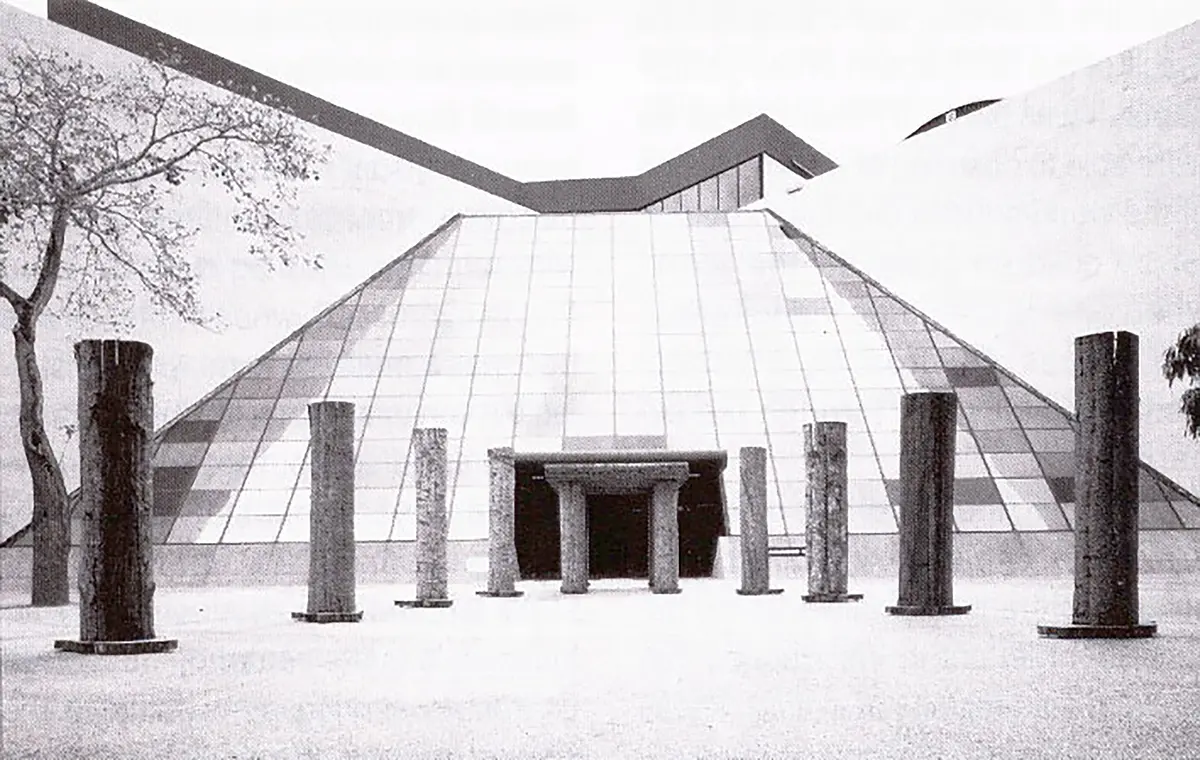
The pedagogical space would be the same exhibition space. The artist creates a space and the curator and museographer make it legible. The art teacher must also create a space that is creative, reliable, and free, where participants feel free to express what they want in various manifestations. This space, which I might call imaginary, virtual, potential, Winnicottian, has a link with the space relationship between mother and child, an affective space in which there is a very free kind of communication through contact, but which is always regulated. These places in the Museum were the simple real support of the human space where images unfolding in various kinds of artistic materiality became transformed into symbols leading to the creative development of the participants and the reading and interpretation of the created forms.
This awareness of the creation of the pedagogical and human space is essential to any transmission of expressive or artistic skills. The Museum rooms were almost ideal for this activity. Azout’s work was also ideal for initiating the contact between the body and the work of metallic structures of Enclosures of the Sacred, permitting the passage from an attitude of contemplation to one of participation. Thus, for example, the bodily interplay in Feminine Forces turned the work into a penetrable. In this exploration process, the metallic structure gradually provided a more specific idea of the dimensions and scales, a module in which the perception of the metallic structure oscillated and changed because of the ludic action of the participants. It was purely by chance that we were able to observe, at the end of one of the workshops, a change in behavior by children towards the work, when one of the guides led a group of Caracas children on a school visit to the Museum through the experience.
Merkabah, the title of one of Azout's exhibitions, offers an exploration of the cultural references of this artist on beliefs about letters in the Hebraic culture and the religions of writing. These references were not known to the audience, which allowed the question of knowledge of references for reading to be raised. Markabah, in Hebrew, means cart or reins, but also the Epiphany of Daniel and Isaiah. The word also means the most secret and profound study of the expressions of divinity. We are in the presence of a name that linked the exhibition Enclosures of the Sacred, by its religious resonance, to inter-cultural translation processes, in which the divine expression of the letter establishes contact with the sacred hieroglyphs of pre-Hispanic cultures. A video was projected on the creation rites of aborigines in Australia, the echoes of pre-Hispanic ruins in San Agustin in the works of Lydia Azout, linking them with the visual poems and installation of our contemporary artists. This provided a means of illustrating what happens in art: the use of elements of alphabet-based writing, pictograms, and hieroglyphs referring to the sacred dimension in the artistic process of both primitive and contemporary peoples. The projection provided an enriching dialogue between the artist and the workshop participants about the multicultural references which had not been read, beginning with the title of the video, Merkabah.
This use of literal elements led to a development of expression which varied according to the sequences. Day by day, there appeared in movements, gestures, lines, forms, and colors the metaphorical relationship between forms and individualities. The participants moved from the initial letter of the name to other letters taken at random until they reached their own name and the writing of phrases in the form of visual poems (as in the cubist poems or visual poems of Tápies). This discovery process continued each day with surprises, showing that everything that is expressed, when the expression is free, has something to do with the subject. After this exercise, there was a period of reflection, theoretical analysis, and a reading of the works in the show.
We worked with dots, with the metallic circle in the center of the Sacred Enclosure serving as a guide to the kinesic itinerary. We worked with lines and the sculptural web (straight, curved, or sinuous) inducing movements, equally straight, curved or sinuous, displacements according to lines, the undulation of the sculptural form, and squirming movements made with the spine. The verbalization of writing made us aware of the processes, from the work to the dance, from dance to plastic expression, and on to writing. I wanted to bring forth from the work the body which lies hidden in all artistic manifestations. In my search for the affective resonance, which is an integral part of contemplation, I managed to annex to the elaboration process the resonance of another work, like the citations, intertextuality, and influences in art. Creative processes took place until we achieved work in common, done in groups, in the Museum's garden, with local materials (stones, branches) and others provided by the participants. The plastic elements brought forth individual forms of expression which had already been worked on during the week. The place selected was a space with sand, near a large stone with a pre-Hispanic hieroglyph. The understanding reached between the participants was evidence of communication between teams and groups: the integration of the works achieved with the petroglyph gave greater meaning to the workshop sequences, from the contemporary to the primitive. However, much of Azout's work was there in the form of individual processes and group creation. Art also serves as a guide and a way of shaping the processes of creators themselves.
To give an artistic reference to this pedagogical work which I carried out in the integrated expression workshop, I could compare it to the Lost steps of the Cuban writer Alejo Carpentier: "A work has been constructed in my spirit; this 'thing' is either open or closed, it sounds in my ears, astonishing me by the logic of my ordering. It is a work within, inscribed within me, and which could emerge without difficulty, becoming text, score, something which everyone could feel, real, and understand."
To understand this construction within oneself, awakening the desire to create, is to have discovered the "score" of movements, images, and words that have belonged to us since our origins. To help in the birth of this personal "score" in various registers of expression and the rebirth of the true subject is one of the essential tasks of education and art. This remark may serve as a conclusion to this integrated experience workshop within the framework of the exhibition of Lydia Azout’s Enclosures of the Sacred. To this work, we owe the heightened sensibilities which allowed the participants to discover their own scores. Azout was present, at first incognito and then with her true identity revealed: she listened to all the readings, and there followed an enriching dialogue. Piedad Casas de Ballesteros, the curator, was responsible for achieving a perfect coherence between the space and the forms, which provided a wonderful pretext for the readings. I should like to thank the artist and curator and above all Emilia Maury, Director of the Department of Education of the MAVAO, for her understanding of creative methodology and strategies which are difficult to transmit at the verbal level, and for the enriching sense of communication which characterized every aspect of the workshop. Would not such a joint enterprise between artist, curator, and teacher within the exhibition space be an ideal situation for the reading of work and the development of education in the Museum? Changes must be made, as in the case of the MAVAO, as awareness grows of the needs and deficiencies of formative-creative groups as they confront the new demands of reading contemporary art. That art reaches the soul through the body is a very old idea: what has changed are the creative strategies used to integrate into the human being a total consciousness of the body through art.
VÍCTOR FUENMAYOR