
Warming Up Exercises is an artistic project carried out by Rafael Ortiz, thanks to a grant awarded by Colcultura, and the first "exercise" of which was presented at the Espacio Cerrado. The fundamental objective is to establish a relationship between the plastic arts and other activities, i.e. to take art out of its pigeon-holes and to deterritorialize its objects, research methods, and plastic results. The artist has taken the risk of abandoning the safe and certain path and confronting an "outside" which involves displacing the limits of his visual activity.
The project seeks to achieve these objectives through a long conversation and encounter with a professional masseur. How can such an activity so apparently distant from the world of art be conceived in plastic terms? What kind of plastic response can be generated from an activity which is in principle alien to such a world? How can we reflect in terms of visual logic on space and time governed by other senses? By observing, studying, and exposing himself to the processes and techniques of massage, Rafael Ortiz has tried to reply to these questions. The result is a prolongation of the visual universe to an unusual field, which in turn opens a vanishing point for the predictable processes, uses languages, and possibilities of artistic language.
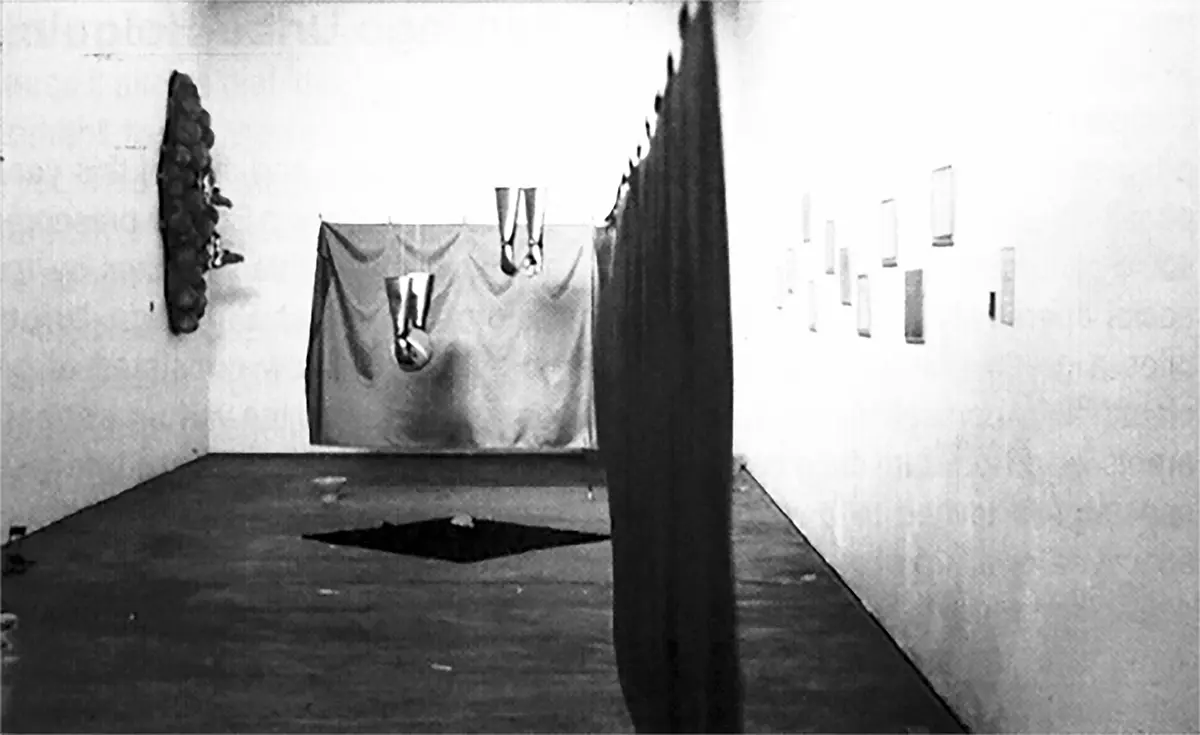
This opening up to the other and otherness is a laudable enterprise, given the introspection of art and its resultant isolation from the everyday experience of people. As is to be expected, the results are rather "strange", may disturb us and not even convince us in plastic terms —but they are pleasantly novel. Nothing less could be expected from such an unusual encounter, the act of massage, the relationship between the hands and the body, bodily rhythms and flows, tensions, and relaxations— all of which reappear from the viewpoint of the artistic gaze. Not only does the act reappear re-configured as an object to be looked at in visual terms, but becomes a living experience in which the spectator brings into play his entire body and experiences the world of massage not just from outside, but from within, by actually experiencing the feelings created by a massage (part of the work involves taking a massage, which creates effects that are necessary to a more vital understanding of the set of pieces on display), and by moving pieces around, etc. In this way, the artist attempts both to read the message in visual terms and to read the visual from the standpoint of the massage.
Just as the artist is obliged to relinquish his usual referents and modes of procedure, so too the spectator is invited to abandon his customary behavior in the presence of artistic work. This results in a passage through a series of spaces, a journey involving both the eye and the body. Any work of art produces a body, and this is even more evident in this case. The eye is led not only towards the visual sphere but towards an optical experience. But more than the eye what is being brought into play is the body, the sense of touch, the skin. Thus, the spectator experiences the effects of a muscle stretching machine, another which registers alterations following stimulation of the skin, and yet another which uses pressure to inflate organic-related elements. Other pieces emphasize the visual resolution of certain processes involved in massage, such as the disappearance of tension knots; some reflect the action of the masseur, others the bodily processes involved in that action. In all cases, there is an attempt to make the image reflect other senses, such as touch and smell, as well as multiple sensations and perceptions, both internal and external. In this way, the artist tries to take us inside the sensation itself by going beyond merely visual explanation or illustration. Such an objective would be difficult to achieve from the position of the artist's exteriority to the processes and phenomena under study, and can only be obtained by a profound and lasting integration into the processes themselves.
The montage of the exhibition was perhaps doubtful at times, with an indiscrete accumulation of pieces without any clear coherence or sequence; there did not seem to be any particular and consistent sense of space gathering the works as a whole. In the same way, not all the works, taken separately, had the same power. However, the merit of the project lay in the possibilities which it suggested in the confrontation between the visual arts and other activities, opening new avenues for art, creating a loss of references and coordinates which in turn may give rise to a rich network of new directions and complexities. On the one hand, the process involves a broadening of the possibilities of art within the various socio-cultural forms of behavior, i.e. its social operativity. On the other, it implies a greater understanding of the plastic arts themselves based on referents that facilitate the process. The spectator is invited to envisage perspectives of a ludic, creative, and didactic kind which are implied by visual thought but unfortunately only rarely activated. This artistic process is further enhanced using displacement and movement resulting from the various stimuli provided by the activities from which it is structured.
The major challenge lies in maintaining a point of tension so that the artistic complexity is not impaired and achieves a certain degree of reflective and pedagogical efficiency. In other words, a point of tension in which art attempts to teach without renouncing its specificity, opening itself up to other things without becoming domesticated by an excess of pedagogical or illustrative trappings. This set of pieces by Rafael Ortiz provided a useful indication of both bodily tensioning’s and the tensions themselves which are necessary to the visual arts.
JAVIER GIL