
The painter Ramón Oviedo lives and works in his studio, a place, full of canvases, dolls, and thoughts. A staircase, between vibrant pink pansies, leads up to this place of honor of pictorial creation in the Dominican Republic. Anyone who has visited this place, which is both austere and baroque, can better understand how the artist has concentrated on his inner life and the forms taken from his rich subconscious, as well as from his craft and experience. It explains the “constant evolution" not only of "form into matter" (the title of his most recent exhibition) but of his career, which has been one of constant movement.
The 38 works presented by Oviedo at the Guayasamin Foundation in Quito as part of that institution’s Arts Month, and later in Caracas, are the culmination of a process of rupture with himself, a compulsive kind of self-renovation, which itself is a relatively exceptional feature in Dominican art and among its established artists. It was interesting to hear Oswaldo Guayasamin, the patriarch of Ecuadorian painting, say that according to the Christian calendar, he was 78 years old, but that in many other calendars, he would be much younger, barely exceeding 22, according to the shamans of his country. So too Ramón Oviedo, with his seven decades, reacts in the calendar of his artistic work as a young artist discovering himself and feeling enthusiasm at such a revelation.
This was Oviedo’s first one-man exhibition, the creator of murals in the OAS and UNESCO in Quito. It was, therefore, something of a groundbreaking event. Guayasamín, his friend and admirer, once again came to discover him in full, looking with eagerness and a sense of rapport at his colleague’s work. We are not very used to this kind of fraternity, which coupled the eloquence of gesture and the words of presentation with the “persistence- of contemplation.
With the title of the exhibition, Oviedo emphasizes the pre-eminence of form.
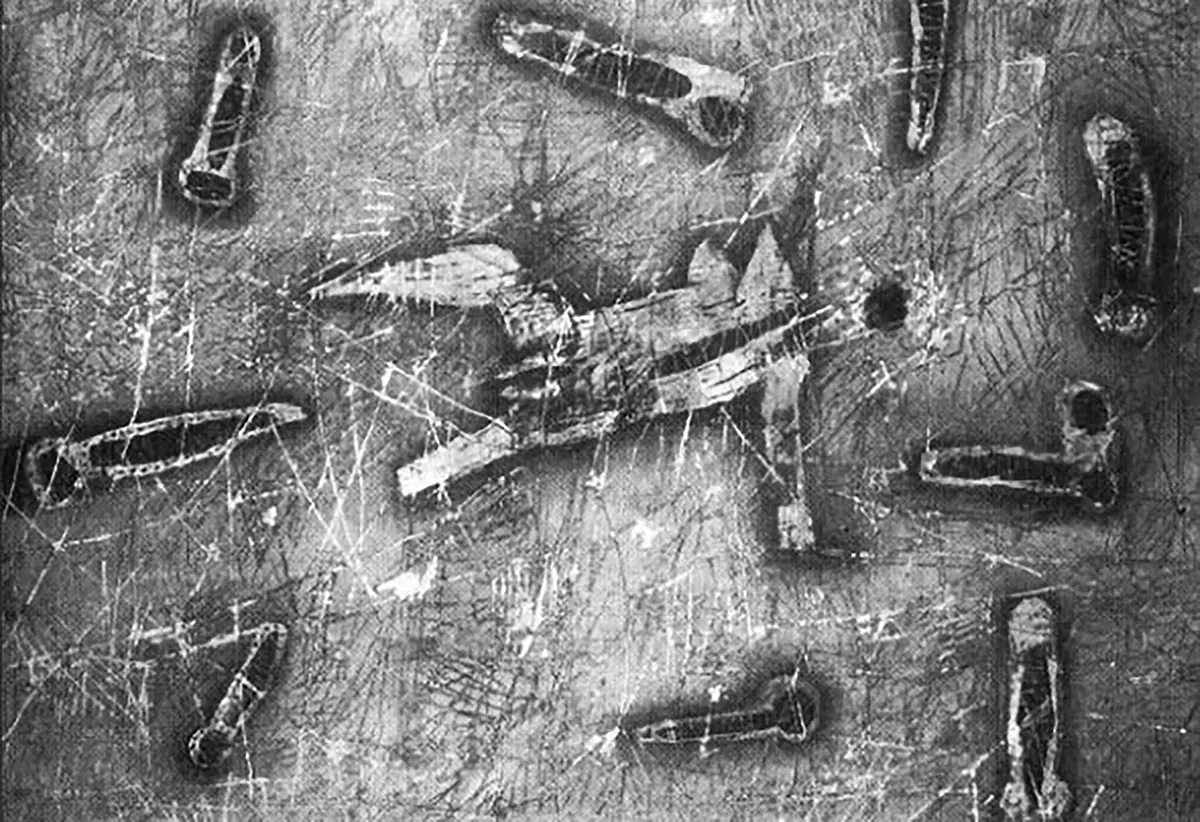
The ghostly and phantasmagoric forms oscillate between life and death, between the here and now, and the world beyond as in Trapped Form, from the First Ones, PreHispanic, or the Sign in case I return, to mention just a few examples. Space becomes extended or restricted around these unknown corporeal presences. Symmetry and asymmetry are given full freedom, although the structural balance between the figure(s) and setting (there are no backgrounds, and even the smooth surroundings become participants) predominates.
Guayasamín has rightly described Oviedo’s painting as “non-objective.“ The artist has reached a point at which there is no need for such manifestations. The artist (re)creates organisms that immediately, or after silent contemplation by the spectator, conjure up forces and allegories. We feel a sense of danger, threat, aggression, survival, origins, and communication. Defined subjects are the exception in this work: there is the Musician, with its slight hint of Guayasamín himself, who has explored the theme in his drawing and painting, or Jaina, an incredible evocation of pursuit and temptation. Objectivity and objectuality may be absent, but the artist has transformed us into seers.
The “matter,“ almost non-matter, mentioned by Oviedo astonishes us with the skill in ‘Which it is created. Through acrylic, which is a chemical and synthetic product, the surface manages to communicate the sense of skin, husk, and earth, a sculpture of transparency. Through a process of scratching, rubbing, tearing, cutting, crosshatching, and the sewing of threads, the magical finish takes us back to a world of natural essences, to geology and translucence. This matte painting possesses its own brilliance and inner light, capturing the most diverse hues, the most varied states of matter...especially of an immaterial and fossilized kind. Finally, the treatment of the image seeks to create a kind of shock in perception, based on the culmination of Oviedo's work before this period.
MARIANNE DE TOLENTINO